Listen.
Can you hear that?
It is a low, metallic thrumming that vibrates right through the soles of your sneakers, rising up from the reinforced concrete floor until it settles somewhere behind your breastbone. If you walk down the center aisle of a modern hyperscale data center—the cold aisle, where refrigerated air is forced upward through perforated steel tiles to keep thousands of stacked silicon blades from melting into slag—the noise is so absolute that you cannot hold a conversation without shouting into your colleague's ear. It smells of ozone, chilled copper, and faint machine oil. Above your head, thick yellow fiber-optic trays stretch toward the horizon like elevated highways in an indoor city built entirely for machines that never sleep.
Most people still think of the internet as an ethereal vapor. We talk about "the cloud" as though our family photos, our medical records, our banking ledgers, and our sprawling conversations with artificial intelligence float gently in the upper atmosphere, weightless and borderless, untethered from dirt, water, or politics.
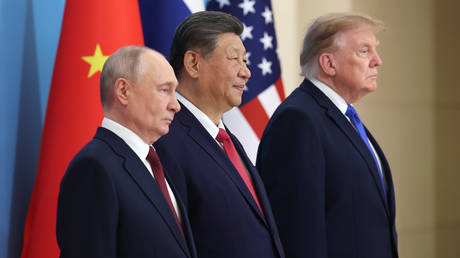
That illusion shattered on a podium when President Donald Trump declared that the United States would no longer allow American technology companies to build data centers outside the country.
Pause and let the weight of that sentence settle.
For the past three decades, the defining story of American tech was one of frictionless expansion. Silicon Valley wrote the code in California, raised the capital in New York, and poured the concrete wherever land was cheap, power was plentiful, and tax incentives were sweet—Ireland, Singapore, Chile, Sweden, India, the United Arab Emirates. A data center was treated like any other global supply chain node, no different in principle from an assembly plant or a shipping hub.
Now, the physical engines of the digital age are being treated like strategic uranium enrichment facilities.
The Invisible Engine Behind the Screen
To understand why a restriction on overseas server farms could alter the trajectory of the global economy—and quietly rewrite the cost of your everyday digital life—you have to strip away the software and look at the dirt.
Consider a hypothetical infrastructure director named Elena. Let’s place her in Ashburn, Virginia, a sprawling corridor thirty miles west of Washington, D.C., known in the industry as Data Center Alley, where roughly seventy percent of the world's internet traffic passes through squat, windowless concrete fortresses. For the last five years, Elena’s job has been an exercise in relentless triage. Her company trains massive generative AI models, and every new generation of silicon demands exponentially more electricity and water than the last.
In Northern Virginia, the electrical grid is straining at its seams. New high-voltage transmission lines take seven to ten years to permit and build. Transformers—the massive, house-sized steel boxes required to step down grid power for server racks—have multi-year backlogs. When Elena looked at her company’s five-year expansion roadmap last autumn, the math in the United States simply did not close. To train their next foundational model, she needed five hundred megawatts of continuous, uninterrupted power—roughly enough electricity to keep the lights on in a mid-sized American city—and she needed it online within twenty-four months.
So Elena did what every major American cloud architect has done since the dawn of the smartphone era. She looked outward. She negotiated land leases near hydroelectric dams in Scandinavia, solar-rich corridors in southern Europe, and newly built industrial zones in the Middle East where sovereign governments were willing to fast-track permits and guarantee megawatts on a silver platter.
Now, imagine Elena sitting at her kitchen table at six in the morning, coffee cooling beside her laptop, reading the news that Washington intends to forbid American firms from building those facilities abroad.
Her five-year plan evaporates before her coffee goes cold.
Why Washington Wants the Servers Home
It would be easy to dismiss the policy purely as economic nationalism, a familiar populist rallying cry aimed at bringing construction jobs and capital expenditure back to the American heartland. And certainly, the domestic economic argument is front and center. Building a single hyperscale campus injects billions of dollars into local economies, employs thousands of union electricians, pipefitters, and ironworkers during construction, and generates massive property tax revenues for rural counties that haven't seen an industrial boom since the mid-twentieth century.
Yet the deeper driver isn't just about pouring concrete in Ohio instead of Dublin. It is about national security in an era where artificial intelligence is viewed by defense planners as the decisive technology of the twenty-first century.
When an American tech giant builds a billion-dollar AI cluster in a foreign country, those servers—packed with tens of thousands of advanced graphics processing units—sit under foreign legal jurisdiction. In a geopolitical crisis, a host nation controls the power switch, the fiber-optic landing stations, and the physical perimeter. Worse, intelligence officials in Washington have spent years warning about "compute leakage"—the risk that foreign adversaries could access cutting-edge American AI hardware remotely through cloud rentals hosted in third-party countries, bypassing export controls that restrict the physical shipment of advanced chips to rival nations.
If you cannot stop an adversary from buying time on a server cluster in a neutral country, the thinking goes, then you keep the server clusters inside the fortress. You treat compute—raw processing power—the exact same way nations once treated steel mills, oil refineries, and naval shipyards.
The Physics Problem Nobody Can Legislate Away
Here is where political ambition collides head-on with the stubborn laws of physics and economics.
You can sign an executive order in an afternoon. You cannot conjure a gigawatt of baseload electricity out of thin air.
Right now, the United States is experiencing its sharpest surge in electricity demand in a generation, driven simultaneously by reshoring manufacturing, electric vehicles, and the insatiable appetite of AI data centers. Unlike a traditional web server from 2012, which sipped electricity while serving static web pages, a modern AI training cluster runs at near-maximum thermal capacity twenty-four hours a day, seven days a week, for months on end.
Think of the difference between an old incandescent porch light and an industrial aluminum smelter. That is the leap the power grid is being asked to absorb.
If American companies are barred from building capacity overseas, every single megawatt of future growth must be squeezed out of the domestic U.S. grid. And what happens when a dozen trillion-dollar tech companies are forced to bid against one another for the exact same scarce plots of powered land in Texas, Pennsylvania, Georgia, and Virginia?
Prices explode.
First, the cost of industrial electricity spikes, which inevitably ripples outward into residential utility bills for families living miles away from the nearest server farm. Second, the timeline for deploying new AI capabilities stretches out, throttled by transformer shortages, turbine manufacturing bottlenecks, and local zoning battles over water usage and noise pollution.
Let’s return to Elena, our hypothetical infrastructure director, to trace the chain reaction. Blocked from building in Europe or Asia, her company redirects its capital back to the American Midwest. They buy up agricultural land and strike deals with regional utilities. To secure power quickly, they end up paying a massive premium—signing long-term power purchase agreements at rates double what they paid three years ago, or funding the restart of retired gas and nuclear plants out of pocket.
Those billions of dollars in extra infrastructure costs do not simply vanish into corporate balance sheets. They get baked directly into the API pricing charged to startups, the enterprise software contracts signed by hospitals and banks, and eventually, the monthly subscription fees you pay for the tools on your phone and laptop.
The Latency Trap and the Splinternet
There is another consequence, quieter but far more structurally damaging to the dominance of American technology, and it comes down to the speed of light.
Data does not travel instantaneously. Even through pure glass fiber-optic cables, light moves at roughly two hundred thousand kilometers per second. When a user in Tokyo, Frankfurt, or São Paulo interacts with an application hosted on a server in Iowa, that request has to travel across oceans and continents and back again. That delay—measured in milliseconds and known as latency—is the invisible enemy of modern computing.
For sending an email, two hundred milliseconds is unnoticeable. For real-time financial trading, autonomous vehicle telemetry, cloud gaming, remote surgical robotics, or voice-to-voice AI assistants that respond with human cadence, two hundred milliseconds feels like wading through wet cement.
Furthermore, over the past decade, dozens of countries have passed strict data localization laws. The European Union's General Data Protection Regulation, alongside similar mandates in India, Brazil, and across Southeast Asia, requires that sensitive citizen data—health records, financial transactions, government communications—be stored and processed physically inside those regions' borders.
If American cloud providers are forbidden from building data centers abroad, they cannot comply with foreign data sovereignty rules. They cannot offer low-latency local hosting to European banks, Asian manufacturers, or Latin American retailers.
Nature abhors a vacuum, and global technology markets abhor an empty shelf.
If Microsoft, Google, Amazon, and Meta are legally prevented from pouring concrete in Frankfurt, Mumbai, or Riyadh, those markets will not simply wait patiently for Washington to change its mind. Foreign enterprises and sovereign governments will turn to domestic European cloud operators, regional telecom giants, or worse—from Washington's perspective—state-backed Chinese technology conglomerates that will happily build the data centers, lay the fiber, and own the digital nervous systems of the developing world for the next fifty years.
In trying to lock down American technological supremacy inside U.S. borders, policymakers risk handing the rest of the planet over to competitors without a fight.
Have We Seen This Movie Before?
I remember walking through an abandoned textile mill in North Carolina twenty years ago, dust motes hanging motionless in shafts of afternoon sunlight, old looms rusted solid beneath broken skylights. Back then, the prevailing orthodoxy in Washington was the exact mirror image of today: borders didn't matter, capital should flow wherever costs were lowest, and offshoring physical infrastructure was seen as an inevitable, harmless evolution toward a pure "knowledge economy." We learned the hard way what happens when a nation surrenders its physical industrial base and discovers during a crisis that it can no longer make its own masks, ships, or semiconductors.
That historical scar is real, and it explains why the pendulum has swung so violently in the opposite direction.
Yet swinging from total laissez-faire offshoring to absolute domestic confinement trades one brittle vulnerability for another. History offers a sharp warning about industrial policies that ignore physical bottlenecks. In the late 1990s, telecommunications companies laid millions of miles of fiber-optic cable across the United States in a frenzied race fueled by cheap capital and regulatory shifts, only to realize that the terminal equipment and local "last-mile" connections couldn't keep up—leading to a historic collapse that wiped out hundreds of billions in value before the infrastructure finally became useful a decade later.
Today, the bottleneck isn't fiber; it is electrons and legal jurisdiction.
Forcing all American digital infrastructure inside the continental United States without first solving the permitting paralysis that stalls new power plants, transmission corridors, and nuclear reactors is like locking fifty race cars inside a single-lane dirt driveway and telling the drivers to floor the accelerator. You don't get more speed. You get a pileup.
What Actually Happens Next
So where does this leave the companies building the future, and the rest of us living inside it?
First, watch for an immediate legal and lobbying firestorm. Can a president unilaterally prohibit private American corporations from investing capital overseas without explicit congressional legislation invoking emergency national security powers, such as the International Emergency Economic Powers Act? Constitutional scholars and corporate trade groups will challenge the statutory authority in federal court within days of any formal order taking shape.
Second, expect creative corporate engineering. If an American company cannot directly build and own a data center in Ireland or Japan, it can still license its software, lease capacity from a foreign-owned real estate investment trust, or form joint ventures where a local partner owns the concrete and the power hookup while the American firm supplies the software layer. Lawyers in Washington and Brussels are already drafting those structures on whiteboards.
Third, and most consequentially, the race for energy inside the United States is about to turn white-hot. If the border walls go up around the cloud, tech giants will no longer be software companies that happen to buy electricity; they will become power utilities that happen to write code. We will see hyperscalers directly financing small modular nuclear reactors, geothermal drilling projects, and massive battery storage arrays across the American West and South—not out of environmental altruism, but out of sheer existential survival.
Walk back into that cold aisle in Virginia for a second.
Look at the blinking green and amber LEDs stretching down the rows of black steel racks, humming in the refrigerated dark. Every query you type, every medical scan analyzed by an algorithm, every video streamed to a child's tablet in the backseat of a minivan passes through physical rooms just like this one. They are loud, hot, thirsty, and deeply rooted in the soil beneath them.
The cloud was never in the sky. It was always a factory. And for the first time since the dawn of the internet, the gates around the factory are slamming shut.