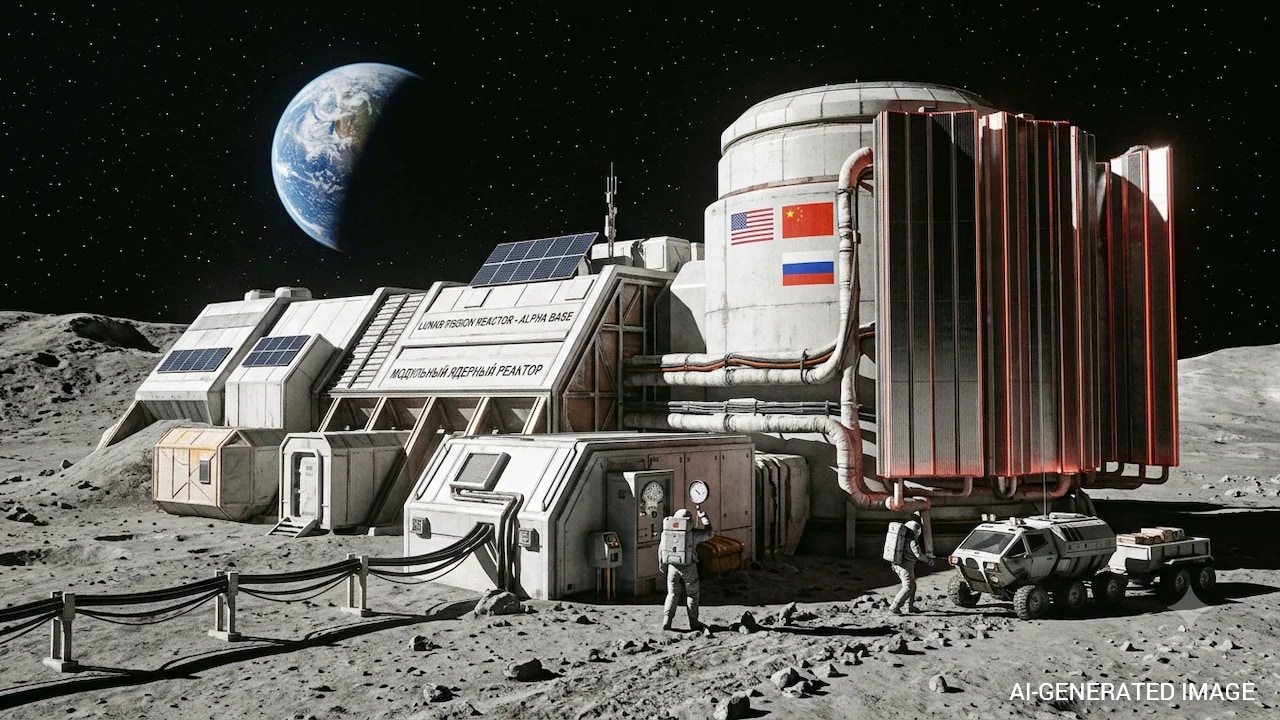
Dawn on the Moon does not arrive with a whisper of birds or the scent of damp grass. It hits like a furnace door flung open in the dark.
For fourteen Earth days, the sun beats down on the lunar regolith, driving temperatures past two hundred degrees Fahrenheit. Then, the night falls just as brutally, plunging the landscape into a deep freeze that would shatter steel. In this unforgiving theater, three nations are currently racing to anchor a permanent heartbeat of fire. For a deeper dive into this area, we suggest: this related article.
The United States, China, and Russia are no longer just sending flags and footprints. They are preparing to build nuclear reactors on the Moon.
To understand why, you have to look past the gleaming CGI renderings released by space agencies and stand instead in the cold reality of a lunar base. Imagine sitting in a habitat module three hundred thousand miles from home. The solar panels outside are thick with abrasive, static-charged dust kicked up by passing rovers. Every fifteen days, the sun dips below the horizon, leaving you in absolute darkness for two weeks. Solar power alone cannot save you here. Batteries freeze. Panels choke. The night wins. For additional background on the matter, extensive coverage can be read on The Verge.
Fission is the only answer.
The physics of this endeavor are as unforgiving as the terrain. Down here on Earth, we take our thick atmosphere and magnetic shield for granted. On the Moon, a nuclear reactor cannot rely on massive cooling towers billowing steam into a generous sky. There is no air to transfer heat. Engineers must design compact, lightweight power plants that reject thermal energy through radiation alone, glowing dull red in the vacuum while they split atoms to keep human lungs breathing and heaters humming.
Consider the historical echo of this race. We have walked this path before, though the stakes were different. Decades ago, the space race was a sprint fueled by political pride and brute-force rocketry. It was a race to plant a piece of cloth in the dust and prove a point to an ideological rival.
This time, the motivation is far more permanent, and far more pragmatic. Water ice is trapped in the permanently shadowed craters of the lunar south pole. That ice is survival. It is drinking water. More importantly, it is hydrogen and oxygen—rocket propellant. If you can mine the ice and fuel your ships on the Moon, you unlock a cosmic gas station for deep space exploration. You stop carrying your entire ocean on your back every time you leave Earth.
But you cannot melt ice, run electrolysis plants, or excavate tons of regolith with a handful of solar cells during a lunar night. You need gigawatts of steady, unyielding power. You need a nuclear reactor.
The geopolitical chessboard is shifting upward. NASA’s Artemis program envisions a sustained human presence, with commercial partners racing to design small fission surface power systems capable of delivering at least forty kilowatts of continuous electricity—enough to power roughly thirty homes on Earth, but on the Moon, it is the difference between a thriving outpost and a frozen tomb. Meanwhile, China and Russia have joined forces on paper and in ambition, eyeing similar southern polar real estate with their own nuclear blueprints.
It is a strange feeling, watching humanity export its oldest rivalries into the quietest place in the solar system.
We are standing on the precipice of a multi-planetary era, yet we carry our baggage with us. The competition to place the first fission reactor on the lunar surface is nominally about science and survival, but beneath the telemetry and the engineering specs, it is about leverage. Whoever controls the power grid of the Moon controls the gateway to Mars and beyond.
The engineers working on these systems in windowless clean rooms across Houston, Beijing, and Moscow know the margins for error are zero. If a reactor on Earth fails, technicians can walk in with hazmat suits. If a reactor fails on the Moon, the nearest repairman is a three-day rocket flight away, assuming you have the fuel to get there. Every weld must be perfect. Every control rod mechanism must operate flawlessly through the thermal shock of a lunar sunrise.
Yet, despite the cold calculus of geopolitics and nuclear physics, there is something profoundly moving about what they are trying to achieve.
Think of the first spark of fire captured by our ancestors in a cave, huddled against the Pleistocene chill. For thousands of years, that flame defined us, keeping the dark at bay, cooking our food, forging our tools. Now, our descendants are packaging that exact same fundamental force—the controlled splitting of the atom—into a cylinder small enough to fit inside a cargo lander, shipping it across the void of space, and dropping it into the eternal shadows of a lunar crater.
We are carrying our oldest warmth to the coldest place we have ever touched.
The race is real. The engineering hurdles are staggering. And long after the political speeches have faded into static, the quiet hum of an atomic core buried in the lunar dust will keep the lights burning against the void.