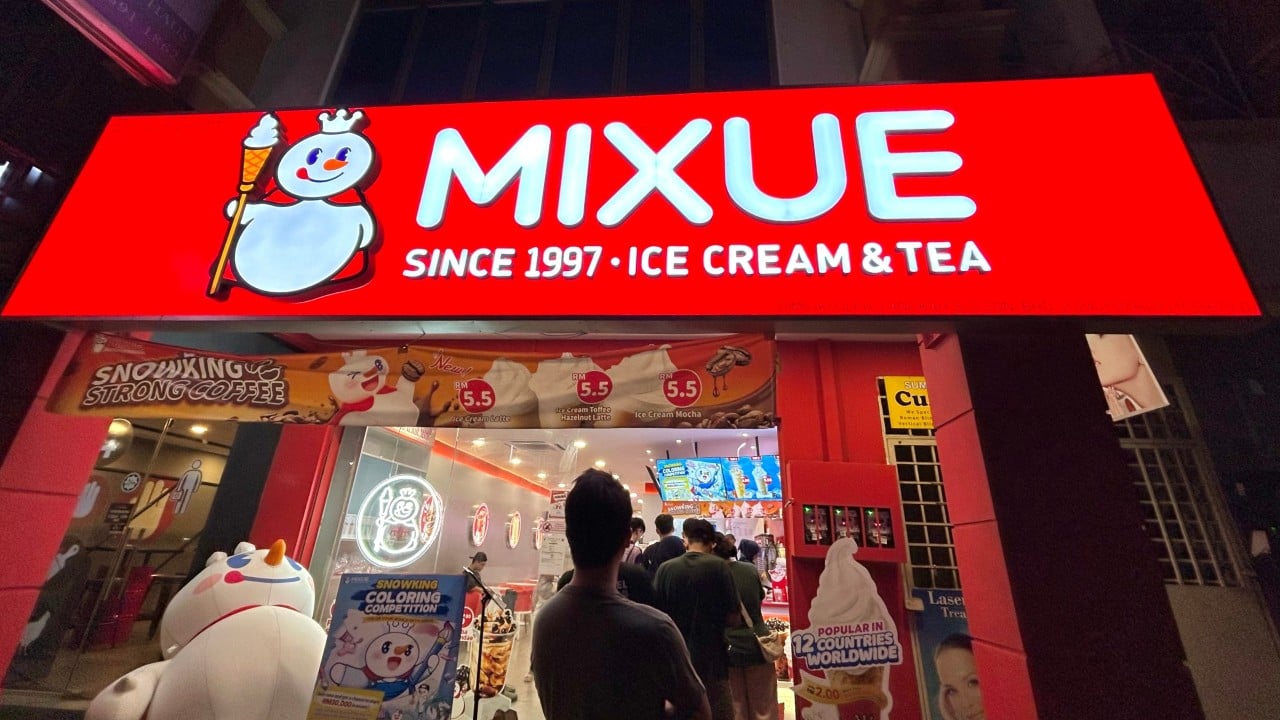
The red neon sign of the Snow King glows against the damp evening air, casting a crimson reflection on the wet pavement. Inside, a stainless-steel machine whirs, pumping out a towering spiral of soft-serve ice cream into a crisp wafer cone. It costs less than a single transit fare. For the teenagers clustered near the counter, it is an effortless luxury, a cheap hit of dopamine wrapped in paper wrapping.
To the corporate executives watching from boardrooms thousands of miles away, however, this cone is a tactical weapon.
For the past decade, a quiet revolution has been marching out of Zhengzhou, a sprawling logistics hub in China’s Henan province. Mixue Bingcheng, the corporate giant behind the smiling cartoon mascot, has rewritten the rules of retail by selling sweetness for pennies. With over thirty thousand locations, it has conquered the domestic market and flooded Southeast Asia, turning sugar, milk powder, and tea leaves into a multi-billion-dollar empire.
But as the brand attempts to plant its flag in the wealthy, high-rent capitals of the developed world, it is running headfirst into an invisible wall. The playbook that minted billionaires in developing markets is sputtering. The reason has less to do with the taste of the tea and everything to do with the brutal realities of global economics.
The Secret of the Penny Empire
Walk into any standard cafe in London, Tokyo, or Sydney, and you are immediately paying for the space. You pay for the minimalist oak tables, the soft ambient lighting, and the barista who spent three minutes meticulously dialing in the espresso grind. The drink itself is almost an afterthought in the accounting ledger.
Mixue operates on a completely inverted philosophy. To understand their model, imagine a hypothetical franchise owner named Lin, running a tiny storefront in a bustling tier-three Chinese city. Lin’s store is barely larger than a walk-in closet. There are no tables, no chairs, and no curated playlists. Customers order via a QR code, grab their plastic cups, and drink on the move.
Because the physical footprint is microscopic, the rent is manageable. Because the menu relies on powdered ingredients and standardized syrup pumps, Lin does not need to hire skilled labor. Anyone can learn to assemble the entire menu in an afternoon.
The real magic, however, happens deep in the background. Mixue does not make its money by selling ice cream to consumers; it makes its money by selling ingredients to its army of franchisees. The company operates its own massive factories, processing plants, and logistics networks. By buying sugar and milk solids by the hundreds of thousands of tons, they achieve an economy of scale that makes it cheaper for a shop owner to buy supplies from corporate headquarters than from a local wholesaler.
This hyper-efficient supply chain turned bubble tea from an occasional treat into a daily commodity. In Jakarta or Hanoi, a Mixue drink costs a fraction of what established premium brands charge. It became an equalizer, offering the aspirational experience of cafe culture to millions who had previously been priced out of it.
Yet, when this machine crosses the border into developed economies, the machinery begins to grind and smoke.
When Cheap Becomes Expensive
The math changes completely the moment a brand sets foot in a city like Seoul or Melbourne.
Consider the fundamental expenses of running a shop in a high-income market. In these cities, the cost of human labor is not just a line item; it is often the dominant expense. Minimum wage laws, worker protections, and mandatory benefits create a high baseline cost that cannot be optimized away by smart supply chain software. A worker scooping ice cream in Sydney must be paid a wage that reflects the high cost of living in Australia, regardless of how cheap the imported milk powder is.
Then comes the real estate. In developed markets, the prime foot-traffic locations required for a high-volume, low-margin business carry astronomical rents. Landlords in Tokyo's Shibuya district or London's Soho do not lower their rates because a brand prefers to sell its products at a discount.
To survive under the weight of these fixed costs, a business has two choices. It can raise its prices, or it can attempt to sell an astronomical volume of product to cover the overhead.
If the brand raises its prices to adjust for local inflation, it destroys its own identity. A three-dollar bubble tea is a revelation; a seven-dollar bubble tea is just another choice in an already crowded marketplace. The moment the price tag creeps upward, the brand loses its populist charm and is forced to compete on quality, ambiance, and prestige—areas where budget giants traditionally hold no advantage.
If the brand keeps its prices ultra-low, the volume required to break even becomes terrifying. A store paying ten thousand dollars a month in rent needs to sell tens of thousands of items just to cover the space before factoring in labor, utilities, and ingredients. The margin for error vanishes. A single rainy week or a seasonal dip in winter sales can push a franchise into the red.
The Cultural Friction of the Mass Market
Beyond the cold ledger lines of profit and loss lies a more ephemeral obstacle: consumer psychology.
In developing markets, an influx of affordable, standardized brands is often viewed as a sign of modernization and accessibility. It represents a clean, reliable, and modern choice. The bright lights and uniform packaging offer reassurance.
In contrast, affluent Western consumers have spent the last two decades moving in the opposite direction. The cultural pendulum in developed markets has swung toward premiumization, authenticity, and ethical sourcing. Shoppers are conditioned to look for narrative labels: organic, locally sourced, artisanal, direct-trade.
When a brand arrives with rock-bottom prices and an unabashedly industrial aesthetic, it triggers a subconscious skepticism in the minds of wealthy consumers. Why is this so cheap? What is actually in this cup?
This skepticism is compounded by intense local competition. The West is not waiting to be introduced to bubble tea. Independent, diaspora-owned shops have spent years establishing deep roots in local communities, tailoring their sugar levels and flavors to regional palates. These independent operators can adapt overnight, whereas a massive global corporate entity moves with the deliberate speed of an ocean liner.
The Invisible Borders
Global expansion also exposes the hidden friction of international trade regulations. Moving millions of tons of agricultural products across oceans is a logistical nightmare even in the best of times. When those products face the strict food safety inspections and customs duties of jurisdictions like the European Union or the United States, the friction intensifies.
Ingredients that are perfectly compliant in one region may require completely different formulations to pass regulatory hurdles in another. Every tweak to a recipe, every separate customs clearance, and every localized warehouse system chips away at the centralized scale that made the business model viable in the first place. The supply chain ceases to be a unified highway; it becomes a series of disconnected toll roads.
None of this means the global ambitions of budget retail are doomed. It simply means that the path forward cannot be a carbon copy of the path that led to domestic dominance.
The ultimate test for these corporate juggernauts is whether they can learn to adapt to the idiosyncratic realities of wealthy consumers without losing the ruthless efficiency that made them famous. It requires a delicate balancing act: maintaining the core economic engine while altering the outward-facing presentation to fit an entirely different cultural landscape.
As the sun sets over another bustling metropolitan shopping district, the neon mascot continues to blink, inviting passersby to partake in a remarkably cheap luxury. A few wander in, curious about the novelty. Most walk past, heading toward cafes that promise something more exclusive, more organic, or simply more familiar. The machine keeps spinning, the ice cream keeps flowing, but every drop of syrup now carries the heavy weight of a global gamble.