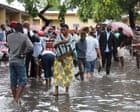
The link between a scorched planet and a collapsing ballot box is no longer a theoretical exercise for academic journals. As extreme weather events move from the fringes of the calendar to the center of daily life, they are actively dismantling the logistical and social foundations required for a functional democracy. We are witnessing the slow-motion erosion of state capacity, where the constant need for emergency response drains the resources and the trust necessary for civil society to operate.
When a city is underwater or a province is on fire, the immediate concern is survival. However, the long-term casualty is often the democratic process itself. From the physical destruction of polling stations to the mass displacement of voters, climate instability creates a vacuum that is frequently filled by emergency powers and executive overreach. This isn't just about bad weather. It is about the fundamental inability of current political structures to manage a permanent state of crisis.
The Logistics of Disenfranchisement
Democracy is a logistical feat. It requires stable geography, reliable communication, and a mobile population. Extreme weather targets all three. When heatwaves buckle infrastructure or floods wash away roads, the basic act of gathering to vote or debate becomes a high-stakes risk.
During recent extreme weather cycles, we have seen local governments forced to choose between public safety and constitutional mandates. These aren't easy calls. If a wildfire is approaching a township, the local registrar cannot realistically expect citizens to prioritize a primary election over their homes. The result is a patchwork of "emergency' voting rules that vary wildly by jurisdiction, often leading to legal challenges that further undermine public confidence in the results.
The displacement factor is even more corrosive. Internal migration driven by climate disasters creates a "voter ghost" phenomenon. When thousands of people are forced from their permanent residences into temporary shelters or out-of-state housing, their registration status enters a legal gray area. Current systems are built on the assumption of residency permanence. Without a fixed address, the right to vote becomes a bureaucratic nightmare, effectively silencing the very people most impacted by environmental policy.
The Rise of the Emergency Executive
History shows that prolonged crises tend to centralize power. In a democracy, power is meant to be diffused, checked, and balanced. But a hurricane does not wait for a legislative committee to meet. This creates a natural "urgency bias" toward executive action.
Governors and heads of state increasingly rely on emergency declarations to bypass traditional hurdles. While necessary in the short term, the normalization of this "rule by decree" sets a dangerous precedent. When every summer is a wildfire season and every autumn is a flood season, the "temporary" suspension of standard procedures becomes the new permanent operating model.
This shift changes the relationship between the citizen and the state. Instead of being a participant in a deliberative process, the citizen becomes a recipient of disaster relief. The government's role narrows to that of a first responder and a provider of aid. While that sounds efficient, it strips away the accountability mechanisms that keep a democracy healthy. If the only metric for a successful government is how fast it can distribute bottled water after a storm, deeper issues like corruption, transparency, and long-term planning are pushed to the sidelines.
Resource Scarcity and the Politics of Resentment
Climate change is an economic multiplier that exacerbates existing inequalities. As resources like water, arable land, and insurance coverage become more expensive or move toward total scarcity, the political temperature rises. We are entering an era of "triage politics."
In this environment, different groups are forced to compete for a shrinking pool of state protection. Should a government spend its limited budget on sea walls for a wealthy coastal district or on heat-mitigation for a low-income urban center? These choices are inherently divisive. When the state can no longer provide a baseline of security for everyone, the social contract begins to fray.
Polarization thrives on this kind of zero-sum competition. Populist movements often capitalize on the fear and resentment generated by resource scarcity, blaming "the other" for the lack of water or the rising cost of electricity. We see this play out in real-time as climate-induced migration triggers nativist rhetoric. The collapse of environmental stability isn't just a green issue; it is the primary fuel for the next generation of authoritarianism.
The Infrastructure of Truth Under Fire
A healthy democracy requires a shared reality. However, the chaos of environmental disasters provides a perfect fog for misinformation. During a crisis, information gaps are filled by rumor, conspiracy theories, and deliberate manipulation.
We have observed this pattern during every major natural disaster of the last decade. False claims about the origins of a fire or the distribution of aid spread faster than official communications. In the heat of a disaster, the public is more susceptible to emotional manipulation. This erodes the "truth infrastructure" necessary for informed voting. If a population cannot agree on the cause of their misfortune, they cannot agree on a solution, leaving the door wide open for demagogues who offer simple, albeit false, answers to complex problems.
The cost of maintaining the physical infrastructure of democracy—the buildings, the servers, the paper trails—is also skyrocketing. Municipalities already struggling with the costs of climate adaptation are finding it harder to fund the mundane but essential components of election security. When a town has to choose between fixing a bridge and upgrading its voting machines, the bridge usually wins.
The Insurance Crisis and Economic Stability
The stability of the middle class is a traditional bulwark against political extremism. That stability is currently being liquidated by the insurance industry. As private insurers pull out of high-risk markets, property values in those areas are set to crater.
This isn't just a problem for homeowners. It is a problem for the tax base that funds local schools, libraries, and election boards. A collapse in the real estate market in climate-vulnerable zones leads to a "municipal death spiral." As tax revenue drops, services are cut. As services are cut, more people leave. The remaining population is often the most vulnerable and the least able to advocate for themselves, creating pockets of democratic abandonment where the state effectively ceases to function as a representative body.
Moving Beyond Triage
Fixing this requires more than just carbon credits or solar panels. It requires a fundamental redesign of how we handle the legal and logistical aspects of governance in a high-volatility world.
First, the concept of residency and voter registration needs to be decoupled from physical geography. In a world of mass displacement, the right to participate in one's government must be portable. Federal and regional standards for "disaster voting" must be established well before the next crisis hits, removing the ability of local partisans to manipulate the rules in the middle of an emergency.
Second, we must address the "emergency power" creep. There need to be clear, legally binding "sunset clauses" on any executive powers triggered by environmental disasters. These powers should be subject to immediate and transparent judicial review to ensure they are being used to save lives, not to bypass political opposition.
Third, the financial burden of climate adaptation cannot be left to local municipalities alone. A national or international "democracy resiliency fund" is needed to ensure that the mechanics of voting and civil society are protected regardless of a local government's credit rating.
The threat to democracy is not just the storm itself, but our lack of a plan for the day after. If we continue to treat each disaster as a one-off anomaly, we will wake up to find that the foundations of our political system have been washed away while we were busy sandbagging the front door. The climate crisis is a governance crisis. Treating it as anything less is a recipe for a quiet, hot, and very permanent decline into instability.
Stop looking at the thermometer and start looking at the statute books. The law is the only thing that can withstand the heat.


