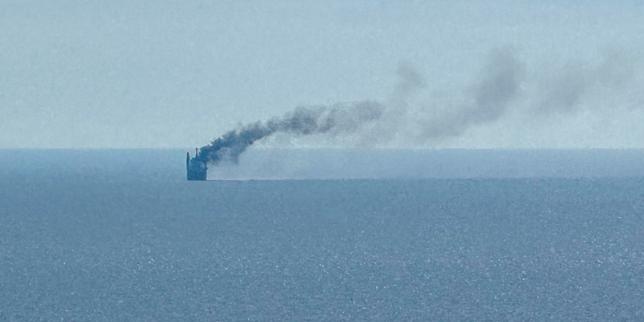
The targeted strikes on merchant vessels in the Odesa transit corridor demonstrate that Russia has shifted from blockading physical space to systematically raising the cost functions of maritime trade. By striking the Togo-flagged cargo ship Lada during unloading operations and subsequently hitting Tanzanian, Liberian, and Marshall Islands-flagged vessels in the Black Sea, Moscow is executing a calculated attrition strategy. The objective is not merely tactical destruction of port assets; it is the deliberate manipulation of commercial risk premiums to isolate Ukraine from global markets.
This operational shift marks the transition from kinetic naval blockades to a economic deterrence model. When a state cannot achieve absolute command of the sea, it can still achieve denial of trade by targeting the economic structures that keep commercial vessels moving: insurance underwriting, crew recruitment, and freight pricing.
The Economic Cost Function of Maritime Risk
To understand why these strikes are highly effective despite limited physical tonnage destroyed, we must deconstruct the financial mechanics of commercial shipping in high-risk corridors. A merchant vessel operates within a strict network of operational expenditures, where risk is immediately monetized.
The total cost of operating a vessel through the Ukrainian maritime corridor is determined by three variables:
$$C_{total} = F_{base} + I_{war} + K_{risk}$$
Where:
- $F_{base}$ represents the baseline operational cost (fuel, crew wages, port fees).
- $I_{war}$ represents the War Risk Premium (WRP), charged as a percentage of the vessel's total hull value for a specific transit window.
- $K_{risk}$ represents the risk premium required to recruit crews willing to enter active conflict zones.
When Russian loitering munitions and missiles strike civilian vessels, they directly manipulate $I_{war}$ and $K_{risk}$. Underwriters at Lloyd's of London and other global syndicates price hull war risk based on the frequency and severity of attacks within a 7-day moving window. A single fatal strike on a vessel moored at port can cause WRP rates to spike from 0.75% of hull value to over 2.0% within forty-eight hours. For a cargo ship valued at $20 million, this single adjustment increases the cost of a single voyage by $250,000, immediately erasing the profit margins of low-value, bulk agricultural or chemical cargoes.
The Anatomy of the Corridor Interdiction Strategy
The Russian interdiction campaign relies on a clear, three-tiered operational logic:
1. Crew Churn and Recruitment Deterrence
The death of foreign crew members, including citizens of Syria and Egypt, targets the human capital bottleneck of maritime shipping. Merchant fleets rely on multinational crews who can choose to refuse transit into declared war zones under standard Seafarers' International Union (SIU) or International Transport Workers' Federation (ITF) guidelines. By demonstrating that ships are unsafe even while docked and unloading, the campaign creates a severe crew retention deficit for any shipowner operating in the Black Sea.
2. Flag-State Arbitrage
The targeted vessels flew flags of convenience—specifically Togo, Tanzania, Liberia, and the Marshall Islands. These registries are chosen by shipowners to minimize regulatory friction, tax liabilities, and operational costs. However, these registries lack the naval capability or political leverage to project power or demand state-backed retribution. By focusing kinetic strikes on flags of convenience, Moscow minimizes the risk of direct escalatory responses from major naval powers, while successfully degrading the logistical capacity of the corridor.
3. Port Infrastructure Desynchronization
By striking vessels while they are actively unloading agricultural inputs or loading grain, the attacks cause immediate disruptions to port logistics. The physical wreckage, subsequent fire-suppression efforts, and mandatory investigation windows stall berth turnover times. In a highly optimized logistics chain, a 72-hour delay at a single berth cascade-effects the entire rail and riverine supply chain feeding the port, leading to storage bottlenecks inland.
The Limitations of Ukraine's Defensive Mitigations
In response to this campaign, Kyiv has deployed layered air defense systems and proposed the utilization of naval surface drones carrying interceptor payloads to establish an aerial defense line over the Black Sea. While technically sophisticated, this defensive posture faces three structural limitations:
- The Geometry of Air Defense: Protecting stationary, high-value land targets is fundamentally different from protecting moving vessels across hundreds of miles of open water. The radar horizon at sea limit the reaction time of land-based systems against low-flying sea-skimming missiles and loitering munitions.
- The Cost-Asymmetry Vector: Decomposing the economics of the intercept reveals a massive structural imbalance. Using high-end surface-to-air missiles (SAMs) costing upwards of $1 million to intercept loitering munitions that cost $20,000 to manufacture is fiscally unsustainable over a multi-month campaign.
- The "Golden Hour" Medical Bottleneck: The strikes on vessels demonstrate that even when a ship survives a strike, the lack of immediate, high-tier trauma care at sea or in damaged port facilities converts injuries into fatalities.
The Strategic Path Forward: Sovereign Risk Underwriting
If the maritime corridor is to remain viable, Ukraine and its international partners cannot rely solely on kinetic air defense. They must construct an economic counter-framework that insulates shipowners from the cost spikes driven by Russian interdiction.
The optimal play is the expansion of sovereign-backed insurance pools. Standard commercial underwriters cannot absorb the volatility of unpredictable missile strikes without charging prohibitive premiums. A coalition of partner nations must establish a first-loss sovereign guarantee fund. By placing state capital as a buffer below commercial reinsurance tiers, the War Risk Premium can be synthetically capped at a stable rate (e.g., 1.0%), regardless of short-term kinetic activity.
Without this structured financial intervention, the physical capacity of Ukraine’s ports will be rendered irrelevant by the quiet, mathematical withdrawal of commercial shipping assets from the Black Sea.