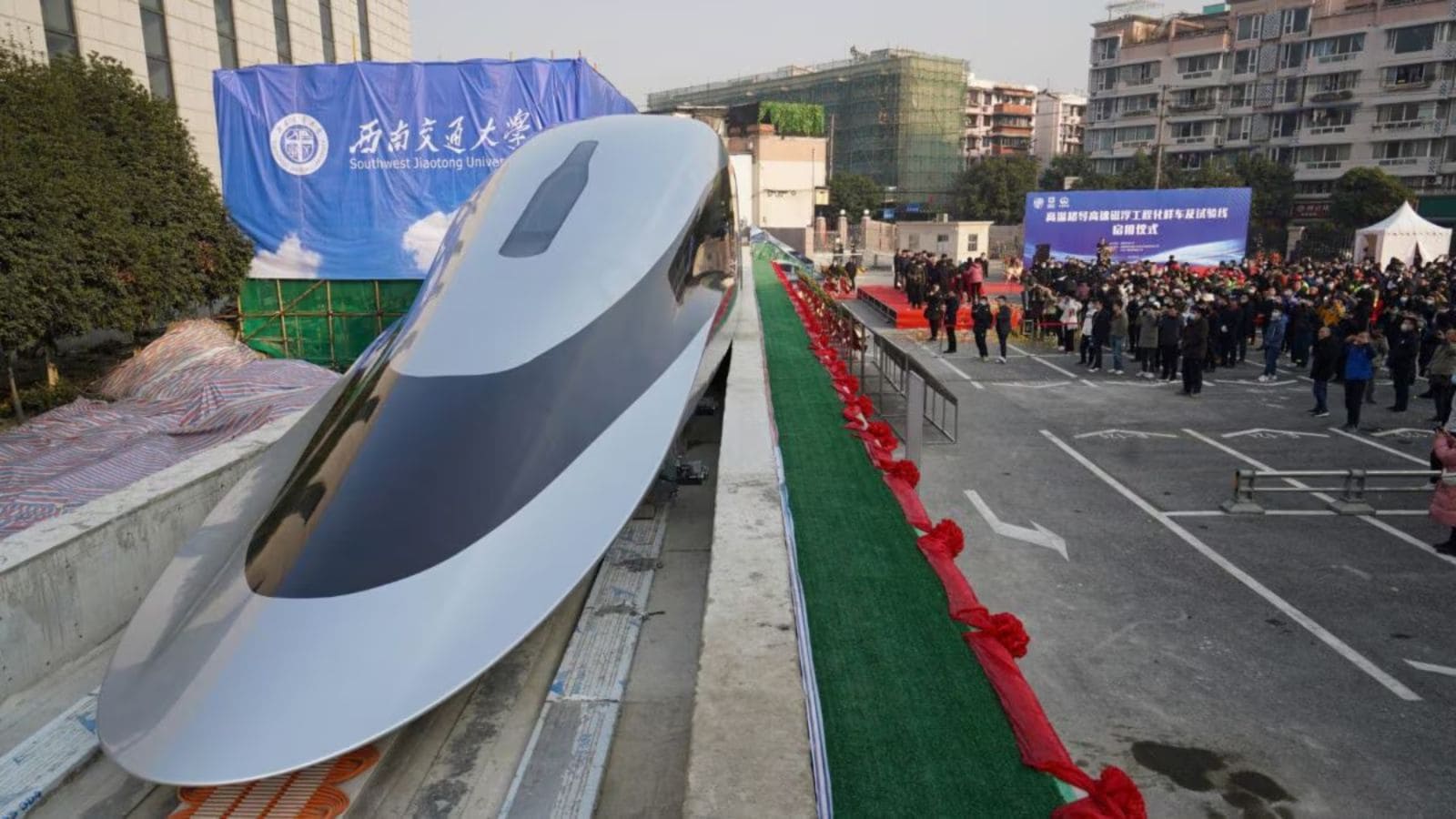
Imagine standing next to a track where a 1.1-tonne vehicle blasts from a dead stop to 800 kilometers per hour in just 5.3 seconds. That is not science fiction. It is the reality recently achieved by researchers at the Donghu Laboratory in Hubei province, marking a massive leap in magnetic levitation testing.
Most headlines obsess over the sheer velocity, but they miss the point entirely. This is not about building a commuter train that will whip you to work at jet-fighter speeds tomorrow. It is about mastering electromagnetic forces to completely rewrite how we move heavy objects, launch aerospace vehicles, and handle extreme acceleration.
Breaking Down the Hubei Test Track Milestone
The numbers coming out of the Hubei East Lake Laboratory demand attention. Operating on a modest one-kilometer test track, the experimental pod hit roughly 799.84 km/h before shutting down safely within a span of 200 meters. This marked the third time the platform broke its own short-distance acceleration benchmark over a six-month window.
Back in June 2025, the initial public trial maxed out at 650 km/h in 7.1 seconds. Incremental tweaks pushed it to 700 km/h, then nearly 800 km/h, culminating in this hyper-fast 5.3-second sprint.
Achieving this requires absolute engineering perfection. At these velocities, a microscopic flaw spells disaster. Track alignment must hold within a strict margin of 0.5 millimeters to prevent the vehicle from destabilizing. The control systems juggle high-voltage energy delivery, constant levitation control, and millimeter-level positioning simultaneously.
Why You Won't Be Riding an 800 KM/H Train Anytime Soon
If you think you will soon board a passenger carriage accelerating at this rate, think again. Human biology simply cannot handle it. An acceleration rate that rockets a vehicle to 800 km/h in five seconds subjects passengers to G-forces similar to a fighter jet launch. Commuters want to sip coffee, not black out from intense gravitational pressure.
Furthermore, the infrastructure costs and power demands for scaling this specific high-acceleration technology to move human payloads across long distances are entirely unfeasible. Commercial maglev lines, like those operating in China, cruise comfortably at much lower velocities around 350 km/h for a reason. Passenger comfort and safety dictate gentle, gradual acceleration curves.
The Real Industrial and Aerospace Applications
So why spend millions on a one-kilometer rocket sled track? Because the utility of this technology lies entirely outside traditional passenger rail.
Engineers are looking at how ground-based electromagnetic propulsion can assist with aerospace launches. Giving a cargo rocket or drone a massive initial velocity boost right off the ground drastically cuts down the onboard fuel required for takeoff. Less fuel weight means heavier payload capacities and cheaper orbital missions.
Beyond aerospace, laboratories are eyeing specialized industrial transport systems and heavy-duty vertical lift mechanisms. Harnessing linear motors and permanent magnet levitation removes mechanical friction entirely. Without friction eating away at efficiency, mechanical wear drops to near zero, opening doors for high-speed material transit in tightly controlled industrial environments.
Building systems that survive these forces teaches engineers valuable lessons about thermal management, rapid emergency braking, and high-frequency communication protocols between fast-moving assets and static track infrastructure.
Stop viewing this breakthrough through the lens of a daily commute. This is a heavy-duty technological stepping stone. It proves that extreme electromagnetic acceleration is controllable, repeatable, and scalable for the next generation of aerospace and industrial engineering.