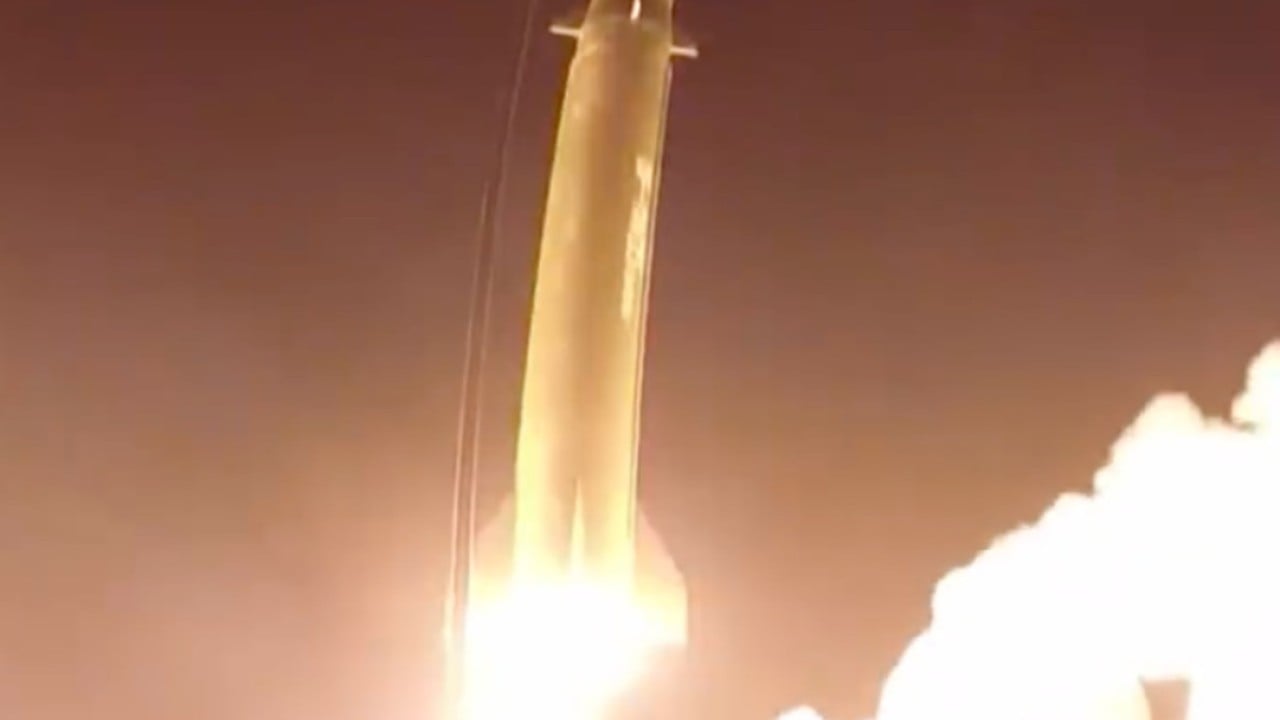
Every time state-controlled media in Beijing drops slick, high-definition footage of a "no-notice" Dongfeng (DF) rocket drill, the Western defense echo chamber reacts on cue. Pundits scramble to television studios. Think-tank analysts fire off urgent threads on X. The consensus is always identical, always predictable, and almost entirely wrong. They claim Beijing is flexing its muscles to intimidate Washington, deter Taipei, or signal imminent war in the Indo-Pacific.
That narrative is lazy. Worse, it is dangerously myopic.
When you look past the theatrical camera angles and slow-motion propellant exhaust, a completely different reality emerges. The People’s Liberation Army Rocket Force (PLARF) is not broadcasting these drills to scare the Pentagon. Washington already knows where those brigades are, how fast they can erect a transporter-erector-launcher (TEL), and roughly how many warheads sit in their underground tunnels. The real target of these meticulously edited propaganda reels is sitting in Zhongnanhai, in regional military commands across China, and inside the minds of domestic skeptics who watched an unprecedented wave of corruption purges gut the Rocket Force’s senior leadership.
If you want to understand modern deterrence, stop reading the footage as an external threat and start reading it as an internal audit.
The Myth of the Spontaneous "No-Notice" Launch
Let’s dismantle the central premise of the mainstream coverage first. There is no such thing as a truly "no-notice" ballistic missile drill when a professional film crew is already positioned at the exact firing azimuth with multi-angle drones, stabilized tracking cameras, and broadcast-grade audio equipment.
I have spent years analyzing military signaling and force posture across the Western Pacific, and the gap between operational readiness and media theater is wide enough to drive a 16-wheeled DF-26 TEL through. True snap drills—the kind that actually keep intelligence officers at the National Geospatial-Intelligence Agency awake at night—happen in the dark, under strict emissions control, with zero press anywhere near the perimeter. You do not detect them on CCTV evening news; you detect them through sudden spikes in encrypted VHF traffic, unexpected closures of civilian airspace via NOTAMs, and infrared blooms picked up by overhead Space-Based Infrared System (SBIRS) satellites.
When Beijing releases a polished montage labeled "no-notice," the label itself is a curated political message. It tells a specific story: Our troops are so disciplined, so politically reliable, and so technically proficient that they can execute complex launch sequences without preparation.
Why does Beijing need to tell that story right now? Because over the past few years, the PLARF suffered the worst institutional crisis in its history.
Cleaning House in the Rocket Force
You cannot separate modern PLARF messaging from the massive anti-corruption crackdown that swept through the service starting in 2023. The removal of top commanders—including former Defense Minister Li Shangfu and successive Rocket Force leaders like Li Yuchao—was not routine bureaucratic turnover. Intelligence assessments and subsequent disciplinary disclosures pointed toward systemic rot in equipment procurement, fuel handling, and silo construction.
Imagine a scenario where a supreme leader pours hundreds of billions of yuan into an elite strategic branch meant to serve as the ultimate guarantor of national sovereignty, only to discover that senior officers were skimming defense contracts and compromising material readiness. Trust evaporates overnight.
When an authoritarian system experiences that level of institutional failure, public displays of competence become mandatory political medicine. The "no-notice" drill footage serves two vital domestic functions:
- Proof of Life for the Party: It demonstrates to Xi Jinping and the Central Military Commission (CMC) that the purged, restructured Rocket Force is back on its feet, purged of disloyal elements, and capable of following orders without friction.
- Reassurance for the Public: Chinese nationalism has been stoked for a decade on the promise of military rejuvenation. Rumors of corruption in the crown jewel of the PLA threaten domestic legitimacy. Showing crisp, flawless execution reassures the domestic audience that their tax money built an invincible shield, not luxury villas for corrupt generals.
Western commentators miss this because they suffer from mirror-imaging. They assume that because the U.S. military conducts Freedom of Navigation Operations (FONOPs) or bomber task force deployments primarily to signal external adversaries, every Chinese military broadcast must also be aimed outward. In the PLA, politics always commands the gun—and domestic political stability always outranks external diplomatic signaling.
What the Footage Actually Reveals About PLARF Doctrine
Even if we set the domestic politics aside and examine the military mechanics shown in these drills, the standard commentary still gets the operational takeaway backward. Analysts love to point to the Dongfeng series—specifically the dual-capable DF-26 intermediate-range ballistic missile or the DF-17 hypersonic glide vehicle—as "carrier killers" designed to push the U.S. Navy past the Second Island Chain.
That is textbook Anti-Access/Area Denial (A2/AD) theory. Everyone knows it. Nobody needs a two-minute video clip to confirm it.
What the footage actually highlights—if you know where to look—is the PLA’s obsession with survivability and shoot-and-scoot logistics in an era of ubiquitous satellite surveillance.
Look closely at the environment in recent PLARF releases:
- Subterranean-to-Surface Transitions: Heavy emphasis on units emerging from hardened underground facilities (the famous "Underground Great Wall"), rapidly deploying camouflage netting, and setting up mobile command posts in rugged terrain rather than prepared concrete launch pads.
- Nighttime and Degraded-Environment Operations: Deliberate inclusion of rain, dust, and low-light conditions to prove that optical and thermal masking protocols work when weather degrades commercial satellite imagery.
- Decentralized Reloading: Showing crane vehicles transferring canisters in austere forest clearings rather than fixed logistics depots.
This is not the posture of a confident aggressor preparing a surprise knockout blow. This is the posture of a force acutely aware that in a high-end conflict with the United States, every fixed garrison, fuel depot, and command bunker will be mapped and targeted within the first hour. The PLARF is practicing how not to die before it fires.
By framing these defensive survival drills as aggressive saber-rattling, Western media inadvertently inflates the psychological impact of Beijing’s messaging. They do China’s information warfare for free.
The Questions Everyone Asks—And Why They Are Flawed
When these videos go viral, search engines light up with the same predictable queries. Let’s look at what people are asking and dismantle the flawed assumptions baked into every single one.
"Are these drills a sign that China is preparing to invade Taiwan soon?"
No. Amphibious invasions do not start with isolated, telegenic missile drills broadcast on national television. If Beijing were actually preparing to cross the Taiwan Strait, you would not see curated clips of three TELs driving through a scenic valley. You would see massive requisitioning of civilian roll-on/roll-off ferries, blood bank mobilization across Fujian and Guangdong provinces, and the quiet evacuation of foreign nationals.
Strategic surprise requires silence, not publicity. Every time Beijing shouts about its readiness on state TV, the odds of an imminent surprise attack go down, not up. Noise is the enemy of operational surprise.
"Can the U.S. military defend against a no-notice Dongfeng missile barrage?"
This question fundamentally misunderstands how missile warfare works. No missile defense architecture on earth—not Patriot, not THAAD, not Aegis Ballistic Missile Defense—is designed to catch 100% of a saturated ballistic and hypersonic volley. If you try to play catcher against an entire PLARF brigade firing simultaneously, you will run out of interceptors long before they run out of boosters.
The U.S. military does not plan to win a missile exchange by shooting every arrow out of the sky. It plans to win by dispersing its forces across dozens of austere airfields (a concept known as Agile Combat Employment), hardening critical fuel and command nodes, and killing the archers—meaning hunting down the TELs, blinding the over-the-horizon targeting radars, and severing the kill chain before the missiles ever leave their canisters. Asking whether defenses can stop the missiles misses the entire tactical equation.
"Why does China call them 'no-notice' if they are staged for cameras?"
Because in PLA terminology, "no-notice" (wu yugao) refers to the lack of advance warning given to the participating operational units regarding the exact timing, coordinates, or simulated combat scenarios—not the absence of planning by the higher command or the propaganda department.
A brigade commander might know a major inspection window is open during a given month, and a camera crew might be embedded with the political commissar’s office, while the actual launch coordinates are handed down via sealed envelope ten minutes before the clock starts. Both things can be true at once: the tactical test is real for the crew, and the media framing is carefully stage-managed for the audience.
The Downside of Dismissing the Signal
Now, let’s be brutally honest about the limits of this contrarian view. If you swing too far in the other direction and dismiss every PLARF drill as empty domestic theater, you walk straight into a different trap: complacency.
Propaganda and genuine capability are not mutually exclusive. Just because a drill is filmed for domestic political consumption does not mean the missile fails to fly, the solid-fuel motor fails to ignite, or the maneuverable reentry vehicle misses its target in the Taklamakan Desert.
Over the past fifteen years, the PLARF has fielded one of the largest, most diverse land-based missile arsenals on the planet. Their solid-fuel technology has drastically compressed launch preparation times compared to the liquid-fueled dinosaurs of the Cold War era. Their integration of BeiDou satellite navigation with terminal radar and infrared seekers has solved many of the accuracy problems that plagued earlier generations of Chinese ballistic missiles.
The danger lies in mistaking the purpose of the broadcast for the reality of the hardware. When Western analysts treat a domestic political loyalty test as an imminent declaration of war, they push policymakers toward reactive, escalatory posturing. Conversely, if policymakers dismiss the footage as mere theater and ignore the steady, grinding improvements in PLARF shoot-and-scoot logistics, they risk underestimating a very real warfighting capability.
How to Actually Read Chinese Military Signaling
If you work in defense policy, intelligence analysis, geopolitical risk, or simply want to stop getting played by sensationalist headlines, change how you consume PLA media. Stop looking at the missiles and start looking at the context.
- Check the Timing Against the Domestic Calendar: Cross-reference major PLA broadcasts with internal Communist Party events—plenums, anti-corruption announcements, economic downturns, or senior leadership reshuffles. You will find a far stronger correlation between domestic political pressure and flashy military videos than between U.S. naval movements and Chinese drills.
- Watch the Logistics, Not the Launch: Any competent rocket crew can press a button on a sunny morning. Look at the background of the frame. Are they using digital camouflage netting? Are commercial-grade civilian trucks mixed into the convoy? How many support vehicles accompany each launcher? Logistics tell you whether a unit can sustain combat; launches just tell you they can put on a show.
- Track What Isn't Shown: Pay attention to the systems absent from the highlight reels. When Beijing wants to rattle Washington strategically, it doesn't just show regional DF-26 units driving through forests; it conducts rare, full-range test launches of intercontinental ballistic missiles into the open Pacific Ocean—just as it did in September 2024. That was a genuine external signal. A domestic "no-notice" regional drill is routine housekeeping.
The next time a breathless headline warns you that China just sent a chilling new message to America with a surprise rocket drill, take a breath. Look at the high-definition cinematography. Notice the dramatic orchestral score. Remember the purged generals sitting in prison cells.
Beijing isn't talking to you. It's talking to itself—and trying desperately to believe its own broadcast.


