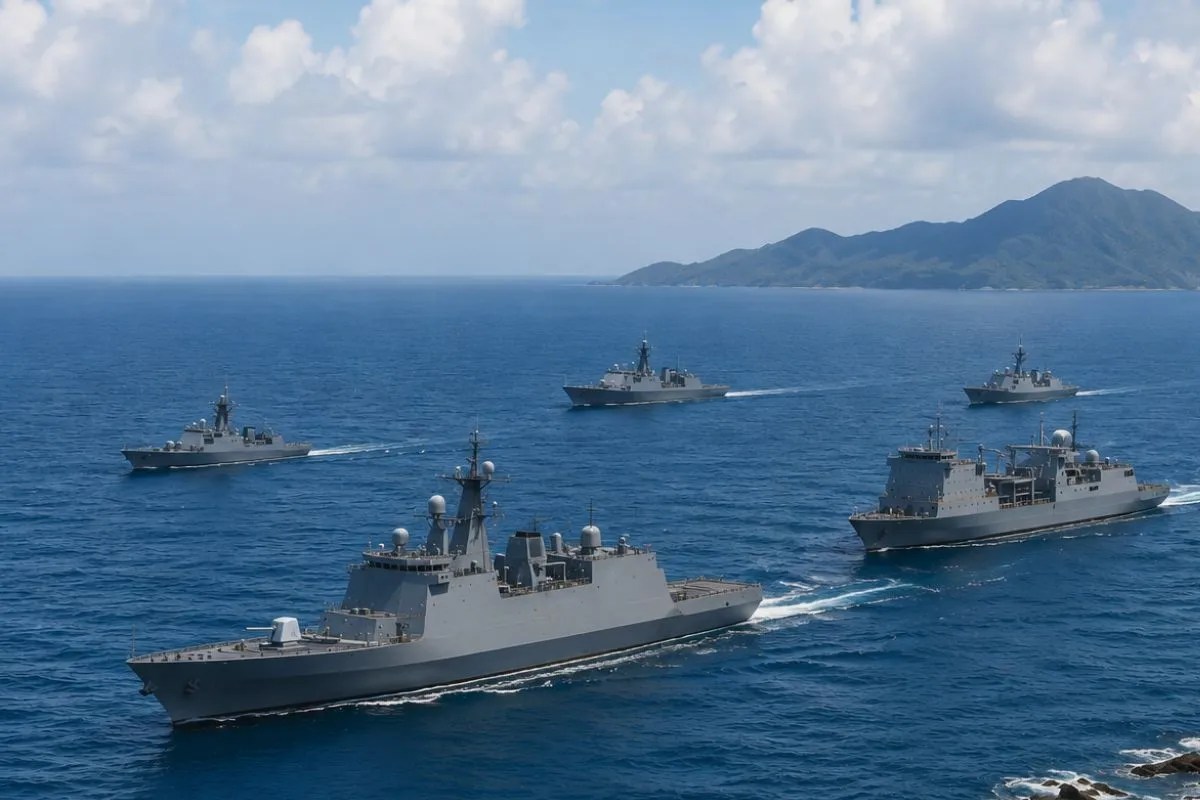
China is flexing its muscles around Taiwan again. This isn't new, but the latest deployment patterns show a shift in strategy that most casual observers are missing entirely. Taiwan's Ministry of National Defense recently tracked a Chinese military aircraft and 15 naval vessels operating close to the island within a 24-hour window.
If you just look at the headlines, one plane and 15 ships might not sound like a full-scale invasion force. That is exactly what Beijing wants you to think. For a more detailed analysis into this area, we suggest: this related article.
The real story isn't the raw numbers. It is the tactical placement of those 15 naval vessels. Sending a high ratio of warships compared to aircraft signals a transition from mere intimidation to sustained maritime presence.
The Reality of Chinas Constant Pressure on Taiwan
Beijing uses a strategy known as grey-zone warfare. It is a state of constant hostility that stops just short of an actual declaration of war. By keeping a steady rotation of ships in the Taiwan Strait, the People's Liberation Army (PLA) wears down Taiwan's military responses. For additional background on this issue, detailed reporting can also be found on The New York Times.
Think about the logistical nightmare this creates for Taipei. Every time a Chinese vessel crosses the median line or enters the air defense identification zone (ADIZ), Taiwan has to scramble its own jets or deploy missile surveillance systems. It costs millions. It exhausts pilots and sailors. It drains resources.
Taiwan's defense ministry confirmed that their armed forces monitored the situation closely, deploying combat air patrol aircraft, naval vessels, and land-based missile systems to respond. This constant back-and-forth is designed to make the Taiwanese military numb to the threat. If you see 15 ships every week, you stop treating them as an emergency. That is precisely when an actual strike becomes dangerous.
Why the Ship to Aircraft Ratio Shifted This Time
Usually, PLA provocations involve dozens of fighter jets, bombers, and early-warning aircraft flying short sorties across the strait. This time, the single aircraft paired with 15 ships points toward a specific exercise in maritime encirclement and blockading.
- Submarine hunting operations: A lone anti-submarine warfare aircraft or a drone can map out underwater topography while naval ships establish a surface perimeter.
- Logistics testing: Moving 15 ships simultaneously requires massive coordination. China is testing how well its different naval branches communicate in real-time under operational conditions.
- Combat readiness patrols: The PLA explicitly calls these actions "joint combat readiness patrols." They aren't parade floats. They are fully armed warships practicing blockade formations.
Western analysts from institutions like the Center for Strategic and International Studies (CSIS) have repeatedly warned that a blockade is a much more likely initial move than an amphibious invasion. A blockade chokes Taiwan's economy, which relies almost entirely on energy imports and semiconductor exports. By keeping 15 ships stationed at key chokepoints, China proves it can close the lid whenever it wants.
The Global Semiconductor Stake
This isn't just a localized dispute between Taipei and Beijing. If the Taiwan Strait closes, global supply chains break instantly.
Taiwan manufactures over 60% of the world's semiconductors and over 90% of the most advanced microchips. Your phone, your car, the medical equipment in your local hospital, and the data centers running the internet depend on a tiny island that is currently surrounded by Chinese warships.
The economic fallout of a blockade would dwarf the 2020 supply chain crisis. A single week of a total blockade would halt global tech production. It is why the US military regularly sails its own seventh fleet assets through the strait to maintain freedom of navigation. Every time a Chinese ship moves in, the risk of a miscalculation or an accidental collision goes up.
What Happens Next on the Water
Do not expect China to stop these patrols. They will likely increase in frequency and density as Taiwan continues to strengthen its political ties with Washington and European allies.
Keep an eye on the specific types of ships China deploys next. If we start seeing amphibious assault docks mixed in with the standard frigates and destroyers, the threat level changes from a pressure campaign to active invasion prep. For now, the focus remains on economic and psychological attrition.
Watch the official briefings from Taiwan’s Ministry of National Defense on their official channels. Pay attention to the ship counts over the next month. If the baseline stays above 10 vessels daily, it means Beijing has successfully normalized a permanent naval blockade posture without firing a single shot.