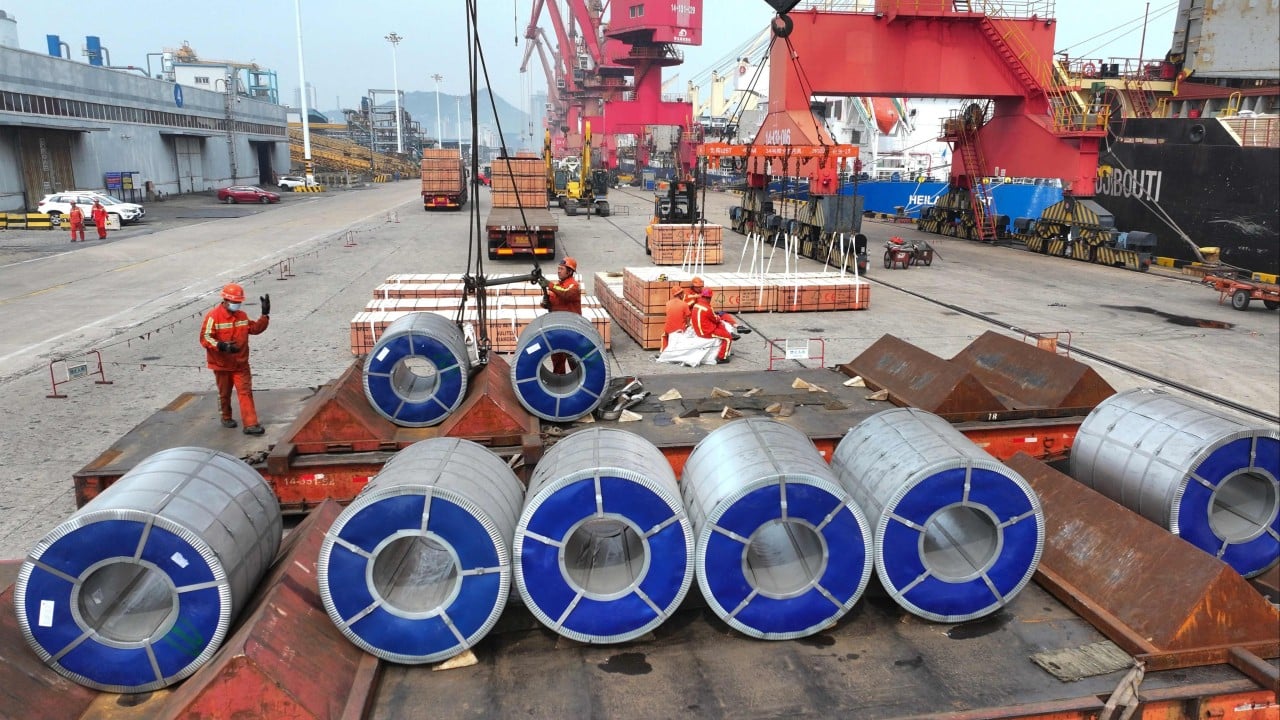
The era of cheap, carbon-heavy industrial dominance is hitting a wall at the European border. China’s steel sector, the largest on the planet, is no longer treating the European Union’s Carbon Border Adjustment Mechanism (CBAM) as a distant policy experiment. Instead, the industry is orchestrating a coordinated survival strategy to protect billions in export revenue. This isn't just about environmental compliance; it is a high-stakes chess match over who pays for the atmospheric cost of heavy industry and how global trade flows will be rerouted to avoid the bill.
China produces roughly half of the world's steel. For years, this massive output relied on coal-fired blast furnaces, a method that is efficient for growth but disastrous for carbon footprints. As the EU begins its transition toward taxing the "embedded emissions" of imports, Chinese steelmakers are realizing that their price advantage could evaporate overnight. To counter this, they are moving away from individual corporate scrambling toward a centralized, state-supported defense mechanism designed to challenge EU data standards while simultaneously racing to decarbonize the domestic supply chain.
The Strategy of Collective Resistance
Beijing is not letting its industrial champions fight this battle alone. Under the guidance of the China Iron and Steel Association (CISA), the industry is developing a unified reporting framework. This is a deliberate move to ensure that when the EU asks for emission data, they receive a standardized, "China-approved" version of the facts.
The core of the conflict lies in measurement. The EU expects granular, transparent data on every ton of steel, tracking the carbon from the mine to the mill. Chinese firms argue that these requirements are discriminatory and technically flawed. By coordinating their response, they aim to create leverage. If the entire Chinese steel sector refuses to adopt certain EU-mandated reporting software in favor of a domestic alternative, they force Brussels into a difficult choice: accept the Chinese data or risk a full-scale trade war with their largest supplier of industrial components.
This unified front also serves as a shield against "carbon leakage" in reverse. The fear among Chinese executives is that if they comply too early or too transparently, they will expose operational inefficiencies that competitors in India or Southeast Asia might exploit. Therefore, the strategy is one of calculated delay and methodological dispute.
The Technological Pivot to Hydrogen and Scrap
While the lawyers and lobbyists argue over data, the engineers are being told to find a way out of the coal trap. The industry knows that diplomacy only buys time. To stay competitive under a carbon-tax regime, the fundamental chemistry of Chinese steelmaking has to change.
Currently, the vast majority of Chinese steel comes from Basic Oxygen Furnaces (BOF) fed by iron ore and coking coal. The alternative is the Electric Arc Furnace (EAF), which uses scrap steel and electricity. If that electricity comes from wind or solar, the carbon footprint drops to nearly zero.
- The Scrap Shift: China is rapidly increasing its scrap collection infrastructure. For decades, China was a net importer of "waste," but as its own infrastructure—cars, bridges, and skyscrapers built in the 1990s—reaches the end of its life, the country is finally sitting on its own mountain of recycled steel.
- Hydrogen Breakthroughs: Heavy hitters like Baowu Steel and Hebei Iron and Steel (HBIS) are pouring capital into hydrogen-based Direct Reduced Iron (DRI). This replaces coal with hydrogen in the smelting process.
- Carbon Capture: For the older plants that cannot be easily converted, the focus is on "end-of-pipe" solutions. This involves capturing carbon at the stack and pumping it underground, a process that remains expensive and unproven at the scale required to move the needle for a billion-ton industry.
Bypassing the European Gatekeepers
If the cost of entering Europe becomes too high, the steel will simply go elsewhere. This is the "leakage" that European policymakers fear most. We are seeing a massive realignment of trade routes where "green" steel—the stuff produced with lower emissions—is earmarked for the European market to satisfy CBAM, while the "dirty" steel continues to flow into developing markets in Africa, Latin America, and other parts of Asia where carbon pricing is non-existent.
This creates a dual-track production system. A single mill might operate one high-tech, low-emission line specifically for the EU and the US, while the rest of the facility continues to run on traditional coal power for domestic consumption. This accounting sleight-of-hand is exactly what EU regulators are trying to prevent, but it is incredibly difficult to police from an office in Brussels when the factory is in Tangshan.
Furthermore, China is looking to the "Global South" to build new capacity. By investing in steel plants in countries like Indonesia and Malaysia, Chinese firms can potentially export to Europe from jurisdictions that haven't yet drawn the same level of regulatory scrutiny as the Chinese mainland. It is a shell game played with millions of tons of hot metal.
The Friction of Data Sovereignty
A major, often overlooked sticking point is the issue of data security. The Chinese government is increasingly sensitive about industrial data leaving its borders. Under recent data security laws, providing detailed energy consumption and process-level information to foreign entities—even for environmental compliance—could be seen as a national security risk.
Steelmakers are caught in a pincer movement. On one side, the EU demands total transparency to grant access to its markets. On the other, Beijing demands total data sovereignty to protect industrial secrets and national security. The result is a stalemate where "intermediate" third-party auditors are being proposed, though neither side fully trusts them. This lack of trust is the primary friction point that could lead to the EU imposing the highest possible default carbon tariffs on Chinese goods, a move that would effectively act as a total trade barrier.
The Economics of a Carbon Border
We must look at the numbers to understand why the coordination is so desperate. Experts estimate that under a fully implemented CBAM, the cost of a ton of Chinese steel imported into Europe could rise by $100 to $150 depending on the carbon price in the EU Emissions Trading System (ETS). In an industry where profit margins are often razor-thin—sometimes as low as $10 or $20 a ton—this is a lethal tax.
$P_{total} = P_{market} + (E_{embedded} \times C_{price})$
In this equation, $P_{total}$ is the final price in the EU, $E_{embedded}$ represents the carbon intensity of the steel, and $C_{price}$ is the fluctuating cost of an EU carbon permit. If Chinese producers cannot lower $E_{embedded}$ or negotiate a lower $C_{price}$ through bilateral agreements, they lose the European market entirely.
This is why the "coordinated response" includes a push for the EU to recognize China's own domestic carbon market (the CCER). If China can argue that its steelmakers have already paid a "carbon price" at home, that amount can be deducted from the EU tax. However, the current price of carbon in China is a fraction of what it is in Europe. Bridging that gap is the central task of Chinese trade diplomats over the next three years.
The Risk of Overcapacity and Dumping
While the industry tries to green its image, it is simultaneously grappling with a massive domestic slowdown. The Chinese property sector, once the primary consumer of domestic steel, is in a state of managed collapse. This has left Chinese mills with millions of tons of excess capacity.
When domestic demand falls, China exports. The influx of cheap steel into global markets has already triggered anti-dumping investigations from Brazil to Turkey. The EU’s carbon tax is, in many ways, an anti-dumping tool disguised as an environmental policy. It is designed to prevent European steelmakers—who have to pay high carbon costs—from being wiped out by Chinese competitors who don't.
The coordination we are seeing now is an attempt to manage this transition without causing a total collapse of the Chinese steel industry's export arm. If they can successfully "green-wash" enough of their production to satisfy the EU, they can maintain their foothold in the world's most lucrative market while continuing to dominate the rest of the world with low-cost, high-emission products.
Beyond the Carbon Border
The battle over steel is a preview of what is coming for every other carbon-intensive industry, from aluminum to fertilizers. China's response—combining state-led technological shifts, unified data resistance, and trade rerouting—is the blueprint for how it will handle the global green transition.
The outcome will be determined by whether the EU stands firm on its data requirements or flinches in the face of a potential supply chain disruption. For the Chinese steelmakers, the mission is clear: change the process just enough to keep the doors open, but never cede control of the data or the pricing power that built their empire.
The steel industry is no longer just about iron ore and fire. It is about the digital tracking of molecules and the political branding of energy. Those who cannot prove their "green" credentials will find themselves locked out of the West, relegated to markets where the price of the future isn't yet being collected at the border. Focus on the verification protocols; that is where the real war will be won or lost.