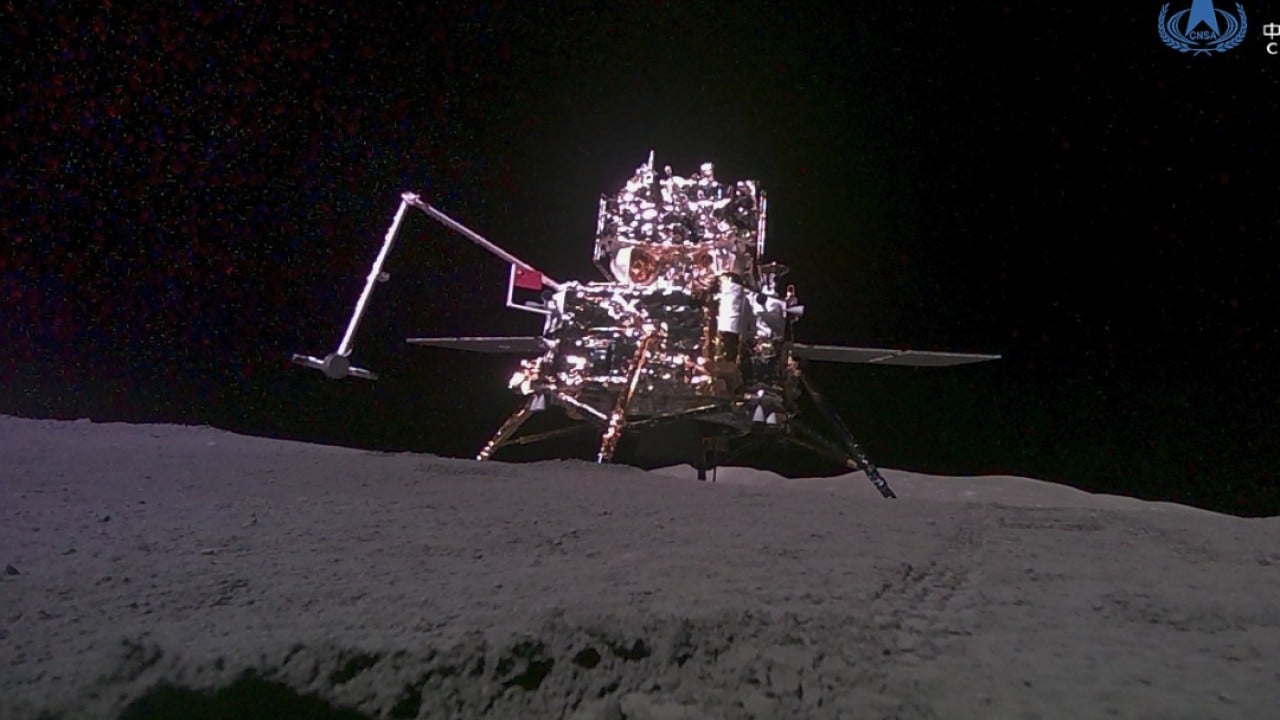
China just handed over a batch of lunar history to Russian scientists. These aren't your run-of-the-mill space rocks. They are pristine physical samples collected from the far side of the moon, hauled back to Earth by the Chang'e 6 mission.
If you follow space exploration, you know how massive this is. Nobody else has managed to land on the dark side of the moon and bring anything back. Now, Beijing is passing a piece of that exclusive cosmic pie to Moscow. It is a massive geopolitical statement wrapped in a scientific laboratory container.
The move shows how space research is splitting into distinct geopolitical camps. You have the US-led Artemis coalition on one side. On the other, you have the growing partnership between China and Russia. It's a brand-new space race, and the rules are completely different this time.
Moving Past the Cold War Space Playbook
For decades, the Soviet Union and the United States dominated the lunar conversation. The US brought back Apollo rocks. The Soviets managed automated return missions with their Luna probes. But those samples all came from the near side of the moon, the side that constantly faces Earth.
The far side is a totally different beast. It is heavily cratered, lacks the vast basaltic plains we see on the familiar side, and possesses a much thicker crust. Scientists want to know why the two halves of the moon look so radically different.
China cracked that puzzle by successfully landing Chang'e 6 in the South Pole-Aitken basin. They scooped up the dirt, launched it off the lunar surface, and brought it home. By sharing these samples with Russia, China is proving it holds the keys to the next era of lunar science. They don't need Western validation. They are building their own network of elite research partners.
What Russian Scientists Are Actually Getting
Russian researchers at the Vernadsky Institute of Geochemistry and Analytical Chemistry are receiving a precious few grams of this lunar soil. That might sound like a tiny amount, but in analytical chemistry, a few grams is a goldmine.
They will be looking for specific things.
- Age verification: Determining the exact timeline of the South Pole-Aitken basin impact.
- Volatile elements: Checking for traces of water or ice trapped deep within the lunar soil.
- Crust composition: Figuring out why the far side crust grew so thick compared to the near side.
This isn't a one-way street. Russia brings decades of experience in analyzing extraterrestrial material to the table. Their scientists know exactly how to handle tiny, invaluable samples without risking contamination. China gets access to that analytical expertise, speeding up the process of publishing groundbreaking papers.
The International Lunar Research Station Agenda
This sample transfer isn't an isolated act of scientific generosity. It's a foundational brick for the International Lunar Research Station, the planned lunar base project led jointly by Beijing and Moscow.
While NASA coordinates the Artemis accords to put boots back on the moon, China and Russia are actively consolidating their parallel alliance. Sharing physical samples builds deep institutional trust. It forces the scientific agencies of both nations to synchronize their workflows, data standards, and security protocols.
Western institutions are largely locked out of this specific loop due to strict political barriers like the Wolf Amendment in the US, which limits NASA's ability to cooperate directly with Chinese state entities. The result is a fractured scientific ecosystem where breakthroughs happen in silos.
How to Follow the Lunar Discovery Pipeline
If you want to keep tabs on what scientists actually discover from these far side samples, you need to look past the mainstream political headlines.
Start by tracking the official publications coming out of the Chinese Academy of Sciences and the Russian Academy of Sciences. Peer-reviewed papers usually take six to twelve months to clear after the initial sample delivery. Look for studies focusing on isotopic analysis and lunar chronology in major planetary science journals. That's where the real secrets of the Chang'e 6 mission will be laid bare.



:max_bytes(150000):strip_icc():focal(665x0:667x2)/gettyimages-50733149-2000-8b129a2475974982a915418ce92a73d8.jpg)