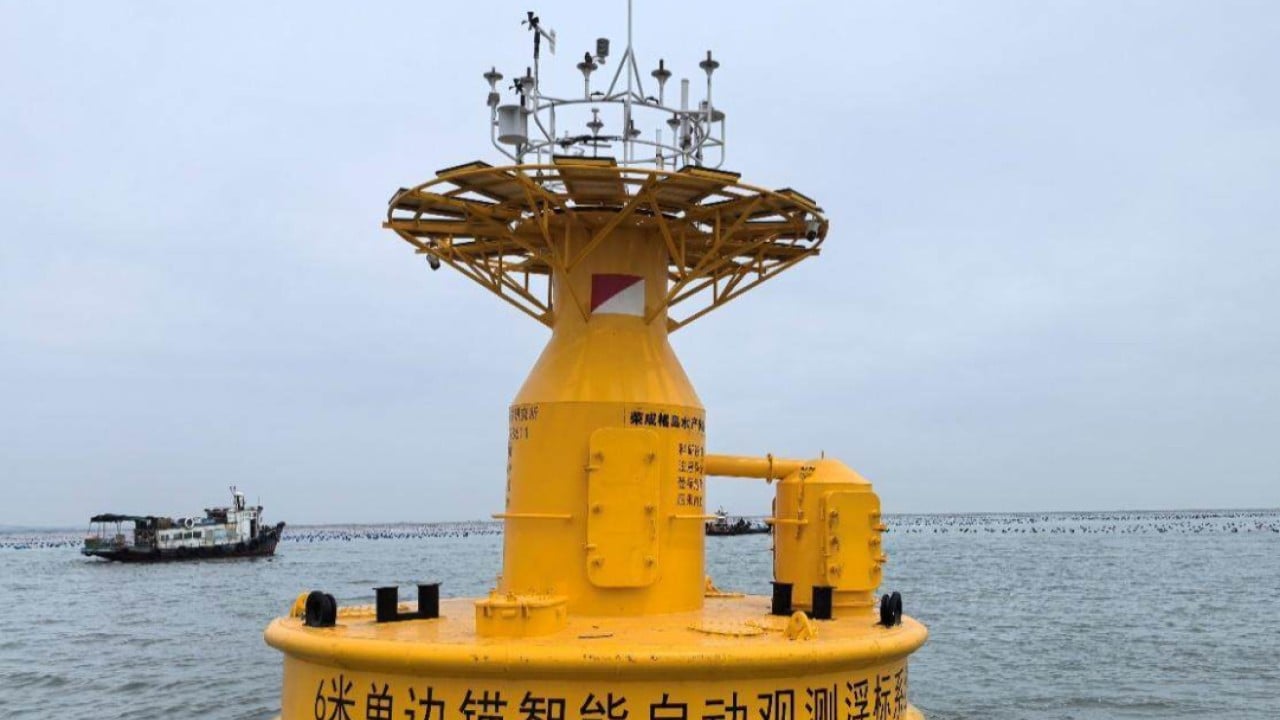
For nearly eighty years, the global standard for oceanographic monitoring has rested on a design birthed in the urgency of World War II. These traditional "discus" buoys, characterized by their flat, circular hulls and heavy metal frames, have served as the eyes and ears of every major navy and meteorological agency. They are reliable, familiar, and increasingly obsolete. China has recently unveiled a radical departure from this legacy hardware, deploying a new generation of marine buoys that scrap the Western architectural playbook entirely. This shift is not merely about better weather forecasting. It represents a fundamental move to dominate the "blue territory" through superior persistence, lower maintenance costs, and advanced data harvesting capabilities that traditional designs cannot match.
The core of this innovation lies in a shift from the heavy, drag-inducing profiles of the past to a more streamlined, bio-inspired, or "intelligent" structural geometry. By breaking away from the classic Western discus shape, Chinese engineers have addressed the two greatest enemies of maritime persistence: biofouling and wave-induced fatigue. These new platforms are designed to remain on station longer and with higher stability than anything currently used by the United States or its allies.
The Death of the Discus
The standard Western buoy is essentially a floating steel or foam donut. While stable in calm waters, it possesses a massive surface area that invites barnacles, algae, and salt crusting. In heavy seas, the circular hull takes the full brunt of wave energy, putting immense strain on the mooring cables and internal electronics. Replacing or repairing these units requires expensive deep-sea vessels and specialized dive teams.
China’s new design—frequently referred to in state research papers as an "integrated observation platform"—utilizes a vertical, spar-like configuration or a multi-limbed "spider" geometry. This reduces the waterline footprint. Less surface area at the air-water interface means less impact from surface waves. It also means there is less room for biological growth to take hold and drag the buoy down.
This architectural shift is a direct response to the "maintenance gap." Western navies spend millions annually just to keep their sensor grids operational. By creating a buoy that requires half the maintenance frequency, China can effectively double its surveillance density for the same price. This isn't just a technical upgrade; it is an economic strategy to outpace the West in maritime situational awareness.
Powering the Sensor Grid
The most significant limitation of the WWII-era design was power. Traditional buoys rely on a small surface area for solar panels, which are frequently obscured by bird droppings or salt spray. When the batteries die, the sensors go dark.
The new Chinese platforms integrate high-efficiency wave energy converters directly into the hull structure. Instead of just fighting the waves, the buoy uses the motion of the ocean to generate a constant trickle-charge for its battery banks. This allows for the deployment of power-hungry technologies that were previously impossible to maintain on a remote buoy:
- Active Sonar Arrays: Traditional buoys are mostly passive, listening for sounds. China's new platforms have the power overhead to ping the environment, identifying "silent" submarines that would otherwise slip through.
- Edge Computing Modules: Rather than sending raw data back via satellite—which is slow and easily intercepted—these buoys process the information on-site. They only transmit the "answers," such as the specific signature of a passing vessel.
- High-Frequency Radar: Integrated radar systems can now track surface movements in real-time, creating a persistent digital fence across contested waters like the South China Sea.
The Strategic Pivot to Resilience
We are seeing a move away from "exquisite" platforms toward "resilient" swarms. In the past, a single sophisticated buoy might cost hundreds of thousands of dollars. The goal was to make it perfect. China's approach appears to favor a modular, mass-produced design that is "good enough" but deployed in such numbers that the loss of a few units is irrelevant.
This reflects a broader shift in Chinese military and industrial philosophy. By using composite materials instead of heavy steel, they have slashed the weight of these units. A lighter buoy is easier to deploy from a standard fishing vessel or a small coast guard boat. You no longer need a multi-million dollar research ship to expand your sensor net. You just need a crane and a motivated crew.
The geopolitical implications are stark. If the ocean is peppered with thousands of low-cost, high-endurance sensors, the concept of "stealth" at sea begins to evaporate. For the U.S. Navy, which relies on the invisibility of its submarine fleet, a ubiquitous Chinese sensor grid is a nightmare scenario.
Material Science as a Weapon
The Western reliance on metal hulls is a liability in the high-salinity environments of the Pacific. Corrosion is a relentless enemy. China has invested heavily in carbon-fiber reinforced polymers and specialized anti-corrosion coatings for these new buoys.
These materials do more than just resist rust. They have a lower acoustic signature, making it harder for opposing forces to locate and disable the buoys. Furthermore, the use of advanced plastics allows for the integration of antennas directly into the "skin" of the buoy. On a traditional Western buoy, the antenna is a visible mast—a prime target for storms or vandals. On the new Chinese units, the entire upper structure acts as a communication array.
The Problem of Data Sovereignty
While the hardware is impressive, the real story is the data. These buoys are nodes in a massive, AI-driven "Oceanic Information Forest." By collecting massive amounts of environmental data—salinity, temperature gradients, current speeds—China is building the world's most accurate model of the underwater environment.
This data is vital for submarine warfare. Sound travels differently depending on the temperature and salt content of the water. If you have the best map of these variables, your sonar is more accurate than your enemy's. The new buoy design isn't just about watching the surface; it's about mastering the physics of the deep.
The Maintenance Trap
Western observers often point to the high failure rate of Chinese maritime tech as a sign of inferiority. This is a dangerous miscalculation. China is intentionally treating these buoys as semi-disposable.
If a Western buoy fails, it is a logistical crisis involving scheduled ship time and significant budget outlays. If a Chinese "spider" buoy fails, the system's redundancy covers the gap until a local vessel can drop a replacement. This is the "Silicon Valley" approach applied to naval hardware: fail fast, iterate, and overwhelm the competition with volume.
The Western defense establishment remains tethered to the "program of record" mentality. This means it takes a decade to design, test, and deploy a new piece of hardware. China has bypassed this by using civil-military fusion, allowing private tech firms to iterate on buoy designs at a pace the Pentagon cannot match.
Surveillance Under the Guise of Science
It is essential to understand that these buoys are officially designated as "meteorological and environmental research" tools. This provides a layer of diplomatic "chaff." If a neighboring country or a rival navy interferes with these buoys, China can claim they are obstructing vital climate change research.
However, the internal components tell a different story. The integration of dual-use technology—where a sensor records water temperature for "science" but also detects the wake of a destroyer for "defense"—makes these buoys a perfect grey-zone tool. They allow China to project presence and gather intelligence without ever firing a shot or deploying a formal warship.
Redefining the Horizon
The classic discus buoy was a triumph of 20th-century engineering, but it was designed for a world that no longer exists. It was built for a time when data was scarce and maintenance was the primary constraint. We are now in an era of data saturation and autonomous systems.
China's move to abandon the Western design is a signal that they are no longer interested in following. They are setting a new standard for maritime endurance. The new platforms are sleeker, smarter, and far more difficult to dislodge.
The era of the "floating donut" is ending. In its place is a sophisticated, energy-harvesting network that turns the ocean itself into a giant sensor. For any power wishing to maintain a presence in the Pacific, the challenge is no longer just watching the horizon. It is dealing with a thousands-strong army of silent, plastic sentinels that never need to come into port.
The real test for Western maritime dominance will not be a clash of aircraft carriers. It will be the ability to counter a silent, submerged, and increasingly intelligent network of sensors that is being built, piece by piece, right under the surface. This is a war of attrition fought with composite materials and wave energy, and currently, the old guard is standing still while the challenger is redesigning the very ground—or water—beneath their feet.
Movements in the South China Sea suggest that hundreds of these units are already being deployed. They are creating a digital "great wall" that is invisible to the naked eye but all-encompassing to those who monitor the electromagnetic and acoustic spectrums. The shift in buoy geometry is the first physical evidence of a total overhaul in how sea power is projected in the 21st century.
Western planners must stop looking at these as simple "floats." They are permanent, autonomous outposts. They represent a fundamental shift in maritime architecture that prioritizes persistence over perfection. If the U.S. and its allies do not move past the WWII-era discus design, they will find themselves operating in an ocean that has been "wired" by an adversary that realized a long time ago that the best way to win a naval war is to make sure you're the only one who can see the battlefield.