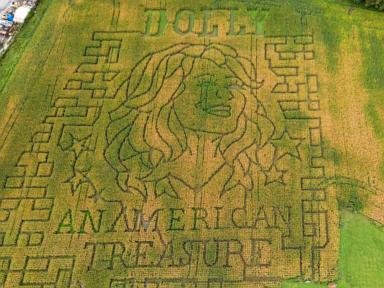
Every autumn, media outlets run the exact same cozy human interest story. A local farmer spends weeks mapping GPS coordinates onto a muddy patch of dirt, carving the likenesses of pop culture icons into towering stalks of maize. This year, twenty different farms across North America debuted massive labyrinths shaped like Dolly Parton. Local news anchors smile warmly. Families buy tickets, wander through dead ends, answer trivia questions about country music hits, and purchase overpriced cider donuts.
The mainstream narrative paints this as a wholesome marriage between rural tradition and pop culture reverence. We are told it honors a beloved cultural treasure while injecting much-needed revenue into small-town operations. It feels warm. It feels safe.
It is also an economic illusion masking a profound structural rot.
Strip away the feel-good sentimentality and the charitable ties to children's book foundations, and what you are actually witnessing is a desperate pivot. Independent farms are no longer viable entities producing commodities for a functioning market. They have been forced to transform themselves into seasonal theme parks, monetizing foot traffic and nostalgia because growing actual crops no longer pays the bills. When a family farm has to carve a country music legend's hairstyle into a cornfield just to survive the fourth quarter, the agricultural model is not thriving. It is on life support.
For decades, the standard advice given to struggling agricultural operators has been to diversify. Extension offices and university economists preach agritourism as the ultimate salvation. Add a pumpkin patch, build a petting zoo, erect a haunted house in October, or hire a design firm to map out a celebrity's face into living vegetation. Farmers are told to become entertainment hosts rather than food producers.
This advice sounds pragmatic on paper. In practice, it represents a complete surrender.
Farming is supposed to be about yield, efficiency, and caloric output per acre. When the primary economic driver of a rural enterprise shifts from the harvest of grain to the sale of admission wristbands, parking fees, and branded merchandise, you no longer have a farm. You have a seasonal outdoor theater company with an overgrown weed problem.
The economics of commodity corn tell a brutal story. Input costs for seed, fertilizer, diesel, and heavy machinery have skyrocketed over the past decade, while crop prices remain volatile and heavily suppressed by massive agribusiness conglomerates. A mid-sized independent grower operating a few hundred acres faces razor-thin margins. Often, the crop itself operates at a net loss once debt service on equipment is factored into the ledger.
Enter the entertainment industry model. Companies that specialize in designing these giant mazes do not offer their services for free. They charge hefty licensing and design fees to transform a field into a canvas. The farmer invests thousands of dollars upfront in specialized GPS seed-drop technology, extra insurance, crowd control infrastructure, and expanded parking lots. They are gambling that local families will drive forty minutes out of town, brave the mud, and pay twenty-five dollars a head to walk through a celebrity portrait.
If the weather holds, if the local economy remains flush with disposable income, and if the marketing campaign hits, the farmer might turn a profit for the season. If it rains every weekend in October, the operation goes under. That is not a sustainable business strategy. That is a casino floor with manure on the floorboards.
Consider the physical reality of the corn itself. The varieties planted for these massive public spectacles are rarely optimized for commercial grain yield or livestock feed. They are bred for height, stalk density, and structural integrity so they can withstand thousands of trampling feet and late-autumn winds without collapsing into a flat mess. The ears produced by these plants are often secondary considerations. In many cases, the corn inside the maze is shredded for silage or left to rot after November rolls around, its primary economic utility exhausted the moment the last tourist buys a souvenir mug.
We are burning arable land and agricultural capital to build temporary tourist traps.
The defenders of this trend point to the charitable angle. Many of these seasonal installations are tied to meaningful philanthropic efforts. Portions of the ticket sales support early childhood literacy initiatives, providing books to children across the country. This creates an impenetrable shield against criticism. Who could possibly complain about a project that feeds children's minds while honoring a universally adored philanthropist?
Critiques of the economic model are immediately dismissed as cynical attacks on goodwill. But separating the emotional resonance of a beloved celebrity from the cold mechanics of rural economics is essential if we want to understand why rural communities are collapsing. Philanthropy is not an economic policy. Relying on the death or legacy of a cultural icon to drive weekend foot traffic to a failing acreage does nothing to solve the underlying systemic failures of modern supply chains. It is a temporary sugar rush for an industry suffering from malnutrition.
Let us examine the operational logistics that participants never see. Designing a giant portrait in a field requires precision engineering. The intricacies of a celebrity's facial features—the sweep of the jaw, the curve of a smile, the volume of a signature hairstyle—translate into thousands of individual coordinate points mapped via computer software. Workers must till or spray out specific paths while the corn is knee-high, trusting that the remaining stalks will grow thick enough to obscure the design from the ground while revealing the portrait from an overhead drone shot.
The maintenance alone consumes countless hours of labor during peak harvest season, when farmers should be focusing entirely on bringing in actual grain. Instead, they are acting as parking attendants, crowd-control managers, and amateur theatrical directors. The labor shortage in rural sectors is severe, yet operators are pulling hands away from tractors and combines to manage porta-potties and ticket booths.
This brings us to a fundamental question that mainstream coverage consistently ignores: Why must a food producer become an amusement park operator to stay solvent?
The answer lies in the corporatization of the entire food supply chain. Monopolistic seed suppliers, chemical giants, and grain cartels squeeze producers from both ends. They dictate the price of inputs and manipulate the market price of outputs. Independent growers are caught in a vise. They cannot scale up fast enough to compete with massive corporate farming operations that control tens of thousands of acres through automated industrial efficiency. Nor can they compete on price with subsidized mega-farms.
So they pivot to experiential retail. They sell the rural aesthetic because they can no longer make a living selling the actual harvest of the soil.
The celebrity corn maze is the ultimate manifestation of this aestheticization of rural poverty. Urban and suburban consumers crave a connection to the land, an authentic touch of rustic life before retreating to their climate-controlled offices and digital lives. They want to believe that agriculture still looks like a Norman Rockwell painting—a friendly farmer in overalls, golden fields under a crisp autumn sky, wholesome family fun.
The industry happily obliges by packaging artificial nostalgia and selling it by the ticket-load. The farmer becomes a living prop in a curated simulation of rural simplicity.
If you visit one of these installations, watch the faces of the operators when the crowds finally thin out at dusk. The exhaustion is palpable. They are not smiling because they are living a pastoral dream; they are exhausted because they have spent twelve hours managing traffic snarls, picking up trash left by tourists who treat a farm like an amusement park, and praying that nobody twists an ankle in a gopher hole and triggers a massive liability lawsuit.
The romance vanishes the moment you look at the balance sheet.
What happens when the novelty wears off? Pop culture tributes rely on temporary cultural relevance or sudden public mourning to generate immediate interest. A tribute installation capitalizing on a celebrity's passing creates a massive initial wave of emotional attendance. But cultural memory is fickle. What happens next year when the public moves on to a different trend, a different celebrity, or a different novelty attraction? You cannot re-architect a business model around the shelf life of celebrity nostalgia without facing diminishing returns.
Let us look at the broader macro trends in rural land ownership. When an independent farm becomes dependent on agritourism revenue to service its debt, the land's highest and best use ceases to be food production. It becomes real estate theater. Over time, properties that rely on seasonal tourist gimmicks are more vulnerable to speculative purchase by developers looking to pave over green space for suburban housing tracts or industrial warehouses. By turning the farm into a carnival ground, the operator inadvertently strips away the cultural and economic argument for preserving it as working farmland. If the soil is just a medium for temporary pop-culture art installations and weekend parking lots, society eventually stops caring when concrete replaces the dirt.
Furthermore, consider the psychological toll on generational producers. A person who spent decades learning the intricate science of soil microbiology, crop rotation, weather patterns, and heavy equipment maintenance does not want to spend their October dressed in a flannel shirt telling tourists where the portable restrooms are located. It is a profound indignity disguised as homespun community engagement.
True agricultural resilience requires structural reform, not stunt farming. It requires breaking up corporate monopolies in seeds and distribution, establishing fair baseline prices for staple crops, expanding cooperative processing infrastructure, and supporting direct-to-consumer localized food networks that cut out predatory middlemen.
None of these solutions fit neatly into a local news segment. You cannot film a heartwarming thirty-second clip about antitrust legislation in the fertilizer industry. It is much easier to point a camera at a five-acre portrait of a beloved singer and talk about how wonderful it is that the community is coming together.
Meanwhile, the structural crisis in the countryside deepens. Farm debt is at historic highs. Generational succession is failing because children raised on these properties watch their parents work eighty-hour weeks just to stay afloat by turning their land into a seasonal circus, and they refuse to inherit the burden. The number of working farms continues to decline year over year, replaced by consolidated corporate mega-holdings or suburban sprawl.
We are watching the slow-motion collapse of independent agriculture, and we are decorating the wreckage with pop culture icons.
The next time you see a headline about a massive agricultural portrait carved into living cornstalks, pause for a moment past the initial charm. Look past the clever trivia questions and the photo opportunities. Recognize that you are looking at a distress signal.
Farmers do not carve portraits into their fields because it is a great way to farm. They do it because farming no longer works. Until we fix the underlying economic machinery that drives independent producers into the entertainment business just to pay their property taxes, these whimsical seasonal displays will remain what they truly are: monuments to a dying way of life, dressed up in a costume for tourists to walk through before the harvest season ends and the reality of winter sets in.