The sirens don't stop for the brushstrokes.
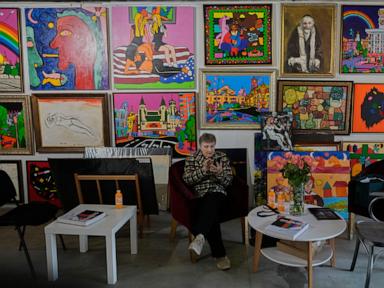
In Kyiv, the air often carries a metallic tang—a mix of spent fuel, old concrete dust, and the sharp, electric scent of ozone that precedes a storm. But inside the cavernous halls of the Mystetskyi Arsenal, the air smells of oil paint and expensive espresso. For a moment, if you squint, the war disappears. You could be in London. You could be in New York. The floorboards creak under the weight of thousands of visitors, their hushed whispers creating a low hum that mimics the sound of a distant hive. For another look, see: this related article.
Then, a phone chirps. A notification from a Telegram channel. A Russian Tu-95 bomber has taken off from an airbase a thousand miles away. The hive doesn't scatter. People glance at their screens, calculate the flight time to the capital, and turn back to a vibrant abstract piece dominated by aggressive streaks of yellow.
This is the Kyiv Art Week, and it is not an escape. It is a counter-offensive. Further coverage on the subject has been provided by NBC News.
Consider Olena. She is a hypothetical composite of the dozens of young professionals I watched navigating the stalls. She wears a structured black blazer and boots that look ready for a hike through rubble, though they’ve only seen the polished floors of a gallery today. Her hands tremble slightly as she holds a brochure. It isn't because she’s afraid of the missiles. It’s because she is looking at a sculpture made of melted shrapnel, and for the first time in three weeks, she is allowing herself to feel something other than tactical numbness.
Art, in a time of genocide, is usually dismissed as a luxury. We are told that when the stomach is empty and the roof is leaking, the soul can wait. We are told that aesthetics are the playthings of the peaceful.
We are told wrong.
The organizers of this fair understand a truth that the invaders do not: you can occupy a city with tanks, but you cannot occupy a culture that refuses to stop creating. When the Russian military targets museums and burns Ukrainian history books, the act of buying a painting becomes a radical gesture of defiance. It is a financial and emotional investment in a future that the enemy says shouldn't exist.
The stakes are invisible but absolute. If the Ukrainian people stop producing art, they concede that they are merely "Little Russians," a provincial subset of an empire. By filling a hall with contemporary, challenging, and avant-garde works, they are shouting their identity into the void.
The numbers back up this desperation for beauty. Despite the decimated economy and the constant threat of power outages, attendance at cultural events in Kyiv has surged. It’s a psychological phenomenon. When your life is measured in the minutes between air raids, the "high-level" concerns of art become strangely grounded. People aren't looking for "pretty" pictures to match their sofas. They are looking for mirrors.
I stood before a series of photographs by a local artist who had documented the interiors of homes in Bucha. These weren't photos of the dead. They were photos of the living rooms—the tea sets, the unmade beds, the dust settling on a child’s piano. The silence in the gallery at that moment was heavier than any explosion. It was the sound of a thousand people recognizing their own fragility.
But why pay for this? Why, when the hryvnia is weak and the winter is coming, would someone spend their savings on a canvas?
The answer lies in the concept of "resilience," a word that has been bleached of its meaning by corporate seminars, but which finds its pulse here. Resilience isn't just surviving; it’s the refusal to be diminished. Buying art in a war zone is a gamble. It is a bet that your walls will still be standing in a year. It is an assertion that you are more than a refugee-in-waiting.
The art itself has changed. Before the full-scale invasion, the Kyiv scene was often preoccupied with the same postmodern ironies that define the West. Now, the irony is gone. There is a new, raw sincerity. It is brutal. It is colorful. It is often terrifying.
Imagine a painter sitting in a studio with boarded-up windows. The power goes out. He lights a candle. He isn't painting the war directly—there are no tanks in his work. Instead, he is painting the light hitting a glass of water. He is obsessing over the exact shade of blue in a summer sky. By focusing on the mundane, he is protecting the sacred. He is refusing to let the war dictate his internal imagery.
This is the "cultural escape" the headlines talk about, but it’s a misnomer. Escape implies running away. These people are running toward themselves.
Critics might argue that the money spent here should go toward drones or medical kits. It’s a fair point, and one that the attendees wrestle with. Almost every gallery at the fair has a QR code prominently displayed, directing a percentage of sales to the armed forces. The market and the military are inextricably linked. You buy a painting to save your soul, and that purchase helps buy the night-vision goggles that save your body.
The logic of the fair is the logic of the trench: hold the line. For the soldier, the line is a strip of dirt in the Donbas. For the civilian in Kyiv, the line is the preservation of a sophisticated, European, and fiercely independent identity. If the theaters go dark and the galleries close, the enemy has already won, regardless of where the border sits.
The tension in the room is palpable when the lights flicker—a common occurrence in a city where the energy grid is a primary target. For a heartbeat, the gallery goes pitch black. Nobody screams. Nobody runs for the exit. There is a collective, weary sigh, and then a hundred iPhones are whipped out. The flashlight beams cut through the darkness, illuminating the art in small, circular bursts of white light.
It is, quite literally, the most beautiful thing I have ever seen.
In those moments, the hierarchy of needs is flipped on its head. The "safety" of the basement feels less important than the "meaning" of the painting. People move closer to the walls, huddled around the glowing screens, discussing the texture of the paint as if the darkness doesn't exist.
The invisible cost of war is the narrowing of the human experience. It turns you into a creature of habit, of fear, of survival. Art expands that experience back out. It reminds you that you are allowed to have opinions on color theory. It reminds you that you are allowed to feel joy that isn't tied to a successful intercepted missile.
As I walked toward the exit, I saw a couple in their sixties. They were dressed in their Sunday best—threadbare but pressed. They were standing in front of a massive installation made of charred wood and silk. They weren't buying; they couldn't afford to. But they were arguing, passionately, about whether the silk represented hope or the frailty of the state.
They were alive.
Beyond the thick walls of the Arsenal, the city of Kyiv stretched out, scarred and defiant. The streetlights were dim to save power, and the checkpoints were manned by tired men with Kalashnikovs. The war was still there, waiting. It would be there tomorrow, and the day after that.
But inside, for the price of a ticket and the courage to look, the war had lost its power to define the people. They were not victims. They were not "displaced persons." They were critics. They were dreamers. They were a people who, when faced with the end of their world, decided to pick up a brush and start painting a new one.
The paint was still wet.