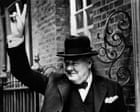
Winston Churchill is public property, but nobody can agree on who owns his legacy. One day he is the bulldog savior of Western civilization who stared down Adolf Hitler. The next, he is a brutal imperialist responsible for the deaths of millions.
The latest battleground is the National Portrait Gallery in London. Turner Prize-winning artist Helen Cammock has found herself in the crosshairs of a furious political row over her new 40-minute video installation, Persistence. In the film, which she narrates, Cammock draws a direct line between Oliver Cromwell’s bloody 17th-century campaigns in Ireland and the 1943 Bengal famine. She explicitly refers to the "wilful starvation of the Indian population by Winston Churchill." Meanwhile, you can find other stories here: Why Canada and Italy Are Rushing to Build a New Fighter Pilot Pipeline.
That single line sparked an immediate, explosive backlash. More than 50 peers, led by prominent Churchill biographer Lord Roberts of Belgravia, fired off a scathing letter to the gallery’s directors. They branded the artwork an "ideologically motivated rant" and accused the artist of spreading a "barefaced lie."
This isn't just a spat between an artist and some angry aristocrats. It is a microcosm of a much larger, messy war over how we handle history in public spaces. To see the full picture, check out the excellent analysis by NPR.
The Art of Starting a Fight
Cammock isn't backing down. She feels the fury misses the entire point of her work. In a blunt statement responding to the outrage, she made it clear that her film isn't meant to be a historical documentary.
"The work thinks about the role of the portrait historically and its relevance today," Cammock argued. "It considers who is honoured and valorised and who is not; whose stories are told and whose are not… and how histories are created and then maintained."
Basically, she wants to talk about curation. Galleries are full of grand oil paintings of powerful white men. For decades, those men were presented without context. Cammock’s video is an attempt to force a conversation about what lies beneath the varnish of those portraits.
The National Portrait Gallery is walking a tightrope. They confirmed receipt of the protest letter but noted they haven't received a single complaint from regular visitors. The institution is hiding behind the standard defense of artistic license, stating they support freedom of expression without necessarily endorsing the views of the artists they display. It's a safe corporate position, but it doesn't quiet the noise.
The Brutal Reality of Bengal in 1943
To understand why people get so incredibly angry about this, you have to look at what actually happened in India during World War II. The Bengal famine was a catastrophe. An estimated three million people died of starvation and disease in eastern India.
The historical debate isn't about whether people suffered; it's about who holds the smoking gun.
Churchill apologists and right-leaning publications argue that the famine was a perfect storm of wartime misery. They point to natural disasters, crop failures, local administrative corruption, and the fact that the Japanese military had just captured Burma, cutting off crucial rice imports. From this perspective, calling it "wilful starvation" is factually wrong and politically malicious.
But a growing body of serious historians argues a very different case. They don't claim Churchill deliberately set out to kill Indians for fun. They argue that his ruthless wartime priorities, combined with deep-seated racial prejudice, caused him to ignore a mounting humanitarian disaster.
What the Archives Actually Show
When you look at the evidence, the picture gets incredibly dark. In 1942, anticipating a Japanese invasion, the British administration ordered a "denial policy" in Bengal. They confiscated boats and stockpiled massive amounts of rice to keep them out of enemy hands. This shattered the local economy and destroyed the food distribution network right before the famine hit.
When the crisis escalated in 1943, officials in India pleaded with London for food shipments. Churchill repeatedly refused them. He was obsessed with stockpiling grain for European civilians and military reserves for the post-war era.
- Shipping shortfalls: Churchill’s government cut the number of ships allocated to the Indian Ocean, making it nearly impossible to move grain to where people were dying.
- The racist rhetoric: Churchill's personal prejudices are well-documented in the diaries of his contemporaries. He famously blamed Indians for the famine, grumbling to his Secretary of State for India, Leo Amery, that they were "breeding like rabbits."
- The contrast: While millions starved in Bengal, Canada offered to send hundreds of thousands of tons of wheat to India. Churchill’s government turned the offer down, claiming there weren't enough ships to transport it. Yet, at that exact moment, British merchant ships were carrying grain across the Atlantic to build up massive surpluses in the UK.
Relief efforts finally began at the tail end of 1943 when Field Marshal Archibald Wavell took over as Viceroy of India and used the military to distribute food. By then, the ground was already covered in corpses.
The Battle to Silence the Gallery
Several artists speaking out anonymously have called this furious pushback an attempt to censor cultural institutions. They see it as a coordinated right-wing effort to dictate what kind of art can be shown in public.
It's a pattern we keep seeing. Whenever an artist or a museum tries to re-examine British imperial history, the response is swift and furious. Critics claim these institutions are being hijacked by left-wing ideology. But history isn't static. The job of a museum isn't just to act as a shrine to national myths; it's to challenge how we look at the past.
Cammock’s language in Persistence is provocative. Comparing Churchill to Cromwell—a man who oversaw actual massacres in Ireland—is a heavy, aggressive choice. But art is allowed to be provocative. It doesn't need to meet the peer-reviewed standards of a university press to earn a space on a gallery wall.
How to Read History without Blinders
If you want to understand this debate without getting sucked into the culture-war shouting match, you need to accept a difficult truth. Churchill can be two things at the same time. He was a brilliant, indispensable wartime leader who saved Europe from fascism. He was also a hardline imperialist whose policies contributed to a horrific colonial famine.
True historical literacy means holding both of those facts in your head at once.
If you want to explore this history for yourself instead of just relying on angry headlines, do some real reading. Look into the work of Madhusree Mukerjee, whose book Churchill's Secret War blows open the economic policies behind the famine. Balance that with standard political biographies like those by Roy Jenkins or Max Hastings to understand the brutal pressures of the global war effort in 1943.
Go see Cammock’s video at the National Portrait Gallery if you're in London before it closes in August. Don't look at it as an absolute history textbook. Look at it as an argument. Decide for yourself if the artist's challenge to the status quo holds water, or if the critics have a point about the limits of artistic exaggeration. Just don't let the outrage machine do the thinking for you.