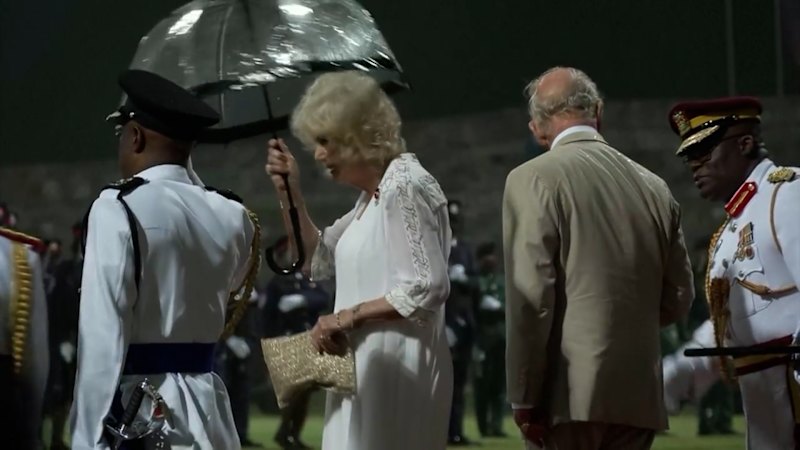
The British press loves a micro-expression. Give a tabloid editor three seconds of telephoto footage, a drizzle over London, and a monarch checking his watch, and you get an instant headline about royal petulance.
They got it backward.
When the media frames King Charles standing in the rain as a moment of fragile, out-of-touch irritation, they are peddling the laziest consensus in modern celebrity journalism. They treat a thousand-year-old constitutional institution like a reality television cast. They look for soap opera drama because soap opera drama sells clicks, ignoring the actual mechanics of royal protocol, security logistics, and what happens when a seventy-something head of state is forced to absorb the operational failures of his own staff in full view of forty global broadcast feeds.
The Anatomy of a Manufactured Royal Tantrum
Let's strip away the tabloid theater and look at the actual physics of a royal engagement.
A state appearance is not a casual stroll. It is a tightly choreographed military-grade operation governed by strict timing windows, diplomatic clearances, and advance security sweeps. Every sixty-second delay at a ceremonial drop-off ripples backward through local police cordons, road closures, and diplomatic motorcades. When a monarch steps out of a Bentley and the host party, the umbrella bearer, or the ceremonial greeter isn't standing on their designated chalk mark, the problem isn't that the King is getting his bespoke Savile Row wool damp. The problem is that the advance team broke the chain of custody on time.
I have watched dozens of high-level diplomatic arrivals and state visits unfold from behind the press pens. When a principal—whether a prime minister, a CEO, or a monarch—flashes a tight jaw or a clipped gesture on a wet tarmac, they aren't throwing a fit over weather. They are signaling to their equerry or chief of staff that the schedule has just slipped and someone down the line missed a cue.
Media commentators love to project emotional fragility onto these moments. They see a grimace and write five hundred words about royal entitlement. In reality, you are watching an executive react to a logistical breakdown while trapped inside a ceremonial straightjacket where he isn't allowed to speak openly, check a phone, or walk away.
The Myth of the Effortless Monarch
The public has been conditioned by seventy years of Queen Elizabeth II's stoic, near-robotic public stillness to believe that any visible human friction from the throne is a character flaw.
That comparison is flawed at its foundation. Queen Elizabeth ascended the throne in 1952, an era before continuous high-definition zoom lenses, directional parabolic microphones, and social media lip-readers dissected every blink. Her reign built a public expectation that a monarch should function like a living statue—pleasant, unbothered, and entirely detached from physical discomfort or scheduling friction.
King Charles inherited the exact same rigid ceremonial architecture in an era of relentless, unforgiving surveillance.
Consider the sheer absurdity of the physical constraints placed on him during an outdoor engagement:
- Zero autonomy over movement: He cannot simply step under an awning without disrupting the camera sightlines agreed upon weeks in advance by the Royal Rota.
- Strict wardrobe protocols: Heavy ceremonial overcoats and tailored suits are designed for visual authority, not breathable weather protection, yet holding his own umbrella often blocks his face from the very photographers paid to document the event.
- Continuous public performance: Even when soaking wet, he must maintain eye contact, shake dozens of hands, and deliver small talk while an aide scrambles behind him to fix a botched arrival sequence.
Imagine a scenario where you are seventy-five years old, recovering from major medical treatment, dressed in heavy wool, and standing on a windswept tarmac while three layers of middle management fail to coordinate a simple doorway handoff—all while forty lenses zoom in on your nostrils to see if you sigh. Calling that "irritation" isn't insight. It is a failure of basic observation.
What the Press Gets Wrong About Royal Protocol
To understand why these moments happen, you have to understand the friction between Palace Protocol and Modern Media Optics.
Palace protocol prioritizes hierarchy, sequence, and ceremonial order. Modern media optics prioritize relatability, humility, and effortless cool. Those two systems are fundamentally incompatible.
When a staffer fumbles an umbrella or leaves the King waiting at a threshold, the media wants Charles to laugh it off like a breezy podcast host. But constitutional monarchy does not run on casual charm; it runs on precision. As constitutional historians like Peter Hennessy and Robert Lacey have documented for decades, the British Crown survives because it projects continuity and order when political systems look chaotic. When the machinery visibly stalls in the rain, the monarch's frustration isn't about personal comfort—it is an acute awareness that the institution looks disorganized.
Here is the nuance the tabloids miss: Charles is notoriously obsessive about punctuality and preparation. Long before his accession, aides at Clarence House noted that he worked late into the night annotating briefing papers and expected the same rigor from everyone on the payroll. When he visibly bristles during a public mishap, you are seeing a lifelong perfectionist watching amateurs drop the ball on his watch.
Dismantling the "Out of Touch" Narrative
Whenever footage like this circulates, the same predictable questions flood search engines and comment sections. Let's address them directly without the usual PR spin.
Is King Charles actually impatient with his staff?
Yes, by almost every credible biographical account—from Jonathan Dimbleby to Sally Bedell Smith—Charles can be demanding, fastidious, and sharply impatient when basic logistics fail. Pretending he is a saintly pushover insults the reader's intelligence. However, conflating professional impatience over a botched schedule with personal arrogance over getting wet is a deliberate distortion. High-stakes principals demand competence because incompetence wastes public money and embarrasses the office.
Why didn't he just hold his own umbrella?
Because protocol and press coverage actively punish him when he does. When a monarch holds a large golf umbrella, it casts a dark shadow across his face, ruining photographs for the press pool, and creates an awkward barrier when greeting crowds or shaking hands. That is precisely why equerries and protection officers exist—to manage the physical environment so the principal can perform the diplomatic function. When the aide is late, the system fails, not the individual.
Does visible frustration hurt the monarchy's image?
Only in the twenty-four-hour tabloid cycle. In the long run, the bigger threat to the Crown isn't a king looking annoyed in a downpour; it is the Crown looking irrelevant or sloppy. Voters and taxpayers tolerate the immense expense of royal pageantry because they expect flawless execution. A monarch who demands that standard from his team is doing his job, even if the cameras catch the unvarnished edges of it.
The Downside of the Perfectionist Crown
Even if we reject the tabloid caricature of a spoiled royal throwing a fit, there is a genuine strategic flaw in how Charles handles these moments—and pretending otherwise would be dishonest.
Transparency in the digital age cuts both ways. By letting his exasperation register so visibly on camera, Charles hands his critics free ammunition. In an attention economy driven by three-second looping clips on X and TikTok, nuance dies instantly. Nobody watching a silent, muted video clip on their phone during a morning commute stops to analyze advance security logistics or royal rota sightlines. They just see a wealthy man scowling in the rain while someone holds an umbrella over him.
His mother understood one brutal truth about modern mass media that Charles still struggles to internalize: the camera does not record context; it only records posture. The moment you let your face show the stress of the machinery behind you, you lose control of the narrative.
Stop Reading Royal Body Language Like a Tabloid
If you actually want to understand what is happening inside Buckingham Palace, stop watching the weather and start watching the operations.
- Ignore the lip-readers and body-language "experts." They are entertainment commentators retrofitting drama onto low-resolution video. Unless you know the exact run-of-show for that engagement, you cannot tell whether a grimace is directed at a raincloud, a late dignitary, or a botched security clearance.
- Follow the staffing changes, not the scowls. Real royal discontent doesn't show up in a five-second clip on a wet pavement. It shows up six weeks later when a deputy private secretary quietly leaves their post or an advance team gets reshuffled before a foreign tour.
- Separate the human from the office. A seventy-something man standing in freezing rain while managing a grueling public schedule has every physiological right to look uncomfortable. Treating basic human irritation as a constitutional crisis says far more about media boredom than it does about royal character.
The British press wants you to believe that a few raindrops exposed a fragile, irritable monarch. Look closer at the footage and you will see something far simpler: an aging executive trapped in a rigid ceremonial machine, surrounded by staff who missed their mark, paying the PR price for someone else's mistake.
The rain wasn't the problem. The people running the schedule were.