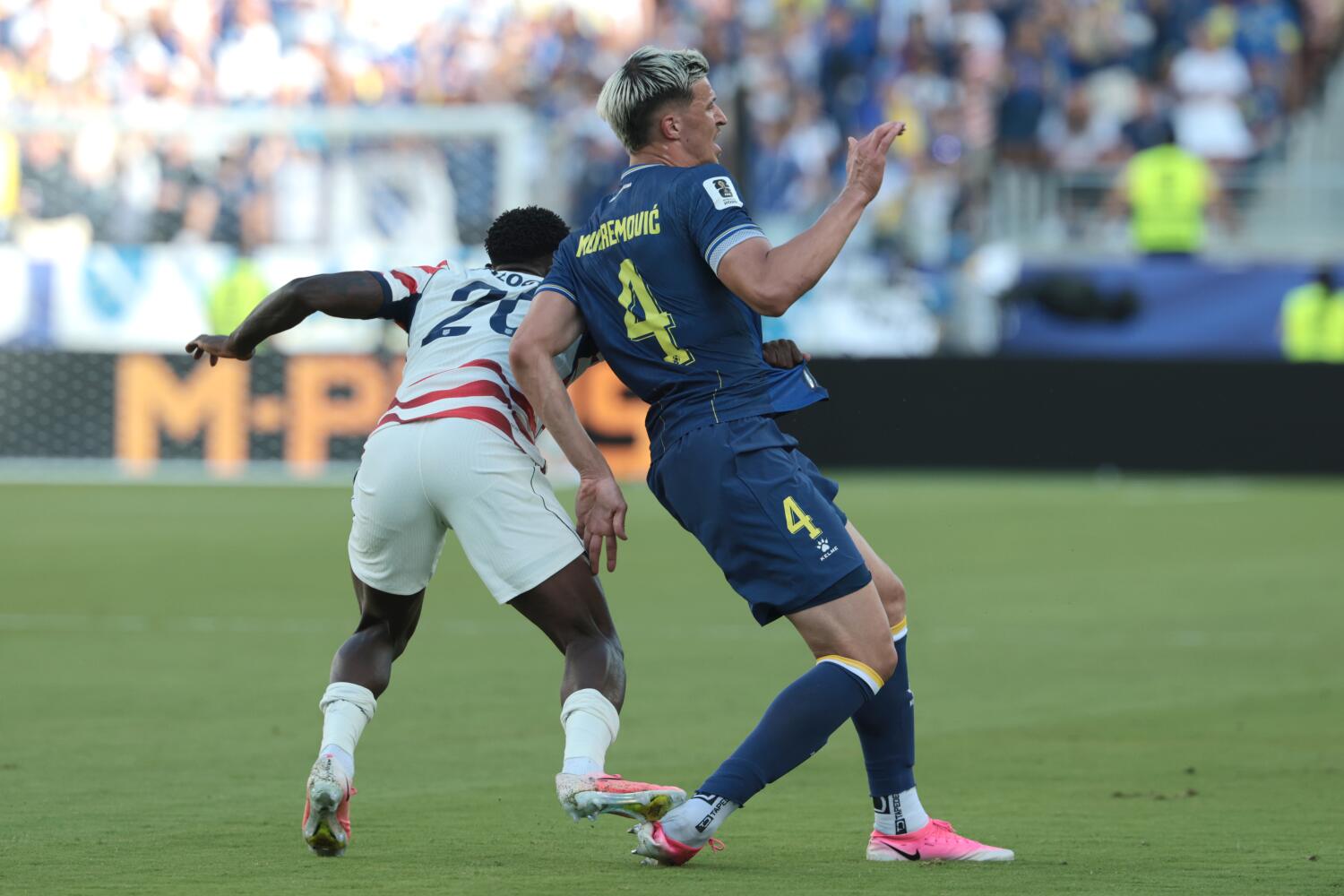
The celebration inside the locker room in Santa Clara had barely started before the legal reality set in. While fans across the country cheered a historic victory over Bosnia and Herzegovina, the leadership of U.S. Soccer was already looking at a closed door. Folarin Balogun is out of the Round of 16 match against Belgium. There is no loophole. There is no mechanism for an appeal. The United States men’s national soccer team will play its most critical match in a generation without its leading striker, handcuffed by a regulatory framework designed to be completely absolute.
U.S. Soccer confirmed the finality of the suspension almost immediately after the final whistle. The federation had explored every possible option within minutes of the red card being shown in the 64th minute. The response from Zurich was instantaneous and unyielding. Under the current governing framework of global soccer, subjective decisions made by the on-field official and verified by the Video Assistant Referee cannot be reviewed, changed, or overturned by a member association. The American team must face the reality of a system that favors bureaucratic finality over situational fairness.
The Bureaucratic Wall Facing U.S. Soccer
The rule itself is simple. FIFA Disciplinary Code Article 9, Section 6 explicitly outlines that no protests may be made against the referee’s decisions regarding facts connected with play. These decisions are legally binding from the second the whistle blows. The system makes a clear distinction between a factual error, such as a referee misidentifying a player and giving a card to the wrong person, and a subjective assessment of a foul. Balogun’s challenge fell squarely into the subjective category.
The incident itself looked worse in slow motion. Balogun went in to challenge Bosnian defender Tarik Muharemovic for a loose ball near the edge of the penalty area. As the striker fell forward, his trailing right foot came down awkwardly onto the ankle and calf of the defender. On-field referee Raphael Claus originally let play continue, seeing it as a standard, high-intensity collision. The intervention from the replay booth changed everything. Once an incident is slowed down to a single frame on a pitchside monitor, an accidental step looks like a deliberate act of violence.
Claus upgraded the challenge to a straight red card for serious foul play. This specific designation triggers an automatic one-match ban under Article 10 of the regulations. The federation is allowed to submit documentation only if FIFA decides to extend the suspension beyond a single game. For the automatic one-game ban, the door is locked. U.S. Soccer has no legal standing to even present a case to the Disciplinary Committee.
Inside FIFA Disciplinary Code Article 9
The absolute nature of this rule exists to protect the authority of the officials on the pitch. If every member association could appeal a subjective red card, the tournament would devolve into a continuous legal battle off the field. FIFA values the immediate progression of the tournament calendar above all else. A single-elimination tournament moves too quickly to allow for a comprehensive appellate process between rounds.
This creates a system where intent is completely removed from the equation. Replay officials look at the point of contact rather than the mechanics of the human body during a fall. Former elite officials have noted that Balogun’s challenge lacked the velocity and malice traditionally required to meet the threshold of a red card. It was a step-and-action motion, a natural consequence of a player losing his balance while attempting to shield the ball. The video review system focused entirely on the consequence of the contact, which showed the Bosnian player’s ankle twisting under the weight.
The international sporting community has debated this specific lack of nuance for years. By removing the ability to appeal clear mistakes of subjective judgment, the system forces teams to suffer the consequences of automated officiating. The rule treats an accidental collision with the same severity as an intentional stamp. The United States is now the latest nation to find out that logic matters very little when compared to the strict wording of the tournament manual.
The Flaw in the System
The introduction of video review was supposed to eliminate clear and obvious errors. Instead, it has introduced a new layer of microscopic scrutiny that alters the nature of the sport. When an official reviews a clip at ten percent of its actual speed, the natural momentum of football is lost. Every contact looks malicious. Every trailing leg looks like a calculated attempt to injure an opponent.
This creates a significant disconnect between the players on the field and the officials in the booth. Mauricio Pochettino expressed his frustration after the match, pointing out that anyone who has played the sport understands that Balogun had no alternative place to put his foot. The striker was tracking the ball, his eyes were focused upward, and his body was adjusting to a heavy challenge from behind. He was falling. The laws of physics dictated his descent, but the laws of the game punished the result.
The current system provides no safety valve for these specific scenarios. A team can lose its most valuable asset because of a structural limitation in how rules are written and enforced. The lack of an independent review panel during a major tournament means that a single mistake by a video official can permanently alter the competitive balance of the knockout rounds.
Mauricio Pochettino Tactical Dilemma
The tactical fallout for the United States is severe. Balogun had been the focal point of the American attack throughout the group stage and the opening knockout round, scoring three goals and providing a consistent outlet against deep defensive lines. His ability to run the channels and hold up possession allowed players like Christian Pulisic and Malik Tillman to operate in space. That dynamic is now gone.
Pochettino faces the most defining decision of his early tenure. The choice of how to replace Balogun will dictate the entire approach against Belgium. The management team has two distinct options available within the current squad structure, each requiring a fundamentally different tactical plan.
The first option is Ricardo Pepi. The forward offers a similar profile in terms of fox-in-the-box positioning, but he lacks the raw recovery speed that Balogun utilizes to stretch opposing center-backs. Pepi is an efficient finisher when provided with service inside the eighteen-yard box, but he requires the midfield to carry the ball deep into the attacking third. If Pepi starts, the United States will likely have to play a more patient, possession-oriented game, building through the wings rather than relying on direct counter-attacks.
The second alternative is Haji Wright. The physical presence of Wright offers a completely different set of advantages. He is capable of battling physical central defenders and can operate out wide if Pochettino decides to shift the structural alignment of the front three. Wright provides the defensive work rate needed to press from the front, a critical component when facing an experienced Belgian midfield. Choosing Wright would signal a desire to play a more physical, direct style, turning the match into a battle of second balls and transitions.
The absence of Balogun also puts an immense burden on the midfield trio. Tyler Adams and Weston McKennie will no longer have the luxury of playing direct balls over the top to relieve pressure. Every transition will have to be precise. The Belgian coaching staff will undoubtedly adjust their defensive line, pushing higher up the pitch knowing that the United States lacks the specific vertical threat that Balogun provided. The American team won a historic knockout match on Wednesday night, but the administrative framework of the sport has ensured that the path to the quarterfinals will have to be cleared without their best weapon.