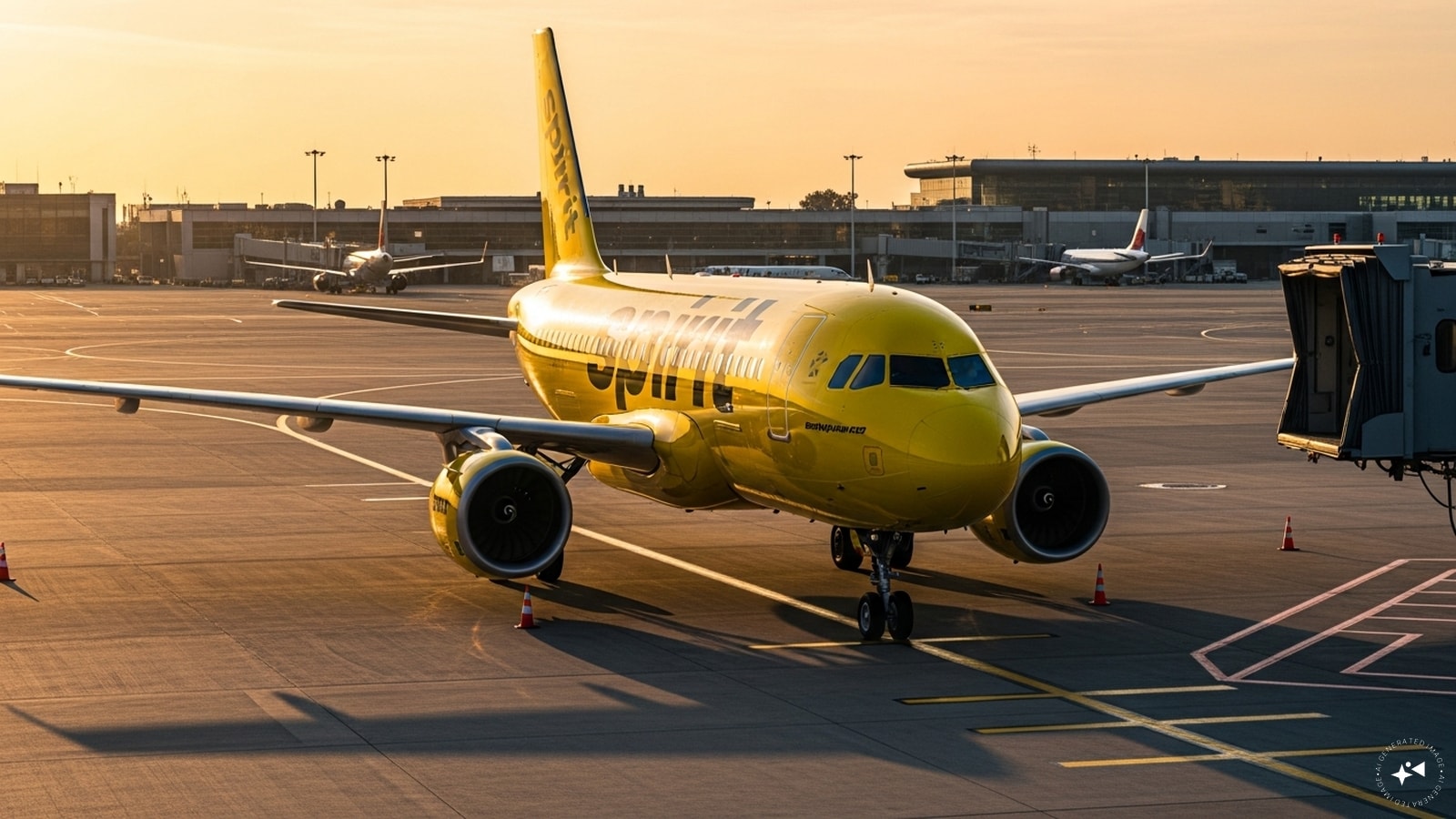
Spirit Airlines is staring into a financial abyss that no amount of cut-rate ticket sales can bridge. While the public narrative centers on a desperate hope for a government-led rescue or a miraculous merger, the cold reality on the balance sheet suggests the yellow-tailed carrier is already technically a ghost. For months, the airline has bled cash while its debt obligations ballooned, creating a mathematical trap that rarely ends in anything other than a Chapter 11 filing—or a total liquidation.
The immediate crisis is driven by a crushing $1.1 billion debt load due within the next year, coupled with a fundamental breakdown of the low-cost carrier business model. Spirit’s stock has shed the vast majority of its value, leaving it with almost no equity to use as a lifeline. Passengers might still be booking flights to Fort Lauderdale and Las Vegas, but the money they pay for those seats is being swallowed by operational costs and interest payments before the wheels even leave the tarmac. For a more detailed analysis into similar topics, we recommend: this related article.
The Mirage of the Federal Lifeline
There is a persistent whisper in the travel industry that the Department of Transportation or the Treasury might step in to save Spirit to "preserve competition." This is a fantasy. The political appetite for airline bailouts vanished the moment the CARES Act funds were fully dispersed. Unlike the 2020 pandemic era, where the entire industry faced an external existential threat, Spirit’s current predicament is viewed by Washington as a self-inflicted wound born of poor strategic planning and a failed merger attempt with JetBlue.
Regulators actually worked against Spirit’s survival by blocking that merger on antitrust grounds. It is a grim irony. The government argued that allowing JetBlue to buy Spirit would harm the budget traveler, yet by winning that court case, they effectively signed a death warrant for the very "Spirit Effect" they claimed to protect. Now that the merger is dead, the government has no legal or financial mechanism to keep the airline afloat, and it certainly lacks the political will to hand out taxpayer cash to a company that was struggling long before the first judge hammered a gavel. For broader details on this topic, in-depth coverage is available on Financial Times.
A Broken Engine at the Core of the Business
Spirit’s failure isn't just about debt; it’s about a hardware crisis that would have crippled even a well-capitalized airline. The carrier is heavily reliant on the Pratt & Whitney Geared Turbofan (GTF) engines. A significant portion of Spirit's Airbus A320neo fleet has been grounded due to manufacturing defects in these engines, which require lengthy inspections and repairs.
- Grounded Revenue: Every plane sitting in a hangar is a liability that still requires lease payments and maintenance staff.
- Operational Chaos: Forced cancellations and reduced frequencies have driven frustrated travelers toward legacy carriers who have regained their footing.
- Compensation Gaps: While Pratt & Whitney has provided some financial credits to Spirit, these payments do not cover the lost opportunity cost of being unable to fly profitable routes during peak seasons.
When you lose your primary competitive advantage—which for Spirit was high-frequency, high-utilization flying—you lose your ability to stay liquid. The "Ultra Low-Cost Carrier" (ULCC) model only works if planes are in the air 12 to 14 hours a day. When they sit idle, the math fails.
The Transformation of the American Traveler
We are witnessing a structural shift in how people buy flights. The "unbundled" model—where a traveler pays $40 for a seat and then $60 for a carry-on bag—is losing its luster. Major players like Delta, United, and American have effectively cannibalized Spirit's market share by introducing "Basic Economy" tiers. These legacy airlines offer a more reliable network and a perceived higher quality of service for a price that often matches or beats Spirit once all the hidden fees are tallied.
Spirit failed to adapt to this "premiumization" of the domestic market. While even Frontier attempted to pivot by introducing more transparent pricing and "stretch" seating, Spirit remained stuck in a reputational rut. They became the punchline of late-night talk show monologues, a branding disaster that made it impossible to attract the higher-margin business travelers or even the savvy "bleisure" flyers who now dominate the skies.
The Bankruptcy Clock is Ticking
The conversation has moved beyond "if" to "how." A bankruptcy filing for Spirit wouldn't necessarily mean the planes stop flying tomorrow. A Chapter 11 reorganization would allow the airline to shed its debt, reject expensive aircraft leases, and attempt to emerge as a leaner, perhaps even more expensive, version of itself. However, the path to a successful reorganization is narrow.
Bondholders are already circling. Those who hold Spirit's debt are looking at the airline's assets—mostly its takeoff and landing slots at crowded airports and its pilot seniority lists—and wondering if the company is worth more dead than alive. In a liquidation scenario (Chapter 7), those slots would be auctioned off to the highest bidder. United or Southwest would likely pay a premium to grab Spirit’s footprint in places like Orlando or Los Angeles, effectively erasing the "Spirit" brand from the map forever.
The Creditor Standoff
The most dangerous players in this drama are the loyalty program lenders. Like many modern airlines, Spirit used its frequent flyer program as collateral for loans. If the airline misses a payment, these creditors could technically seize the intellectual property of the loyalty program, leaving the airline without its most valuable intangible asset. This is the "nuclear option" in airline finance, and it is currently being discussed in boardrooms from New York to London.
Why Investors Should Not Wait for a Miracle
For those holding Spirit stock or speculating on a recovery, the historical precedent is bleak. In the history of American aviation, very few airlines have successfully navigated the "death spiral" Spirit is currently in without wiping out equity holders entirely. Even if the airline survives in some form, the current shares will likely be canceled and rendered worthless as part of a restructuring agreement.
The market has already priced in a catastrophe. The yields on Spirit’s distressed debt are trading at levels that suggest a default is a statistical certainty. Professional traders aren't looking for a turnaround; they are betting on the recovery value of the airframes and the scrap value of the gates.
The Impending Vacuum in the Budget Market
If Spirit disappears, the immediate result will be a spike in airfares on the routes they currently dominate. This is the "hidden tax" of the airline's collapse. When a low-cost carrier exits a market, the remaining legacy airlines no longer feel the pressure to keep their Basic Economy prices floor-level.
Travelers in "Fortress Hubs" like Atlanta or Detroit, where Spirit provided the only real price competition, will see the most pain. This isn't just a business story; it’s a consumer crisis that will hit the pockets of the exact demographic the government claimed it was protecting when it blocked the JetBlue deal. The irony is thick enough to choke a jet intake.
The Technical Reality of Liquidation
Liquidating an airline is a logistical nightmare that involves returning hundreds of leased aircraft to various global banks. This process often takes years, but the impact on the industry is felt within weeks. We should look at the 1991 collapse of Pan Am or the more recent demise of Thomas Cook in the UK. The sudden removal of capacity creates a vacuum that competitors are all too happy to fill—at a much higher price point.
Spirit's management team is currently in a "extend and pretend" phase, trying to push out debt maturities just long enough to see if the engine issues get resolved or if a private equity firm with a high risk tolerance emerges. But private equity wants a path to profitability, and Spirit hasn't seen a profitable quarter in years. The numbers don't lie, even if the press releases do.
The Final Descent
The window for a "soft landing" has slammed shut. Spirit is currently flying on fumes, kept aloft only by the slow pace of legal proceedings and the reluctance of creditors to pull the trigger during a busy travel season. But the fall travel lull is approaching, and that is traditionally when the industry's weakest players finally hit the ground.
Expect the announcement to come late on a Friday night or over a holiday weekend. That is the standard operating procedure for an industry that wants to bury the lead. When it happens, it won't be a surprise to anyone who has been watching the cash flow statements instead of the stock tickers. The yellow planes are running out of sky.
Go to the airport, look at the Spirit counter, and see the long lines of people looking for a bargain. They are participating in the final act of a business model that was built for a different era of fuel prices, interest rates, and consumer expectations. The "Spirit" of low-cost travel is being priced out of existence, and no one is coming to save it.