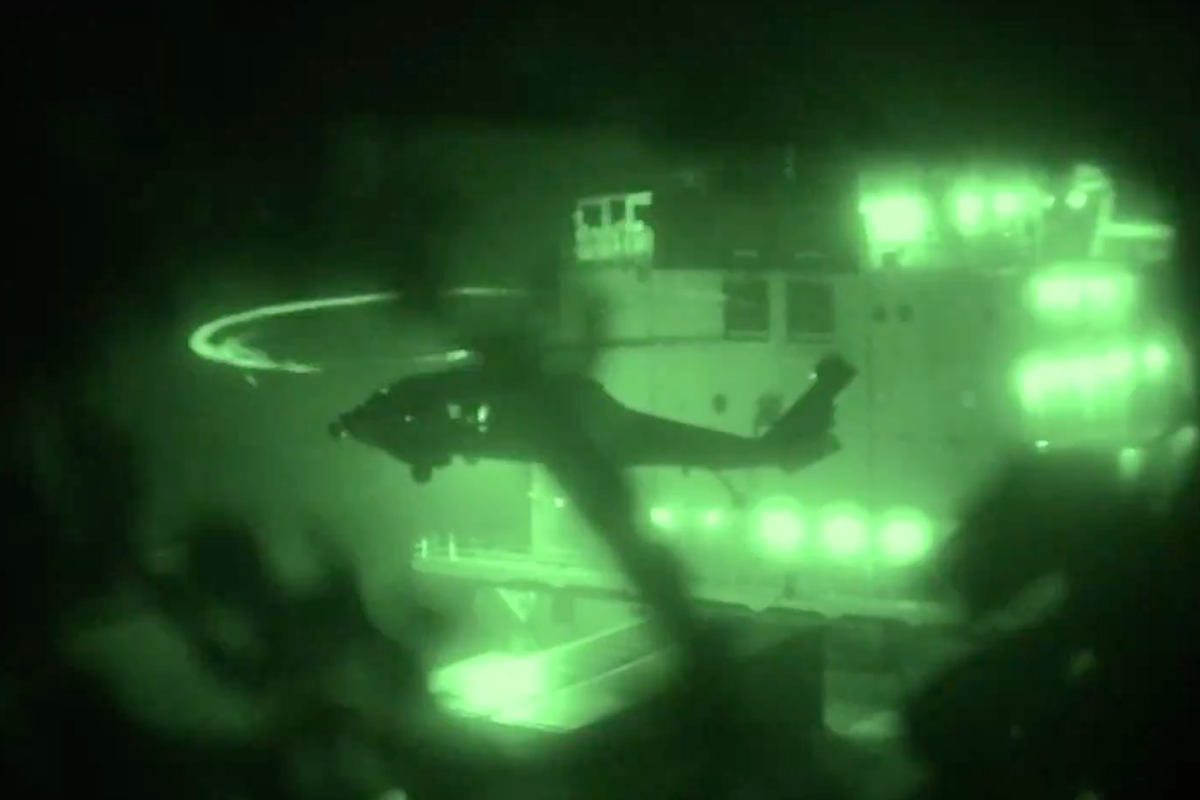
The recent footage of US Marines fast-roping onto an Iranian-flagged vessel in the Gulf of Oman is more than a display of tactical proficiency. It is a calculated move in a high-stakes chess match over global energy security. When US forces board a ship in these contested waters, they aren't just seizing illicit cargo or enforcing sanctions; they are projecting a specific type of maritime power designed to stabilize a region that teeters on the edge of chaos. The Gulf of Oman serves as the primary artery for the world’s oil supply, and any disruption there has immediate, painful consequences for global markets.
This operation represents the sharp end of a broader strategy to counter maritime aggression and smuggling. The "how" of these missions involves elite units like the Maritime Raid Force, utilizing specialized training to secure vessels that are often actively resisting or attempting to flee into territorial waters. The "why" is rooted in a decades-old doctrine of ensuring the "freedom of navigation," a principle that allows the global economy to function without being held hostage by regional actors.
The Mechanics of a High Seas Takedown
A boarding operation begins long before the first boot hits the deck. It starts with intelligence. Sensors, satellite imagery, and human intelligence networks track vessels of interest as they move through the Persian Gulf and into the Arabian Sea. When a target is identified as carrying prohibited goods—whether that be weapons destined for conflict zones or oil sold in defiance of international law—the decision to intervene is made at the highest levels of military command.
The actual boarding is a masterpiece of synchronized violence and precision. Stealth is rarely an option once the helicopters arrive. Instead, the goal is overwhelming speed. By the time the crew of the target vessel realizes they are being boarded, the Marines have already secured the bridge and the engine room. This rapid dominance is essential because it prevents the crew from scuttling the ship or destroying evidence.
Every second matters. In many cases, these vessels are "stateless" or flying "flags of convenience," which creates a legal minefield. The Marines must document every step of the process to ensure that the seizure holds up under international scrutiny. It is a grueling, dangerous job that takes place in temperatures that often exceed 100 degrees Fahrenheit, amidst the constant threat of booby traps or armed resistance from the ship's security detail.
Why Diplomacy Fails at Sea
Critics often argue that these aggressive interdictions escalate tensions rather than resolving them. They suggest that diplomatic channels should be exhausted before sending in the military. However, the reality on the water is far less civil. In the Gulf of Oman, diplomacy is often seen as a sign of weakness by those who profit from illicit trade. When a rogue state uses commercial shipping to fund its operations, they aren't looking for a seat at the negotiating table; they are looking for a payday.
Economic sanctions are only as effective as their enforcement. If the US and its allies allow sanctioned goods to flow freely through the Strait of Hormuz, the entire logic of non-kinetic pressure collapses. This turns the Gulf of Oman into a proving ground for international resolve. By physically stopping these ships, the US sends a message that the cost of defiance outweighs the potential profit. It is a blunt instrument, but in the absence of a functional international policing body with actual teeth, it is the only instrument that works.
The counter-argument is that these actions provide a pretext for retaliation. We have seen this cycle repeat: a seizure occurs, and shortly after, a Western-linked tanker is harassed or detained in a "tit-for-tat" maneuver. This cycle creates a volatile environment for commercial shipping companies, who must weigh the risk of seizure against the rising costs of insurance and private security.
The Shadow Fleet Problem
One of the most significant factors driving these confrontations is the rise of the "shadow fleet." This is a collection of aging, poorly maintained tankers that operate outside the traditional maritime regulatory framework. These ships often turn off their AIS (Automatic Identification System) transponders to "go dark," making them difficult to track. They engage in ship-to-ship transfers in the middle of the night, moving millions of barrels of oil to hide its origin.
The shadow fleet isn't just an economic problem; it's an environmental time bomb. These vessels are frequently under-insured and lack the safety standards required by reputable shipping lanes. A single collision or mechanical failure in the Gulf of Oman could lead to an ecological disaster that would shut down the region's desalination plants and cripple the local fishing industry.
When the US Marines board these ships, they are often stepping onto "rust buckets" that are barely seaworthy. The danger isn't just from the opposing crew; it's from the ship itself. This adds a layer of complexity to the mission that is rarely captured in the flashy video clips released to the press. The goal is to stop the flow of money, but the secondary benefit is removing these hazardous vessels from the water before they can cause a catastrophe.
Regional Alliances and the Burden of Policing
The United States is increasingly looking to its regional partners to take a larger role in maritime security. Organizations like the Combined Maritime Forces (CMF) aim to bring together dozens of nations to patrol these waters. However, the political reality is that many regional powers are hesitant to openly confront their neighbors. They prefer to operate in the background, providing intelligence or logistics while letting the US Navy and Marine Corps take the lead on the actual interdictions.
This creates a lopsided burden. While the US provides the hardware and the specialized personnel, the benefits of a stable Gulf are shared by the entire world. China, for instance, is the largest importer of Persian Gulf oil, yet it rarely participates in the security operations that keep those lanes open. This imbalance is a growing point of contention in Washington, where policymakers are questioning how long the US can afford to be the world's sole maritime guarantor.
The shift toward a "multipolar" world means that these naval operations are becoming more complicated. The presence of Russian or Chinese warships in the vicinity adds a layer of geopolitical risk to every boarding. A simple seizure of a smuggling vessel could, in theory, spark a direct confrontation between major powers if mismanaged. This is why the rules of engagement are so strictly defined and why the personnel involved are among the most highly trained in the military.
The Legal Grey Zone of Maritime Law
International law regarding the seizure of ships on the high seas is famously murky. The UN Convention on the Law of the Sea (UNCLOS) provides some guidelines, but interpretations vary wildly. Most boarding operations are justified under the right of "visit and search" if there are reasonable grounds to suspect piracy, slave trade, or unauthorized broadcasting. In the context of the Gulf of Oman, the justification usually falls under specific UN Security Council resolutions or the "right of self-defense" against state-sponsored threats.
The legal battle often lasts much longer than the physical one. Once a ship is brought into port, a mountain of paperwork follows. Lawyers from multiple countries get involved, disputing the legality of the boarding, the ownership of the cargo, and the jurisdiction of the courts. In some cases, the ships and their crews are held for months or even years as these cases wind through the system.
This legal friction is a deliberate tactic used by those who engage in illicit trade. They know that if they can make the process difficult and expensive enough, they might deter future interdictions. This is why the US military places such a high premium on "battlefield forensics." They aren't just seizing a ship; they are building a legal case that can stand up in an international forum.
The Human Element on the Deck
Behind the tactical gear and the high-tech weapons are individuals making split-second decisions in high-pressure environments. When a Marine jumps onto the deck of a moving ship, they don't know if they will find a cooperative crew of merchant sailors or a group of armed militants ready to fight to the death. The psychological toll of this type of work is immense.
The sailors on the target vessels are often caught in the middle. Many are from developing nations, working for meager wages on ships owned by shell companies they have never heard of. They are pawns in a global game of shadow boxing, often unaware of the illegal nature of their cargo until the helicopters appear overhead. Treating these crews with dignity while maintaining total control of the ship is a delicate balancing act that requires maturity and discipline.
The Cost of Inaction
What happens if the US stops these operations? The most immediate result would be a surge in the price of oil. Markets hate uncertainty, and the knowledge that the Gulf of Oman is a "wild west" where anything goes would lead to a massive spike in insurance premiums for all commercial shipping. This cost would be passed directly to consumers at the pump.
Beyond the economics, a withdrawal from maritime policing would create a power vacuum. Regional actors would move quickly to fill the void, likely using more heavy-handed and less regulated methods to secure their interests. The result would not be peace, but a more chaotic and violent competition for control of the waterways.
The footage of Marines storming a ship is a reminder that the global order is not maintained by treaties alone, but by the physical presence of those willing to enforce them. It is a grim reality of our modern world that the flow of commerce relies on the threat of force. These operations are the friction points where global policy meets the physical world, and as long as there is profit to be made in the shadows, these confrontations will continue.
The Gulf remains a volatile theater where the line between a routine patrol and an international incident is razor-thin. Success isn't measured by the number of ships seized, but by the number of days the oil continues to flow without interruption. In this context, every successful boarding is a small victory for a global system that is constantly under threat from those who wish to bypass its rules.
The mission is never truly over. As soon as one ship is secured, the sensors are already scanning for the next one. The "shadow fleet" continues to grow, and the methods used to hide illicit trade become more sophisticated every day. The Marines on the deck are the final barrier against a complete breakdown of maritime law, standing on a thin line between the global economy and total disruption.


