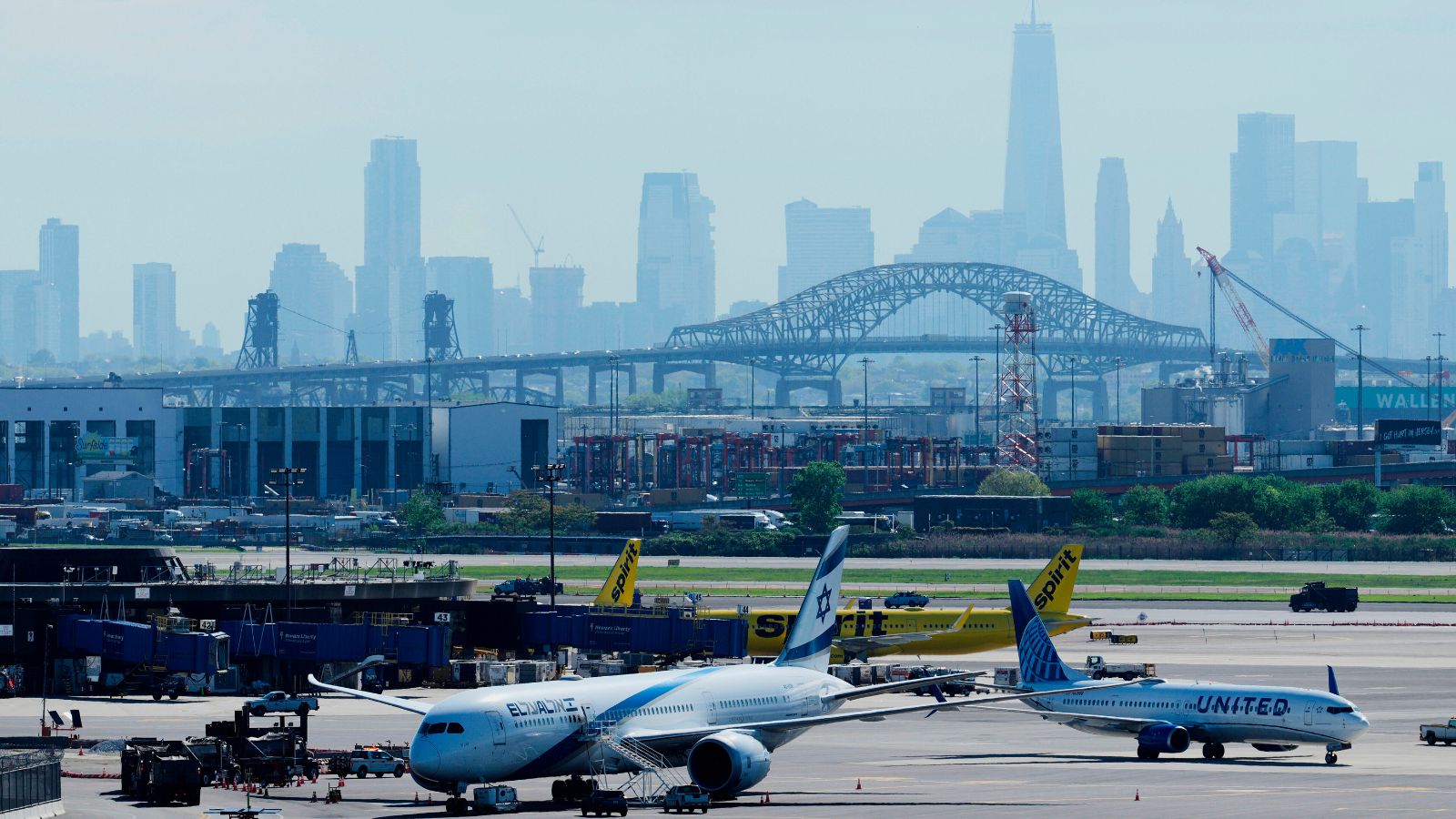
A United Airlines Boeing 767-300ER arriving from Naples, Italy, taxied into a series of obstacles at Newark Liberty International Airport, striking a light pole and a ground vehicle. While the aviation industry often dismisses these events as minor "fender benders," they represent a systemic failure in the ground-handling ecosystem. This incident highlights a growing tension between massive long-haul airframes and the aging, congested infrastructure of major East Coast hubs.
The aircraft involved, a veteran of the skies, completed its trans-Atlantic crossing only to find its greatest challenge was the final several hundred feet of pavement. This is not merely a story of a pilot’s spatial awareness or a tug driver’s positioning. It is an investigation into the razor-thin margins of safety that define modern airport operations.
The Physics of a Taxiway Collision
When a Boeing 767-300ER moves under its own power, it carries immense momentum. With a wingspan of over 156 feet, the margin for error on a crowded taxiway is often measured in inches. In the Newark incident, the left wing of the aircraft made contact with a light pole before the airframe clipped a ground service vehicle.
To understand why this happens, one must look at the "blind spots" inherent in heavy jet operations. Pilots sit high above the ground, and their view of the wingtips is non-existent from the cockpit. They rely entirely on painted taxi lines and, in complex maneuvers, ground marshals or wing walkers. If a vehicle is parked even slightly outside its designated safety box, or if a pilot deviates by a fraction of a degree from the centerline, the results are expensive and potentially lethal.
The Newark Bottleneck
Newark Liberty International Airport (EWR) is notorious among flight crews for its tight quarters. Unlike newer, sprawling airports in the desert or overseas, Newark was built in an era when aircraft were smaller and the volume of traffic was a fraction of what it is today.
Ground congestion at EWR creates a pressure cooker environment. Ground crews are under immense "turnaround" pressure to clear gates for arriving flights. When a long-haul flight from Italy arrives, it is often fighting for space against regional jets and maintenance vehicles. The ground service vehicle involved in this clip was part of that chaotic ballet. Whether the vehicle was poorly positioned or the aircraft was vectored into a restricted lane is a question for the National Transportation Safety Board (NTSB), but the underlying cause remains the same: too much metal in too little space.
The Economic Ripple Effect of a Clipped Wing
An incident like this is a financial nightmare for a legacy carrier. The immediate costs are obvious, such as the repairs to the wing’s leading edge and the replacement of the light pole. However, the true damage lies in the "AOG" (Aircraft on Ground) status.
Revenue Loss and Logistics
A Boeing 767 is a workhorse for trans-Atlantic routes. Every hour it sits in a hangar at Newark is an hour it isn't generating revenue on a high-yield route to Europe.
- Re-accommodation costs: Hundreds of passengers scheduled for the return leg must be re-booked, often on competing airlines, at a massive premium.
- Maintenance logistics: Specialized structural engineers must be flown in to X-ray the wing spar to ensure no internal fractures occurred.
- Downstream delays: The absence of that specific tail number ripples through the entire network, causing cancellations days later in cities the plane was never even scheduled to visit.
This isn't just a United Airlines problem. It is a business model problem. The industry relies on high utilization rates. When a light pole takes a plane out of service, the efficiency of the entire hub is compromised.
The Human Factor and Technical Oversight
We often want to blame the person behind the controls. It is the easiest way to close a file. But the veteran journalist knows that human error is usually the symptom, not the cause.
Aviation safety culture is built on the "Swiss Cheese Model." For a wing to hit a pole, multiple layers of protection must fail simultaneously. The air traffic controller, the pilots, the ground marshals, and the airport's own safety markings all represent layers of that cheese. On this day in Newark, the holes lined up.
Fatigue and Long-Haul Realities
The crew had just finished an eight-hour flight from Naples. While they are professionals trained to handle exhaustion, the "last mile" of a flight—the taxi to the gate—is when the adrenaline of the landing wears off and complacency can set in. The industry calls it the "taxi-in phase," and statistically, it is where a disproportionate number of ground incidents occur.
Furthermore, the technology intended to prevent these collisions is lagging behind the tech used in the air. While we have sophisticated collision avoidance systems (TCAS) for the sky, ground-based "surface movement" radar and warning systems are often relegated to the largest airports and even then, they frequently fail to track small ground vehicles or stationary poles with the necessary precision.
The Maintenance Burden of Aging Fleets
The 767 is a robust aircraft, but it is an aging one. United and other major carriers are keeping these planes in the air longer because of delays in the delivery of newer models like the 787 Dreamliner.
Older aircraft require more frequent inspections. When an older airframe suffers a ground strike, the repair process is more complex. Parts may not be as readily available, and the aluminum skin of a 767 reacts differently to impact than the composite materials of newer jets. This incident adds another layer of stress to a maintenance department already stretched thin by a global parts shortage and a retiring workforce of senior mechanics.
The Role of Ground Contractors
A hidden factor in many of these stories is the outsourcing of ground services. Many of the people driving the trucks and guiding the planes are not airline employees; they are third-party contractors working for lower wages with higher turnover rates.
When you have a rotating door of ground staff, institutional knowledge—the "feel" for a specific gate's hazards—evaporates. A driver might not realize that a specific light pole at Newark is notoriously close to the taxiway because they’ve only been on the job for three months. This "de-skilling" of the tarmac is a quiet crisis that the industry refuses to address because it saves the bottom line.
Rebuilding the Buffer Zone
The Newark incident is a warning. As we push for more flights and more "efficient" gate turns, we are eroding the physical buffer zones that prevent accidents.
To fix this, airports need more than just a fresh coat of paint on the taxiway lines. They need a fundamental redesign of ground traffic flow and a reinvestment in the human beings who guide these multi-million dollar machines. If we continue to treat the tarmac like a crowded parking lot, we shouldn't be surprised when the planes start acting like cars.
The NTSB will likely issue a report in several months citing "failure to maintain clearance." They will recommend better training. They will suggest a review of taxi procedures. But unless the industry addresses the claustrophobia of its major hubs and the fatigue of its crews, the sound of aluminum hitting steel will continue to be a standard soundtrack to the modern travel experience.
The safety of a flight doesn't end when the wheels touch the runway. It ends when the engines are shut down and the brakes are set. Until then, every inch of the taxiway is a potential failure point.
Demand better infrastructure or accept the delays. There is no middle ground.