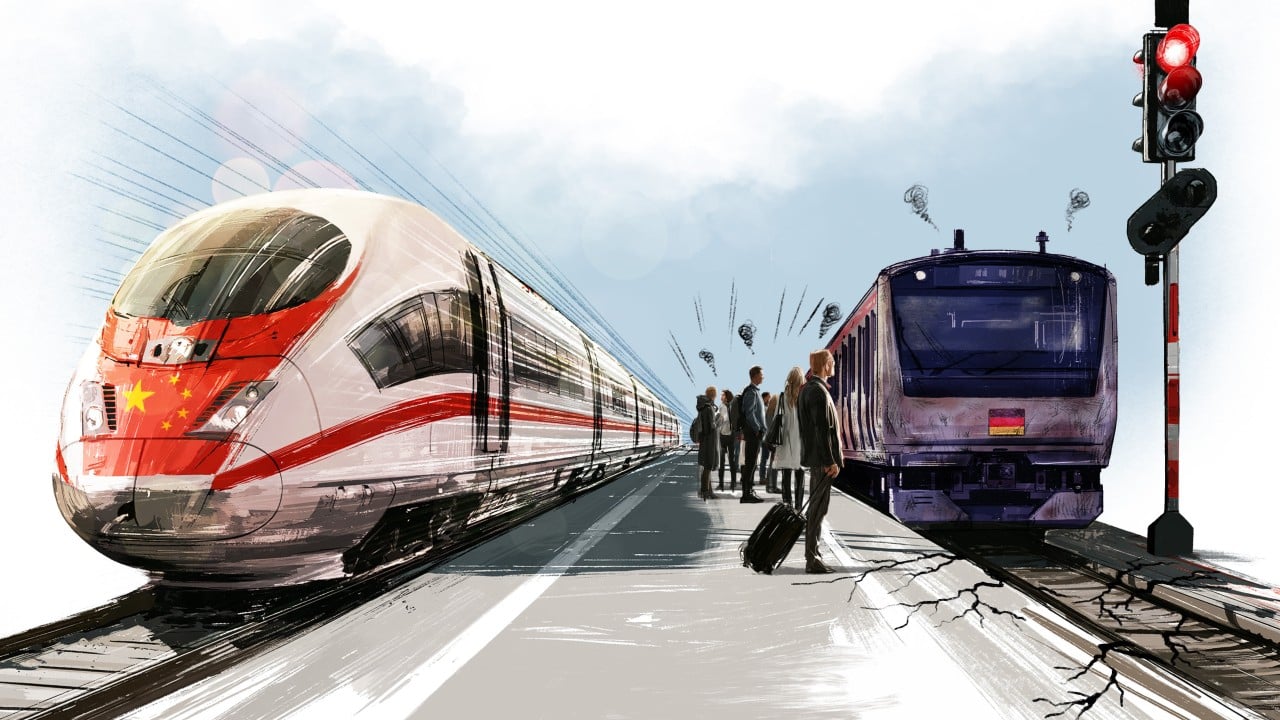
Germany's rail network is collapsing under the weight of its own administrative inertia and decades of deliberate underinvestment. Trains run late with staggering predictability, stations crumble into functional obsolescence, and the economic toll ripples through the heart of Europe's manufacturing powerhouse. While Deutsche Bahn stumbles through perpetual crisis management, China operates a high-speed rail empire spanning tens of thousands of kilometers, moving millions with clockwork precision. This divergence is not an accident of geography or culture. It is the result of starkly opposing political choices, fiscal doctrines, and structural priorities that have left Europe's premier economy looking like a sluggish relic next to an industrial titan.
The Myth of German Efficiency
For decades, the global perception of German infrastructure remained frozen in a postwar fantasy of flawless engineering, immaculate autobahns, and trains that operated down to the microsecond. That fantasy died on the tracks. Today, punctuality metrics for long-distance passenger services tell a grim story of systemic failure. Millions of commuters face chronic delays, cancellations, and overcrowded carriages on a daily basis. You might also find this similar story interesting: The Billionaire Conservation Blueprint Ted Turner Left Behind.
The decay is not cosmetic. It is structural, running deep into the foundations of the nation's logistics spine. For a long time, political leaders in Berlin treated the national railway as a commercial enterprise rather than a public utility. They expected a profit-driven corporate entity to maintain an aging, complex network while simultaneously cutting costs to satisfy shareholder demands—the German state being the sole shareholder, yet acting like a distant absentee landlord.
The consequences of this approach materialized slowly, then all at once. Decades of deferred maintenance accumulated into a massive modernization backlog. When a single switch fails near Frankfurt, the delay cascades across the entire country within hours. The network operates at maximum capacity with zero operational buffer. Any minor disruption snowballs into a continental headache because the system lacks the redundant infrastructure required to absorb shocks. As discussed in detailed coverage by The Wall Street Journal, the implications are worth noting.
The Fiscal Straightjacket
To understand why Germany starved its rails, one must look at the constitutional obsession with fiscal restraint. The Schuldenbremse, or debt brake, enshrined in Germany's Basic Law in 2009, severely limits structural deficits for the federal government. While this policy was touted as a masterclass in fiscal prudence, it created a perverse incentive structure for public investments.
Politicians discovered that starving infrastructure budgets was the easiest way to balance books without cutting popular social programs or raising taxes on the wealthy electorate. Roads and bridges received temporary patches, but rail infrastructure requires massive, multi-decade capital commitments that cannot be squeezed into short political election cycles.
Road transport enjoyed a powerful lobby of automotive giants and freight haulers, securing consistent funding streams through fuel taxes and vehicle fees. Rail, by contrast, was treated as a secondary concern. Year after year, federal grants fell short of what engineers and planners stated was necessary simply to maintain status quo operations. When inflation struck and construction costs soared, the nominal budgets shrank in real terms, turning a bad situation into an outright operational crisis.
The Privatization Experiment That Broke the Tracks
In 1994, the German government enacted the grand rail reform, transforming the state-run railway monopolies into a unified joint-stock corporation known as Deutsche Bahn AG. The theory of the time was seductive. Expose the railway to market forces, split infrastructure management from train operations, and watch efficiency soar through private-sector discipline.
In practice, the reform created an institutional nightmare. Deutsche Bahn was listed on paper as a private company, yet the government retained complete ownership. This split personality paralyzed strategic decision-making. Management pursued international acquisitions and global logistics ventures—such as buying freight forwarders abroad—while neglecting the domestic rail tracks that rusted at home.
Furthermore, the separation of infrastructure from train operations pitted different arms of the same corporate family against one another. Track maintenance budgets were viewed as cost centers to be minimized rather than investments to be protected. Stations were sold off or neglected. Thousands of kilometers of secondary tracks, sidings, and freight switches were systematically dismantled to save on maintenance fees. This ruthless slimming of the network eliminated passing loops and alternative routes, leaving the system intensely vulnerable when primary lines required repairs.
The Chinese Contrast
Thousands of miles to the east, a completely different philosophy birthed a revolution in rail transport. China recognized early that physical connectivity was the absolute prerequisite for sustained economic dominance. Beginning in the early 2000s, Beijing unleashed a wave of state-directed capital deployment that defies historical comparison.
China did not wait for private investors to calculate profit margins on remote rural lines. The government mobilized state-owned banks, coordinated massive land acquisition without protracted legal gridlock, and standardized rolling stock production at an industrial scale. The result is a high-speed rail network that grew from virtually zero to over forty thousand kilometers in less than two decades.
This network transformed domestic commerce, reduced domestic aviation pressures, and integrated sprawling interior provinces with coastal manufacturing hubs. The engineering feats required to tunnel through the mountains of western China or bridge massive river deltas forced Chinese firms to innovate rapidly, creating a domestic supply chain for rail technology that now rivals or exceeds European capabilities.
Yet, this comparison requires journalistic nuance. China's model is not an unblemished triumph of efficiency; it carries severe financial liabilities. The state-owned enterprise responsible for the network, China State Railway Group, sits on a mountain of debt that troubles independent financial analysts. The rapid expansion relied heavily on debt financing backed indirectly by municipal and national state guarantees.
However, the fundamental difference lies in purpose. While Germany viewed rail as a balance-sheet item that needed to justify its existence through immediate financial returns, China viewed rail as essential infrastructure—the concrete foundation upon which the broader economy stands. For Beijing, a train line does not need to turn an immediate profit if it unlocks regional productivity, facilitates labor mobility, and drives industrial output. Berlin spent decades trying to make its trains act like private tech startups, while Beijing treated its tracks like public utilities of the highest order.
The Technological Quagmire
Back in Germany, the physical decay is compounded by severe technological obsolescence. Many core corridors rely on signaling and switching technology that belongs in a museum rather than a modern digital economy.
The European Train Control System, known as ETCS, is the mandated digital standard designed to unify cross-border rail traffic and increase track capacity through automated train control. Germany's rollout of ETCS has been plagued by bureaucratic delays, budget overruns, and severe shortages of specialized engineering talent.
Consider a hypothetical example to illustrate the mechanical bottleneck. On a conventional analog line, signal boxes spaced miles apart require human operators to manually verify track clearances and switch positions. If a single relay fails in a rural junction box, technicians must drive to the site, inspect the hardware physically, and reset the system manually. This process halts traffic for hours across a major regional corridor.
By contrast, a digitized network using centralized electronic interlocking and modern radio-based signaling allows dispatchers to monitor thousands of kilometers of track from a single screen, adjusting train speeds dynamically to maximize throughput. Germany is still attempting to transition its massive legacy network to these digital standards while keeping trains running on tracks that were laid out in the nineteenth century. The friction between old hardware and new software creates constant system failures.
The Economic Price of Delay
The degradation of Germany's rail network is no longer merely a passenger grievance; it is a profound threat to industrial competitiveness. Chemical plants, automotive assembly lines, and steel mills depend on predictable freight logistics to move raw materials and finished goods.
When freight trains are constantly sidelined to let delayed passenger expresses crawl past, supply chains fracture. Manufacturers must maintain higher buffer stocks or rely more heavily on road transport, adding congestion to already overburdened highways. The green transition adds another layer of urgency. Germany has committed to ambitious climate targets, promising to shift a significant percentage of freight and passenger traffic from road and air to rail.
Meeting these targets requires a functioning network. Pushing more traffic onto a system that is already cracking under its current load is an exercise in administrative self-delusion. Every company executive considering a major factory investment in Europe looks at the reliability of the local transport infrastructure. When reliable power and predictable logistics cannot be guaranteed, capital flows elsewhere.
The Long Road to Reconstruction
Recognizing the depth of the crisis, recent federal budgets have finally begun pouring billions of euros into general overhauls. Major trunk routes, such as the heavily trafficked line between Frankfurt and Mannheim, are slated for total closure and complete reconstruction rather than piecemeal repairs.
These massive construction projects bring short-term pain. Entire corridors are shut down for months at a time, forcing passengers onto unreliable replacement bus services and further disrupting freight movements. Planners insist that this radical surgery is the only way to clear the decades-long maintenance backlog.
Even so, skepticism remains warranted among industry veterans. The planning approval process in Germany is a labyrinth of bureaucratic hurdles, environmental impact assessments, and citizen lawsuits that can delay a simple track expansion for twenty years. A project conceived today might not see a single shovel in the dirt until the next political generation takes office.
The capital required to bring the entire network up to modern standards dwarfs anything Berlin has allocated thus far. Fixing switches, modernizing signaling, rebuilding crumbling stations, and laying new tracks require a sustained, multi-partisan financial commitment that transcends changing coalition governments.
Germany built its economic miracle on the strength of its physical infrastructure, steel mills, and transport arteries. For decades, it chose to live off the inheritance of past generations, milking the system for short-term political and financial gains while investing the bare minimum required to keep the wheels turning. That inheritance is now spent. The tracks are worn thin, the patience of the public is exhausted, and the industrial foundation of the nation is straining under the weight of decades of willful neglect. Fixing the network will require not just money, but a fundamental reckoning with how a modern state values its most vital public goods.