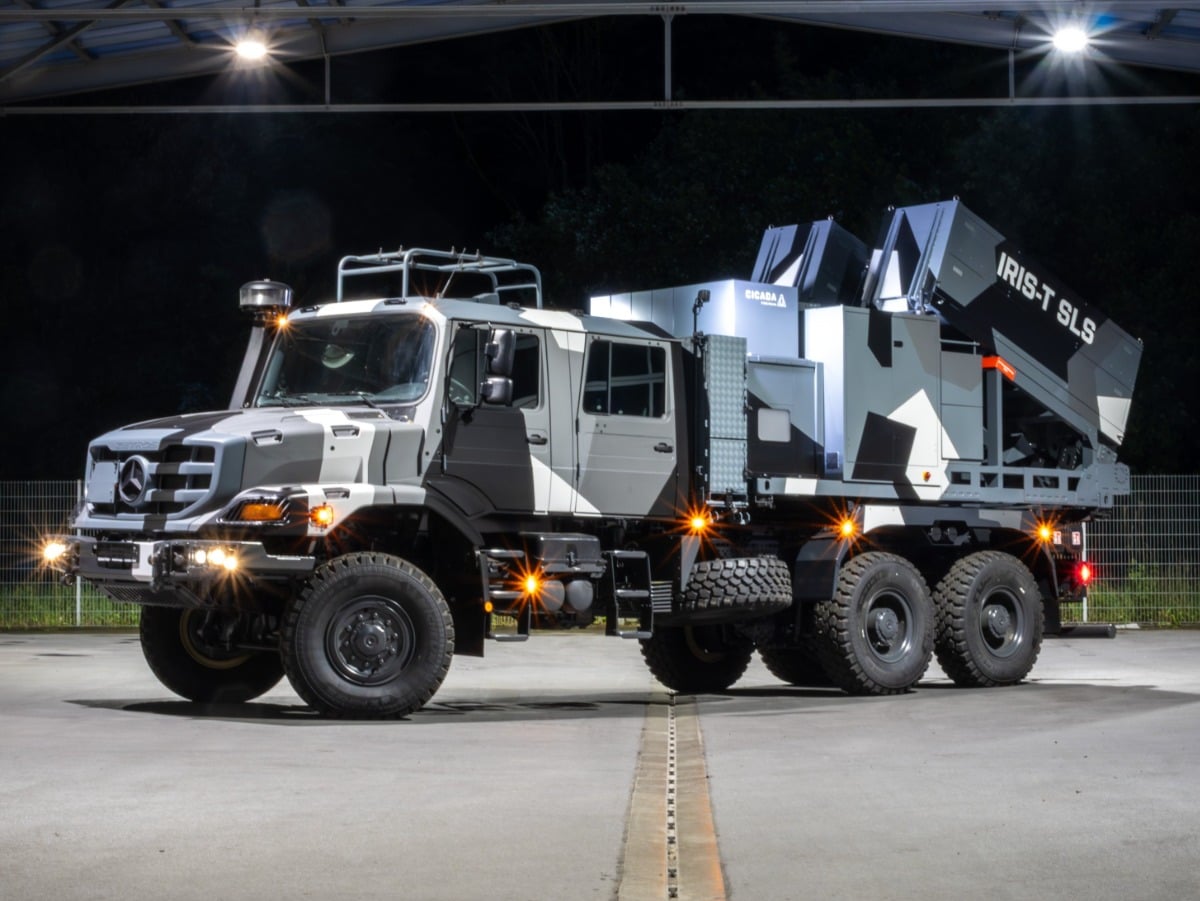
Diehl Defence has unveiled the IRIS-T SLS MK 4, a highly automated, all-in-one short-range air defense system designed to engage threats while protecting mobile troops and critical infrastructure. The system packages radar, command-and-control, and an eightfold missile payload onto a single vehicle, offering an engagement range of 12 kilometers and a maximum intercept altitude of 6 kilometers. By utilizing the existing IRIS-T air-to-air missile variant, the system sets the stage for a true fire-on-the-move capability that allows operators to launch interceptors without halting the vehicle.
Yet, behind the slick marketing rollouts at the ILA Berlin Air Show lies a much harsher industrial reality. Europe is trapped in a desperate, multi-billion-euro sprint to secure its skies against cheap drones, cruise missiles, and massed artillery, revealing gaping vulnerabilities in supply chains, certification timelines, and foundational physics.
The Industrial Funnel and the 1.5 Billion Euro Gamble
For decades, European defense procurement operated under a peacetime delusion. Governments ordered exquisite, low-volume systems and expected contractors to maintain dormant factory floors. The war in Ukraine shattered that paradigm. The original IRIS-T SLM medium-range system achieved near-perfect 99% intercept rates in Kyiv, transforming Diehl Defence from a respectable regional supplier into the industrial anchor of the European Sky Shield Initiative.
But high intercept rates on the battlefield mean nothing if the factory floors cannot replenish the tubes.
Diehl is currently burning through a €1.5 billion capital expenditure program to scale up infrastructure. The crown jewel of this expansion is the newly opened 3,400-square-meter missile integration center in Nonnweiler, designed explicitly to handle high-volume explosives assembly. Consider the scaling mountain Diehl is attempting to climb:
| Production Metric | 2023 Performance | 2025 Output | 2026 Target | 2028 Target |
|---|---|---|---|---|
| IRIS-T Interceptors / Year | ~150 | 800–1,000 | Up to 2,000 | Retained at peak |
| Complete Battery Fire Units / Year | — | — | 10 | 16 |
This tenfold increase in missile manufacturing since 2021 looks impressive on a corporate ledger. In reality, it highlights how dangerously close Western Europe came to total industrial atrophy.
A single sustained wave of modern standoff strikes can deplete dozens of interceptors in a single night. If Diehl maxes out at 2,000 missiles a year, that leaves a terrifyingly thin margin for a continent trying to protect thousands of leagues of critical infrastructure across multiple NATO member states.
The Logistical Friction and the Red Tape Trap
Building hardware is only half the battle; navigating the labyrinth of peace-time bureaucracy is the other. While Ukraine deploys these systems immediately out of survival instinct, Western European militaries remain bogged down by their own regulatory machinery.
Take Germany's own procurement saga. The Bundeswehr cleared a massive €4.2 billion budget expansion in late 2025 to procure additional IRIS-T variants, aiming to field up to 50 systems across the Air Force and newly formed Army air defense units. The goal was to base the initial tranches with the 61st Surface-to-Air Missile Group in Todendorf.
The implementation hit a wall. Bureaucratic friction emerged when the Bundeswehr could not operationally deploy its purchased units because the systems lacked formal domestic safety and technical certifications. This creates a deeply ironic dynamic: a weapon system can successfully defend civilian populations in a live combat zone abroad, yet remain legally grounded by domestic safety inspectors at home.
Diehl’s rollout of the SLS MK 4 all-in-one vehicle attempts to mitigate this by reducing manpower requirements through extreme automation. It consolidates the radar, command post, and launcher onto a single platform. If a system can be operated by a skeleton crew, it lessens the military's severe personnel shortages. However, the software complexity required to manage a single-vehicle air defense network introduces a new layer of digital compliance and cyber-security hurdles that could delay domestic field deployment even further.
The Technical Limits of the Modular Illusion
At recent defense expos like Enforce Tac, Diehl aggressively pushed its modular philosophy. The centerpiece of this strategy is the common SLM/X launcher. The concept is architecturally elegant: take the standard mobile launcher and modify it to fire both the 40-kilometer-range SLM missile and the developmental 80-kilometer-range SLX long-range interceptor from the same eight-canister platform.
This avoids forcing nations to purchase entirely separate truck fleets for medium and long-range defense. But modularity cannot bypass the unyielding laws of physics.
The IRIS-T family relies fundamentally on an infrared imaging seeker for its terminal phase. While highly resistant to electronic warfare and jamming, an IR seeker requires a clear thermal signature. In a dense environment packed with low-altitude, cold-body threats or advanced stealth airframes, thermal tracking faces inherent operational envelopes.
Furthermore, look at the altitude ceilings. The standard SLM tops out at an altitude of 20 kilometers; the upcoming SLX pushes that to 30 kilometers.
$$\text{Maximum Engagement Ceiling} = 30\text{ km}$$
Against low-flying cruise missiles or tactical aviation, this is an exceptional envelope. Against intermediate-range ballistic missiles re-entering the atmosphere at hypersonic speeds, it is completely inadequate.
The SLM/X framework is not a replacement for heavier, vastly more expensive systems like the American MIM-104 Patriot or the Franco-Italian SAMP/T NG, which features the Aster 30 Block 1NT and can engage targets out to 150 kilometers. Diehl knows this. They are quietly developing the IRIS-T HYDEF variant under a separate European Defence Fund initiative, aiming for a 50-kilometer altitude ceiling specifically to counter hypersonic weapons.
By stretching the core IRIS-T design from a 12-kilometer short-range asset up to an 80-kilometer pseudo-strategic asset, Europe risks over-relying on a single underlying missile architecture to do everything.
The Supply Chain Bottleneck Beyond Diehl
An air defense system is a complex ecosystem, and Diehl is entirely dependent on external suppliers who are facing their own industrial bottlenecks. Diehl manufactures the interceptor and the launcher, but the eyes of the system belong to others.
The standard IRIS-T SLM setup relies on the Hensoldt TRML-4D active electronically scanned array radar. While Hensoldt opened a dedicated innovation and maintenance hub in Ukraine to speed up battlefield repairs, their radar production lines face identical component constraints. Solid-state gallium nitride power amplifiers, advanced microprocessors, and specialized sensor optics cannot be stamped out like sheet metal.
If Hensoldt or alternative sensor providers like Thales cannot scale their radar deliveries to match Diehl's target of 10 complete battery fire units, those extra missiles will sit in storage facilities in Saarland, completely blind.
The market is responding to this scarcity with brute-force capital. Lockheed Martin secured a historic $9.8 billion contract to scale PAC-3 MSE interceptor production, targeting nearly 1,500 missiles annually by the late 2020s.
Europe's air defense strategy relies on a fragile patchwork of American imports and ramping domestic production. If Diehl’s €1.5 billion industrial expansion stumbles, or if domestic regulatory bodies refuse to fast-track certification, the European Sky Shield Initiative will quickly transform from a unified defensive umbrella into an incredibly expensive collection of unfulfilled order forms.


:max_bytes(150000):strip_icc():focal(665x0:667x2)/gettyimages-50733149-2000-8b129a2475974982a915418ce92a73d8.jpg)