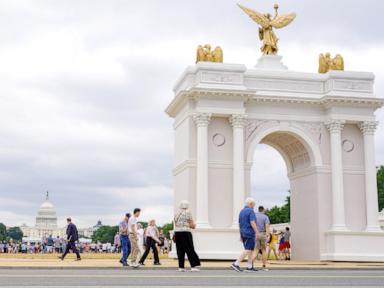
The federal government is quietly grinding through another bureaucratic review of a proposed 250-foot-tall stone monument that threatens to permanently alter the ceremonial core of the American republic. Dubbed the United States Triumphal Arch, the massive neoclassical project championed by the White House has moved past initial design approvals despite historic, unanimous public opposition and ongoing federal lawsuits. The core conflict is not merely about aesthetics. It is a fundamental clash over presidential power, executive overreach, and who ultimately owns the visual narrative of the nation's capital.
White House officials insist the monument will celebrate the upcoming semiquincentennial of American independence. However, the chosen location at Memorial Circle on Columbia Island places the towering structure directly along the historic axis connecting the Lincoln Memorial and Arlington National Cemetery. This specific line of sight was intentionally engineered after the Civil War to symbolize national reconciliation. Placing a massive, modern monument directly in the middle of this view breaks that historical connection, triggering fierce resistance from preservationists and military veterans alike.
The Raw Power Play to Bypass Congress
Monuments on federal land in Washington normally require explicit authorization and funding from Congress. The White House has completely bypassed this traditional legislative route. By claiming that the project is funded entirely through private donations and residual money from other executive branch projects, the administration asserts that the Department of the Interior has independent authority to build on its own land.
This legal maneuver sets a dangerous precedent. If the executive branch can unilaterally install massive vertical monuments on federal property without congressional consent, the statutory framework governing the capital city is effectively broken. This strategy relies entirely on a friendly Commission of Fine Arts, which approved the design in May 2026 despite the fact that every single one of the one thousand public comments submitted to the agency opposed the project.
The rushed review process has deliberately sidelined local oversight. Independent historic preservation groups have complained about truncated public comment windows and a deliberate exclusion from federally mandated reviews. This is an intentional strategy to shield an aggressive architectural intervention from genuine expert scrutiny.
The Engineering Chaos in a Historic Traffic Circle
Beyond the symbolic damage, the sheer physical scale of the project introduces immediate, practical hazards. The structure will rise 250 feet, making it more than twice the height of the nearby Lincoln Memorial. It will feature gold lettering reading "One Nation Under God" and "Liberty and Justice for All," topped by a massive Lady Liberty figure holding a torch.
Transportation engineers have raised alarms about putting a structure of this scale inside a highly active traffic roundabout.
- Obstructed Sightlines: The arch requires two massive support walls measuring roughly 186 feet wide and 110 feet deep. Drivers entering the confusing merging lanes of Memorial Circle will have their views blocked by immense granite barriers.
- Pedestrian Hazards: While initial plans for an underground pedestrian tunnel were dropped due to cost and logistical concerns, the revised design relies on surface crosswalks. Forcing thousands of tourists to cross a chaotic commuter roundabout on foot creates a permanent safety hazard.
- Traffic Flow Disruption: The addition of a public observation deck at the top of the arch means tour buses and pedestrian traffic will flood an area designed exclusively to move vehicles efficiently between Virginia and the District of Columbia.
Local officials have urged the administration to consider alternative sites, such as the vacant traffic areas near South Capitol Street, where a major monument could help anchor an emerging neighborhood without defacing historic views. The White House has flatly ignored these suggestions.
The Escalating Legal Standoff
The fate of the project now rests in a federal courtroom. A coalition of military veterans and historians has filed a lawsuit to halt preliminary surveying work, which began in mid-2026. The plaintiffs argue that the administration is violating federal preservation laws by altering a historic district without proper consultation.
The administration’s defense rests on speed and executive authority. With construction timelines pushed aggressively to meet the 2026 anniversary deadlines, the White House is gambling that it can get concrete in the ground before a federal judge can issue a permanent injunction. It is a calculated race against the legal system, executed with the explicit goal of creating a physical reality that will be too costly and embarrassing for any future administration to dismantle.