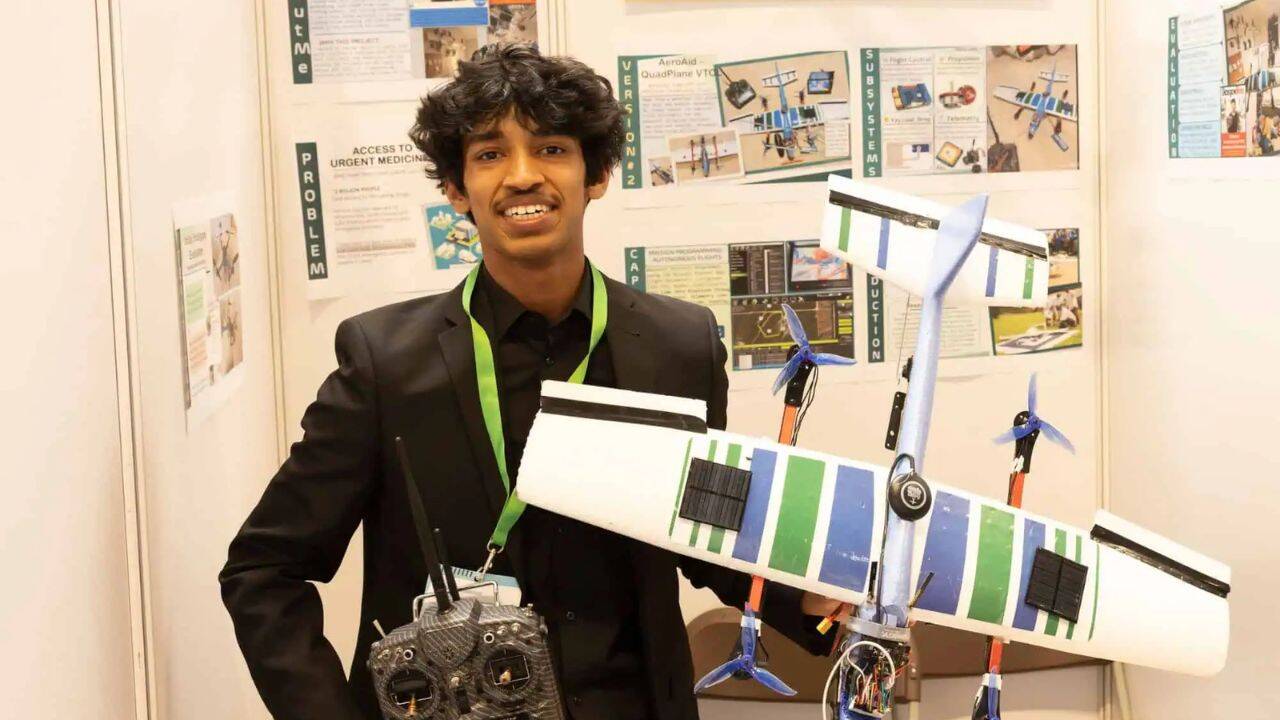
The engineering community recently feted Kanav Jain, a Scottish student from Broxburn, for his work on the AeroAid quadplane. He earned the title of UK Young Engineer of the Year for developing an autonomous vehicle designed to bridge the gap between medical supply depots and isolated, hard-to-reach rural regions. On the surface, the narrative is perfect: a bright young mind uses drone technology to solve a humanitarian crisis. Yet, beneath the accolades lies a complex reality regarding autonomous flight. We have been chasing the dream of "drone medicine" for over a decade, but the path to implementation remains blocked by more than just gravity.
Jain’s project is technically sound. It utilizes a Vertical Take-Off and Landing (VTOL) configuration. This specific architecture is vital for the mission. By combining the hovering ability of a multirotor with the cruise efficiency of a fixed-wing aircraft, the system solves the primary constraint of battery endurance. It lifts vertically, avoiding the need for a runway, then transitions to wing-borne flight, which is exponentially more energy-efficient. It is a logical, elegant solution to the geography of places where road infrastructure is non-existent or destroyed.
However, the industry obsession with "low-cost" autonomous platforms frequently ignores the massive, invisible tax imposed by regulatory hurdles and airspace management. Even if you build an aircraft for pennies, you cannot fly it legally in most parts of the developed world without navigating a labyrinthine approval process.
Consider the hypothetical example of a medical courier drone deployed in the Scottish Highlands. The craft might weigh only a few kilograms. To the engineer, it is a tool. To the civil aviation authority, it is a high-risk projectile. It must operate within segregated airspace or possess sophisticated detect-and-avoid capabilities that cost significantly more than the airframe itself. The hardware is cheap; the permission to operate is exorbitant.
We often hear that autonomous aircraft will save millions of lives. This is a bold claim that requires a reality check. While such devices are ideal for delivering vaccines or anti-venom to inaccessible areas, they are not a substitute for the underlying infrastructure of a healthcare system. A drone can deliver a single vial of medication, but it cannot perform surgery, diagnose complex ailments, or manage the cold-chain storage required for most biologicals. There is a tendency to view technology as an end-state rather than a component. This is where innovation often stalls.
The propulsion system Jain implemented—switching between vertical lift and forward flight—is effectively a transition from high-draw power to a steady-state cruise. In practical terms, this manages the heat signature and power drain that typically kills smaller drones. But for this to be a viable humanitarian tool, it must handle adverse weather. Scotland, for instance, is notorious for high winds and rapid visibility changes. A craft designed in a laboratory environment often fails when it encounters the turbulence of a mountain pass or the salt spray of a coastal flight path.
True progress in this field will not be measured by the ingenuity of the airframe alone. It will be measured by the ability to move from individual, student-led "proof of concept" projects to reliable, long-term fleet operations. That shift requires a focus on battery density, weather-proofing, and software that can interpret complex terrain without human intervention.
There is also the matter of noise pollution and social license. As these devices become more common, communities will inevitably push back against a sky filled with buzzing, low-flying autonomous aircraft. We have yet to design the social architecture that allows for widespread adoption of aerial logistics.
Jain’s success reflects the raw, unbridled potential of a generation raised on accessible robotics. His project serves as a reminder that the basic mechanics of flight are no longer the primary hurdle. We have mastered the art of building small, efficient vehicles. The challenge has shifted entirely to the integration of these machines into our existing social, legal, and environmental fabric.
We should praise the engineering, but we must stay cynical about the timeline. The gap between a winning competition entry and a life-saving, daily-functioning logistics network is not an engineering problem anymore. It is a stubborn, bureaucratic, and systemic deadlock that no single aircraft, however clever, can solve on its own.