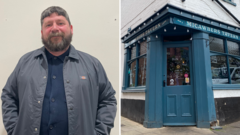
Restaurateurs are increasingly making a choice that was once unthinkable in the hospitality industry: telling customers to eat elsewhere. This isn’t a matter of dress codes or bad behavior. It is a calculated, defensive maneuver against the rising tide of food allergies and the legal liability that follows them. When a burger kitchen owner recently defended the decision to turn away diners with severe allergies, it wasn't an act of cruelty. It was a cold admission of operational limits. In a kitchen where flour dust hangs in the air and peanut oil splashes across shared griddles, "total safety" is often a mathematical impossibility.
The traditional hospitality model is built on the word "yes." But in an era of massive lawsuits and social media cancellations, "no" has become the most important tool for survival.
The Liability Trap and the Death of the Disclaimer
For decades, restaurants relied on a simple sentence at the bottom of the menu: "Please inform your server of any allergies." This was a handshake agreement. The diner disclosed their risk, and the kitchen did its best to avoid cross-contamination. That era is dead. Today, a single mistake can result in a million-dollar settlement or a criminal negligence charge.
Business owners are looking at their insurance premiums and their tiny, cramped kitchens and realizing the math doesn't work. If you have a twelve-square-foot prep area, you cannot guarantee that a trace amount of dairy won't find its way onto a vegan bun. By refusing service, the owner is effectively saying that their kitchen is a high-risk environment. It is a brutal form of honesty that protects the customer's life and the business's existence.
The Myth of the Allergy Friendly Kitchen
True safety requires more than just washing a pan. To properly accommodate a severe allergy—the kind where parts per million can trigger anaphylaxis—a kitchen needs dedicated equipment, separate ventilation, and isolated storage. Most independent burger joints or boutique eateries operate on razor-thin margins and in footprints designed for speed, not sterile separation.
When a chef tells you they cannot serve you, they are often acknowledging that their staff is overworked and their space is compromised. They are admitting that under the pressure of a Friday night rush, the "purple handle" knife for allergens might get swapped for a regular one. It is a failure of infrastructure, not a lack of empathy.
The High Cost of Absolute Safety
Building a kitchen that can truly handle the top fourteen allergens is a massive capital investment. We are talking about separate deep fryers, isolated prep stations, and specialized training protocols that slow down ticket times. For a high-volume burger kitchen, speed is the only way to stay profitable. If every third order requires a "kitchen reset"—where chefs must stop, wash hands, change aprons, and sanitize surfaces—the line stops moving.
- Labor Costs: Specialized training for staff increases the hourly wage floor.
- Space Constraints: Every square foot dedicated to an "allergy-safe zone" is a square foot not producing revenue.
- Insurance Burdens: Failure to follow a stated "safe" protocol after promising it is a fast track to being uninsurable.
Many operators have looked at these variables and decided that the risk-to-reward ratio is broken. They would rather lose the revenue from a table of four than risk the catastrophic fallout of an ambulance arriving at their front door.
When Personal Responsibility Meets Corporate Liability
There is a growing friction between the expectations of the modern consumer and the reality of industrial food production. Diners with life-threatening conditions often feel marginalized or discriminated against when a restaurant refuses them. From their perspective, they are being punished for a medical condition they didn't choose.
However, the legal system treats a restaurant more like a pharmacy than a dinner party. If a business claims it can accommodate an allergy, it takes on a "duty of care" that is nearly impossible to meet in a standard commercial kitchen. When an owner shuts the door on an allergic diner, they are opting out of a legal contract they know they cannot fulfill.
The Selective Menu Problem
The rise of "customizable" menus has actually made the problem worse. In a kitchen where you can "build your own burger" with thirty different toppings, the cross-contamination points multiply exponentially. Tongs move from cheese to onions to bacon. Spatulas scrape against buns containing sesame. In this environment, every ingredient is a potential contaminant for something else.
Restaurateurs who specialize in a single product—like high-end burgers or artisanal pizzas—often use ingredients that are ubiquitous in their space. If you are a sourdough pizza shop, your entire building is coated in a fine layer of flour. Telling a celiac sufferer they can eat there because you have a "gluten-free crust" is often a lie. The honest ones are the ones who refuse to play that game.
The Regulatory Squeeze
Government regulations around food labeling are becoming stricter, yet the physical reality of small-business kitchens remains unchanged. In many jurisdictions, the burden of proof for "reasonable care" is shifting. It is no longer enough to show that you tried; you must prove that you had a foolproof system in place.
For a small business owner, the "foolproof system" is simply not serving the high-risk customer. It’s a defensive crouch. They are choosing a quiet afternoon over a day in court.
The Social Media Fallout
We live in an age where a "refusal of service" can be broadcast to thousands of people in seconds. Business owners who turn away allergic customers often face a storm of online vitriol. They are labeled as "ableist" or "lazy." This creates a dangerous incentive for other owners to "wing it" and hope for the best just to avoid a bad review.
The burger kitchen boss who stood his ground is a rarity because he prioritized physical safety over digital reputation. He understood that a one-star review is a nuisance, but a dead customer is a tragedy that ends a career.
Redefining the Dining Contract
The industry is reaching a tipping point where we must redefine what a restaurant is. Is it a public utility that must serve everyone regardless of the complexity? Or is it a private specialized service with specific limitations?
If we demand that every kitchen be safe for every person, we will eventually be left with only large corporate chains that have the capital to build sterile, laboratory-like environments. The small, "messy," soul-filled local spot cannot survive that level of regulation.
Hard Truths for the Modern Diner
For those with severe allergies, the world is becoming a smaller place. This is an uncomfortable reality. As kitchens become more specialized and ingredients more complex, the gap between "home-cooked safety" and "restaurant risk" grows wider.
The move toward refusing service isn't a sign of a failing industry. It is a sign of an industry finally waking up to the gravity of the risks it has been taking for years. It is an end to the "she'll be right" attitude that has governed commercial cooking for a century.
The most honest thing a chef can ever tell you is that they cannot keep you safe. If you find a kitchen that is willing to turn you away, you have found an operator who actually respects the stakes of your condition. They are not rejecting your business; they are respecting your life.
Stop looking for the restaurant that promises they can do it all. Look for the one that knows exactly what they can’t do.
The era of the "everything-safe" kitchen is an illusion that is finally being dismantled, one refused booking at a time.