Chemical rockets have reached their ceiling. For sixty years, we have been throwing giant cans of explosive kerosene and liquid oxygen into the sky, praying for enough thrust to break the grip of Earth’s gravity. It works for getting to the moon, but for a journey to Mars, it is a slow-motion suicide mission. A standard chemical burn creates a trajectory that leaves astronauts floating in a radiation-soaked tin can for seven to nine months. By the time they arrive, their bones will be brittle, their vision may be failing from intracranial pressure, and their DNA will look like a frayed rope.
NASA is finally admitting that the only way to make the Red Planet viable is to stop thinking about explosions and start thinking about magnets. The latest advancements in Variable Specific Impulse Magnetoplasma Rockets—better known as VASIMR—and Hall effect thrusters represent a desperate, brilliant attempt to rewrite the rules of deep-space logistics. If these engines work, we could cut transit time to just over 3 months. If they fail, the Mars dream dies with the current generation of explorers.
The High Stakes of the Fourth State of Matter
To understand why plasma is the only path forward, you have to look at the sheer inefficiency of current propulsion. Chemical rockets are high-thrust but low-efficiency. They burn all their fuel in a few violent minutes. Once that fuel is gone, the ship is a ballistic rock, drifting through the void with no way to speed up.
Plasma changes the math. By using radio waves to heat gases like argon or krypton to millions of degrees, the engine creates a soup of charged particles. These particles are then accelerated out of the back of the ship using powerful magnetic fields.
Because the exhaust velocity of plasma is exponentially higher than the smoke coming out of a Falcon 9, the engine provides more "bang for its buck" in terms of fuel mass. This is Specific Impulse. While a chemical engine is a heavy-duty truck that gets two miles to the gallon, a plasma engine is a high-performance electric racer that can run for weeks on a single charge.
The Energy Gap Nobody Wants to Discuss
Here is the uncomfortable truth that NASA press releases often gloss over: plasma engines are power-hungry monsters. To get a VASIMR engine to push a crewed vessel to Mars in 100 days, you need a power source far beyond what solar panels can provide. At the distance of Mars, solar energy is weak. To truly "reduce travel time," we don't just need the engine; we need a space-rated nuclear fission reactor.
Without a nuclear heart, these engines are relegated to moving cargo slowly or keeping satellites in orbit. The technology is ready, but the political will to launch a nuclear reactor into orbit remains the single biggest bottleneck in the industry. We are building a Ferrari engine and trying to power it with AA batteries.
Breaking the Thermal Barrier
Heat is the enemy of every engine ever built by man. In a traditional rocket, the combustion chamber has to withstand the literal melting point of its components. Plasma is different because it never actually touches the engine walls.
The magnetic fields act as a "virtual pipe." The plasma is held in a magnetic vacuum, suspended in the center of the thruster. This allows the engine to reach temperatures hotter than the surface of the sun without vaporizing itself.
- Argon Fuel: Plentiful, cheap, and inert.
- Magnetic Confinement: Prevents the engine from melting.
- Scalability: Unlike ion thrusters, plasma engines can handle massive amounts of power.
The Competition for the Void
NASA isn't the only player. Ad Astra Rocket Company, led by former astronaut Franklin Chang-Díaz, has been the primary driver of the VASIMR technology. Meanwhile, the Hall effect thrusters used by SpaceX’s Starlink satellites prove that electric propulsion is already a commercial reality. However, there is a massive difference between moving a coffee-table-sized satellite and moving a 100-ton habitat.
The current challenge is Power Processing Units (PPUs). These are the components that take raw electricity and convert it into the specific frequencies needed to ionize the gas. Right now, these units are heavy and prone to overheating. If we cannot shrink the electronics, the weight of the engine will negate the speed benefits of the plasma.
The Logistics of a Three Month Sprint
Shortening the trip isn't just about convenience. It is about biological survival. The "Conjunction Mission" profile—the most common plan for Mars—requires astronauts to stay on the planet for 500 days while they wait for the planets to realign for a return trip. Total mission time? Nearly three years.
With a high-power plasma engine, we move into the "Oppositions Mission" territory. We can fly when the planets aren't perfectly aligned because we have the raw speed to burn through the extra distance.
This creates a safety net. If a medical emergency happens on the Martian surface, a plasma-driven ship could potentially launch a rescue or return far faster than a chemical rocket ever could. We are talking about the difference between a stranded shipwreck and a functional supply line.
The Hidden Cost of Speed
Faster travel requires more energy, which means more weight, which requires more thrust. This is the Rocket Equation, and it is a cruel master. Even with plasma, there is a point of diminishing returns.
If we push the engine too hard, the amount of shielding required to protect the crew from the onboard nuclear reactor becomes so heavy that the ship slows down anyway. Engineers are currently walking a razor's edge between weight, safety, and velocity.
The Reality of the Test Stand
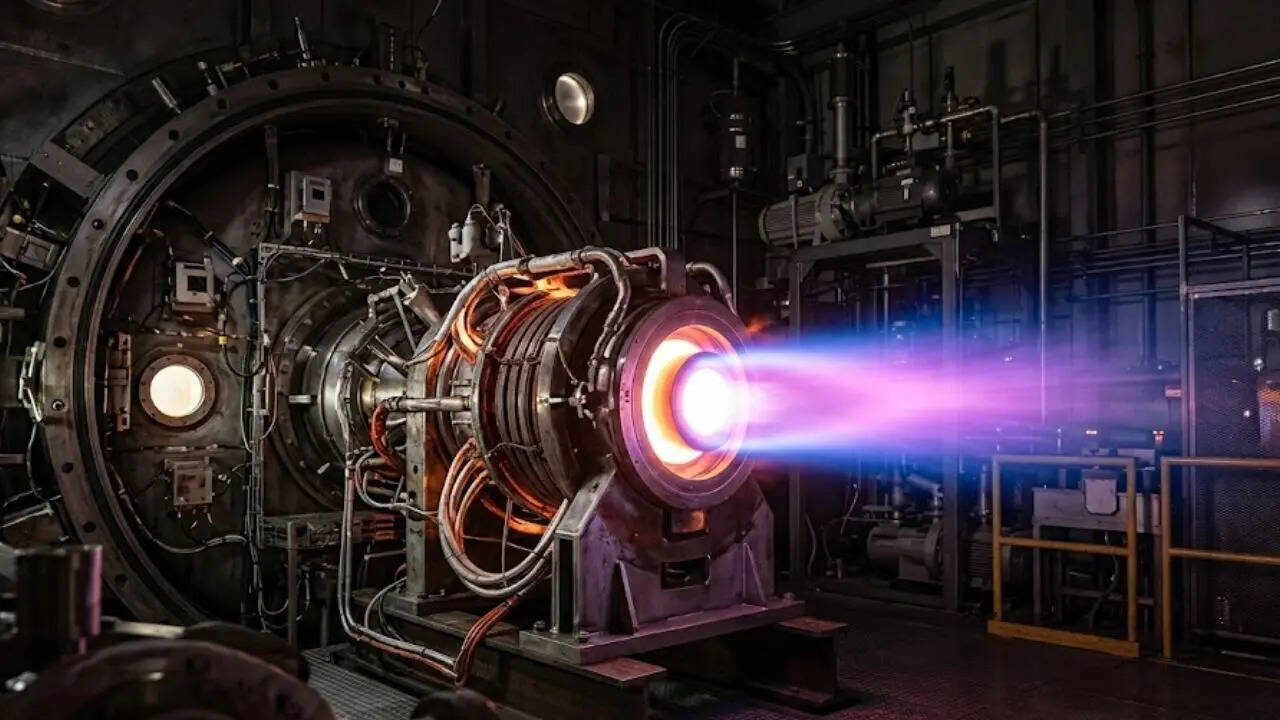
Testing these engines on Earth is a nightmare. You need a vacuum chamber that can swallow the massive exhaust of a plasma plume without letting air leak back in. NASA’s Glenn Research Center and the private facilities at Ad Astra are some of the few places on the planet that can even simulate the conditions of deep space.
We have seen the 200kW milestones. We have seen long-duration fires that last for scores of hours. But we have yet to see a flight-ready prototype that can sustain a burn for months at a time. The transition from a laboratory curiosity to a deep-space workhorse is where most aerospace dreams go to die.
The industry is currently focused on the PPE (Power and Propulsion Element) for the Lunar Gateway. This will be the first real-world stress test for high-power solar-electric propulsion. If the Gateway can maintain its orbit around the moon using Hall thrusters, it proves the reliability of the steady, constant push that plasma provides.
The Geopolitical Engine
Space has always been a proxy for Earthly power. While the United States focuses on the high-efficiency plasma route, other nations are doubling down on heavy-lift chemical rockets. It is a gamble on two different philosophies of movement. One side believes in brute force; the other believes in refined acceleration.
If the plasma gamble pays off, the solar system becomes a neighborhood. Asteroid mining becomes profitable because the transport costs drop. The moons of Jupiter come within reach of human hands. But this all hinges on our ability to master the magnetic bottle.
The physics are settled. The engineering is difficult. The politics are exhausting. We know how to turn gas into a sun-mimicking plume of fire, and we know how to point that fire at the stars. The only question left is whether we are brave enough to put a reactor on top of a rocket and actually light the fuse.
Stop looking for a magic "warp drive" or a fictional hyperdrive. The future of human expansion is a purple glow in a vacuum chamber, humming at the frequency of a new era. We have the fire of the gods; we just need the courage to let it burn.