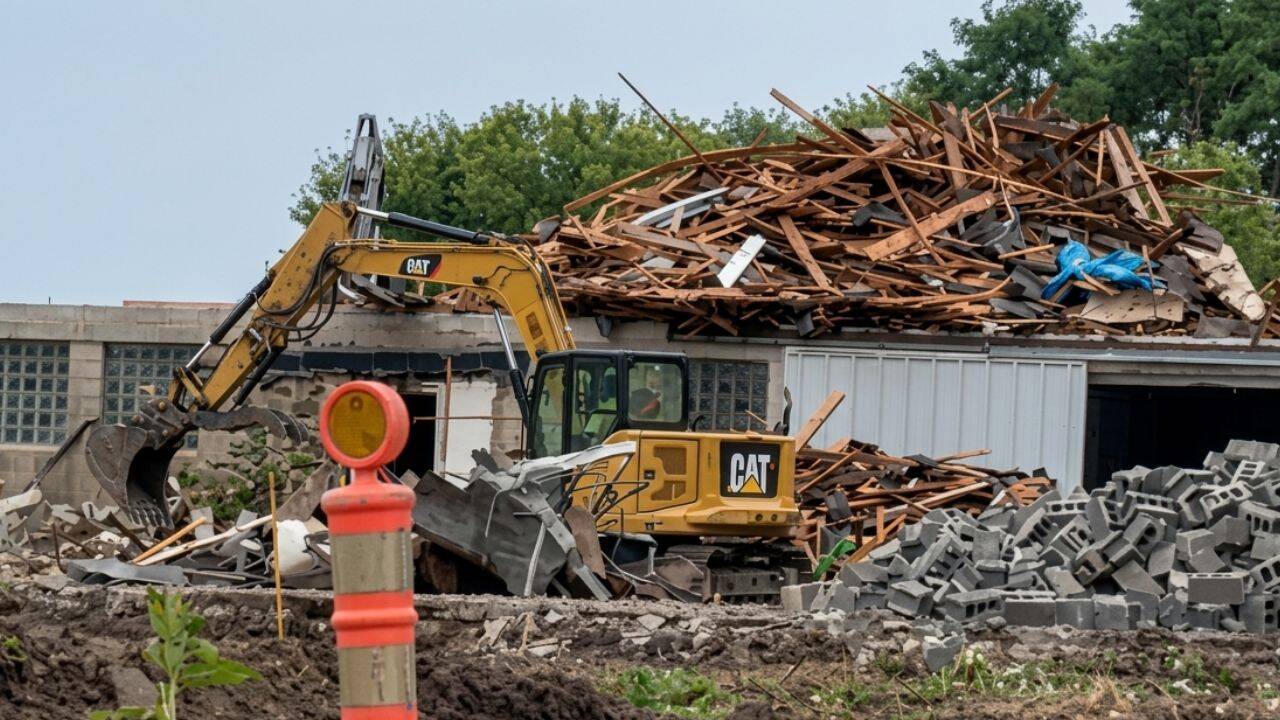
When a family works the same plot of Wisconsin soil for nearly two centuries, the dirt accumulates more than crop yields; it absorbs history. Yet across the Midwest, historic family farms are vanishing under fleets of yellow bulldozers, replaced by cookie-cutter residential subdivisions. This loss is not merely a sentimental casualty of progress. It is the predictable outcome of crushing property tax structures, generational wealth transfer crises, and agricultural margins that cannot compete with suburban real estate development. When a farm operating since the 1840s goes under the blade, it exposes the brutal economic realities driving America's rural heartland out of business.
Romanticized accounts of generational land loss often focus on grief. The sentimental narrative laments the loss of old barns, heirloom apple orchards, and rusted tractors sitting quiet in overgrown weeds. But sentimentality does not pay the bills. The true story of why a 179-year-old farm gives way to asphalt is found in municipal tax codes, estate planning statutes, and the sheer impossibility of surviving as a mid-scale agricultural operation in an industrialized market. For a closer look into this area, we suggest: this related article.
To understand how a family farm with roots stretching back to territorial Wisconsin ends up as a collection of four-bedroom houses with two-car garages, one must examine the mechanics of use-value assessment and how it fails when metropolitan expansion reaches rural borders.
Most agricultural states utilize a use-value taxation system. This policy assesses farmland based on its agricultural productivity rather than its fair market value or highest-and-best use. If a farmer grows corn on a hundred acres, they pay taxes on the economic return of that corn, not on what a housing developer would pay for the dirt. This protection is vital. Without it, suburban creep would price farmers out of their fields decades before a single shovel hit the ground. For additional background on this development, extensive coverage can be read at Al Jazeera.
However, use-value laws have limits. When municipal boundaries expand and developers circle with multi-million-dollar offers, the pressure points multiply. If a farmer enters a deferred taxation program or shifts land out of agricultural production, the penalties can be severe. Yet the ultimate breaking point rarely arrives via a sudden tax spike alone. It arrives through the compounding friction of succession.
Generational handover is where most family farms quietly die. Consider a hypothetical farm valued at five million dollars in real estate potential, despite generating modest annual revenue from commodity crops. When the aging owner passes away, the surviving children or grandchildren face an immediate inheritance tax burden calculated on that inflated asset value.
If there are three siblings and only one intends to keep farming, buying out the other two requires massive capital. Cash is rarely sitting in a bank account on a family farm; it is tied up in soil, machinery, steel, and seed. Taking out commercial loans to pay estate taxes or buy out non-farming heirs saddles the operation with debt servicing costs that modern crop yields cannot support.
The math turns predatory. When a farm operation owes hundreds of thousands of dollars in debt payments every year just to keep ownership within the family bloodline, the offer from a suburban residential developer starts looking less like a desecration and more like an emergency exit. Sell the land, pay off the debts, and walk away with enough capital to secure retirement. For many families, holding out for principle becomes financially impossible.
Local government policies also stack the deck against open space. Rural townships and county boards face perpetual budget shortfalls for road maintenance, emergency services, and school infrastructure. Farmland requires very few municipal services; it does not send children to public schools, demand police patrols, or require municipal water treatment plants. But it also generates very low tax revenue per acre compared to residential housing.
Once a town council eyes commercial expansion, the fiscal incentive flips. A hundred acres of corn yielding a few thousand dollars in property taxes transforms into two hundred single-family homes generating hundreds of thousands of dollars in annual municipal revenue. Local governments often use zoning changes, annexation maneuvers, and infrastructure investments to quietly encourage development at the edges of agricultural zones. The message to the farmer is implicit. Your way of life is an inefficient use of our tax base.
Beyond taxation and zoning sits the unforgiving reality of modern agricultural economics. The scale required to turn a profit in commodity farming has ballooned exponentially over the past several decades. Equipment costs are staggering. A single modern combine harvester can cost upwards of half a million dollars. Seed, chemical fertilizers, and fuel prices fluctuate wildly based on global supply chains and geopolitical events, while grain prices remain tethered to corporate grain buyer oligopsonies that dictate terms to independent producers.
Mid-scale operations find themselves squeezed in the middle. They are too large to survive purely on high-margin direct-to-consumer niche markets like local farmers markets or agritourism, yet too small to benefit from the economies of scale enjoyed by massive corporate agricultural conglomerates farming thousands of contiguous acres with automated machinery.
Year after year of razor-thin margins creates cumulative exhaustion. When a farm has struggled through multiple consecutive seasons of weather volatility, high input costs, and stagnant grain prices, the temptation of a developer's cash offer is not just financial relief; it is an end to chronic anxiety.
Public mourning for historic land ignores these structural failures. Observers express shock when a farm that survived the Civil War, the Great Depression, and the farm crisis of the 1980s finally succumbs to a bulldozer. They write elegies about lost heritage, blaming the heirs for selling out or pointing fingers at local growth.
This framing misses the mark. The disappearance of century farms is not a failure of character among the families who worked them. It is the logical endpoint of an economic system that treats land exclusively as a financial asset rather than a finite ecological and cultural resource.
When society constructs tax laws that penalize family continuity, zoning frameworks that incentivize sprawl, and agricultural markets that punish independent scale, the result is predetermined. The bulldozers do not arrive because people stopped caring about history. They arrive because the financial architecture of the country made preservation an unaffordable luxury.
The remaining multi-generational farms operating today are navigating this same pressure cooker. They are racing against tightening credit markets, encroaching suburban subdivisions, and the inevitable day when aging operators must pass the ledger to the next generation. Each time a historic farm falls, the rural landscape changes permanently, replaced by driveways, sod lawns, and stormwater retention ponds.
The ground is flattened, the topsoil is stripped or buried beneath foundations, and the physical memory of a century and a half of labor vanishes behind subdivision entry signage. The bulldozers keep moving because the economic incentives demand it, and sentimentality has never stopped a real estate transaction.