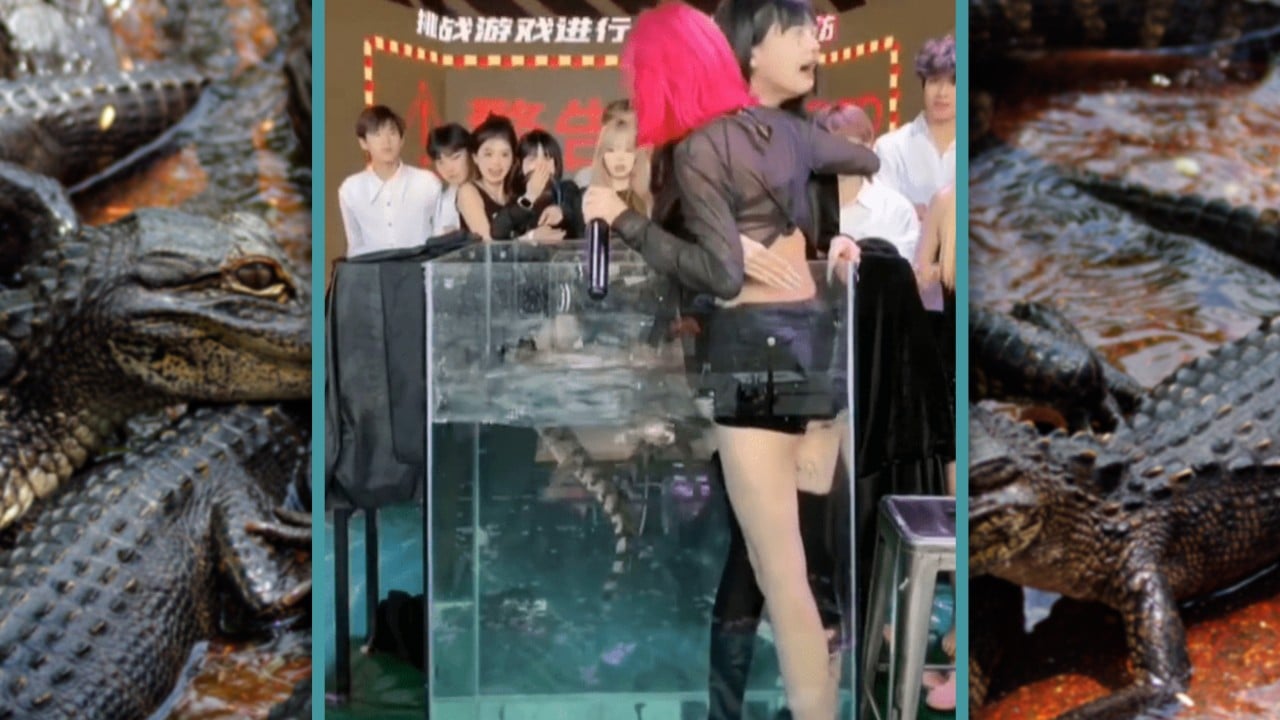
The permanent ban of the Chinese social media account "Sichuan Foodie" marks more than just another content moderation sweep. It signals the breaking point of an ecosystem where human safety is traded for algorithmic favor. When a short-form video creator forced young women into a water tank with a live crocodile to sell spicy snacks, they weren't just breaking local laws. They were following the logical, albeit sociopathic, progression of a digital marketplace that rewards shock over substance. This wasn't a freak accident. It was a calculated business move in a saturated market where the price of a "like" has climbed to life-threatening heights.
The account, which operated on platforms like Douyin, frequently pushed the boundaries of safety to promote regional food products. The specific incident that triggered the ban involved three women submerged in a glass tank alongside a crocodile, its snout barely restrained, while they performed promotional tasks. Local authorities in Sichuan Province and platform moderators eventually moved to scrub the account from the internet, citing violations of public order and safety. However, the deletion of one account does little to address the systemic pressures that make "death-defying" content a viable career path for thousands of creators across the mainland.
The Architecture of Extreme Engagement
To understand why a creator would risk a lawsuit or a fatal mauling for a video about dried tofu, you have to look at the mechanics of the Chinese influencer market. The competition is suffocating. In a space where millions of creators fight for the same three seconds of a user’s attention, the traditional methods of high production value or charm no longer guarantee a return on investment.
The algorithm prioritizes "dwell time" and "re-watch rates." A woman eating a snack is boring. A woman eating a snack while a prehistoric predator circles her waist is an arrestingly visual spectacle that stops the thumb from scrolling. This creates a feedback loop. When "extreme" becomes the baseline, creators are forced to escalate. Yesterday it was eating massive quantities of food until internal organs failed; today it is physical proximity to apex predators. Tomorrow, the bar moves higher.
Labor Exploitation Behind the Lens
We often focus on the creator, but the women in the tank represent a more vulnerable layer of this industry. These are often "MCN" (Multi-Channel Network) employees or gig workers hired for specific shoots. In the Sichuan case, the power dynamic is clear. The account owner directs the scene, while the performers endure the psychological and physical risk.
Labor protections in the livestreaming and short-video sector remain murky. When a "talent" is asked to enter a tank with a crocodile, the "choice" to refuse is often weighed against a breach of contract or the loss of future shifts in a hyper-competitive job market. The industry treats these performers as disposable props rather than human beings with a right to a safe workplace.
The Failure of Platform Governance
ByteDance and its competitors claim to use sophisticated AI to flag dangerous content, yet the "Sichuan Foodie" account operated with increasingly risky stunts for a significant period before the final hammer fell. This delay points to a fundamental conflict of interest. Platforms profit from the traffic generated by "gray area" content. As long as a video generates millions of views without causing an immediate public relations nightmare, there is a financial incentive to let it run.
Reactive moderation is not a strategy; it is damage control. By the time an account is banned, the harm is already done. The creator has likely already cashed out on the surge of traffic, and the viewers have already been conditioned to expect high-stakes spectacle. The platform’s "permanently banned" status acts as a convenient shield to deflect government scrutiny, but it fails to disincentivize the next creator waiting in the wings with a different, equally dangerous gimmick.
Legal Consequences and the Illusion of Safety
Chinese authorities have stepped up the "Clean and Bright" campaigns to scrub the internet of what they deem "vulgar" or "harmful" content. The creator in this instance faces more than just a digital exile. Under Chinese law, endangering public safety or violating animal protection and business regulations can lead to heavy fines and administrative detention.
The presence of the crocodile also brings the "Wildlife Protection Law" into play. Even if the animal was farmed, its use in a commercial stunt involving human risk creates a multi-layered legal crisis for the business owner. Yet, the sheer volume of content being uploaded—thousands of hours every minute—means that the law is often a distant abstraction until it is too late. Creators operate on the "forgiveness, not permission" model, gambling that they can go viral and move on before the regulators notice.
The Psychological Toll on the Audience
There is a darker side to the consumption of this content. When viewers watch women trapped in a tank with a predator, the desensitization is immediate. It turns genuine peril into a commodity. This "gladiator-pit" mentality shifts the cultural needle toward an environment where empathy is replaced by a demand for higher stakes.
The snack being sold in the video becomes secondary to the thrill of the potential disaster. This isn't marketing. It is a digital circus where the performers are the only ones who don't know the lions aren't tame. The viewers, shielded by their screens, participate in a form of voyeurism that rewards the creator for putting lives at risk.
The Myth of the Controlled Environment
In many of these viral stunts, creators claim that the situation is "professionally handled" or that the animals are "docile." This is a lie designed to bypass moderation filters and soothe the viewer’s conscience. A crocodile is a wild animal with an unpredictable nervous system. No amount of taping or handling by a small-town influencer makes a glass tank a safe environment for three people and a reptile.
When these stunts go wrong, the footage is rarely uploaded. We only see the "successes"—the videos where nobody got bitten or drowned. This creates a survivor bias that encourages amateur creators to attempt similar feats, assuming that because they saw it on their feed, it must be achievable.
Reclaiming the Digital Standard
The "Sichuan Foodie" ban should be a catalyst for a broader discussion on the liability of MCNs and the platforms that host them. If a platform’s algorithm promotes a video that involves illegal or life-threatening activity, the platform should share the legal and financial burden of that violation.
Currently, the creator takes the fall, the account is deleted, and the platform keeps the data and the ad revenue generated during the video’s lifespan. This lopsided accountability ensures that more "crocodiles" will appear in different forms. True reform requires moving beyond the "ban-and-forget" cycle. It requires a fundamental shift in how engagement is valued.
The industry needs a hard pivot toward transparent labor practices for performers and a "safety-first" verification for any content involving physical risk. If a video involves an animal or a dangerous environment, the creator should be required to provide proof of permits and safety protocols before the algorithm is allowed to push it to a mass audience.
The era of "wild west" growth in the short-video sector is over. What remains is a choice between a regulated, ethical creative economy or a race to the bottom that ends in a glass tank.
Stop clicking on the spectacle. Every view is a micro-transaction that funds the next life-threatening stunt. If the audience refuses to watch the circus, the cages will eventually stay empty.