Geography is a cruel master. While a coastal border is a gateway to the global economy, a landlocked border is often a prison wall. For the world’s largest landlocked nations, the lack of a coastline isn't just a trivia point; it is a structural tax on their existence.
The 10 largest landlocked countries account for millions of square kilometers of territory, yet they remain tethered to the whims of their neighbors. If you are coastal, you serve the world. If you are landlocked, you serve your neighbors. This reality creates a dependency that dictates everything from the price of a gallon of milk to the stability of the national government.
The Giant in the Center
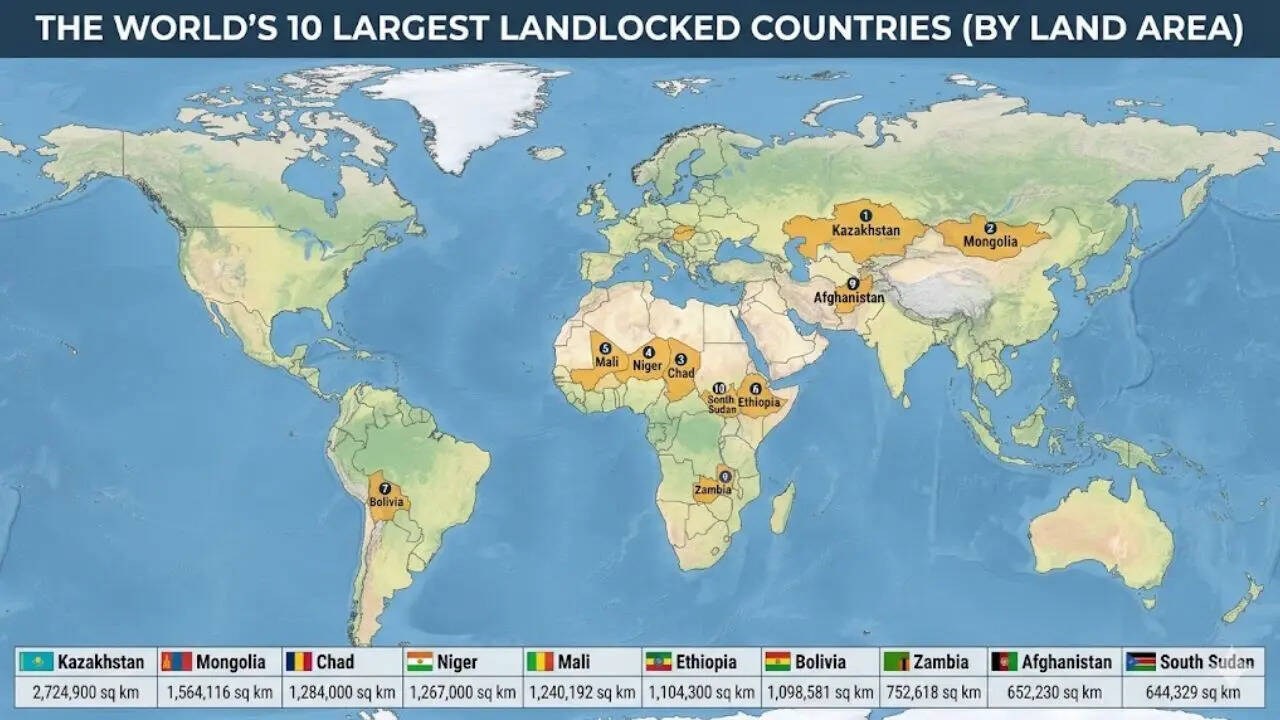
Kazakhstan holds the title of the world's largest landlocked country. Spanning roughly 2.7 million square kilometers, it is a titan of Central Asia. To put its size into perspective, it is larger than the entirety of Western Europe.
Despite its vastness, Kazakhstan faces a unique geographic irony. It sits on the shores of the Caspian Sea, yet it remains landlocked. Because the Caspian has no natural connection to the world’s oceans, it is technically a lake. For a Kazakh oil exporter, the Caspian is a cul-de-sac.
To reach global markets, Kazakhstan must funnel its resources through thousands of kilometers of pipelines and railways crossing Russia or China. This "land-linked" strategy, as the government calls it, is an expensive necessity. Every kilometer of pipe is a point of vulnerability where a neighbor can turn a valve and cripple an economy.
The Mongolian Buffer
Mongolia, the second-largest, is perhaps the most strategically trapped nation on earth. It is squeezed between two superpowers: Russia to the north and China to the south.
For Mongolia, trade isn't just about economics; it’s about survival. With no other neighbors, the country is a permanent hostage to the geopolitical temperature between Moscow and Beijing. When China closes a border crossing due to political friction or a pandemic, the Mongolian economy doesn't just slow down—it stops.
The African Core
A significant portion of the list is dominated by African nations. Chad, Niger, Mali, and Ethiopia represent a massive, contiguous block of landlocked territory.
- Chad: Covering 1.28 million square kilometers, it sits at the "Dead Heart of Africa." Its nearest port is over 1,600 kilometers away in Cameroon.
- Niger: Much of its 1.27 million square kilometers is Sahara Desert. Its primary trade route depends on the stability of Nigeria and Benin.
- Mali: A vast territory of 1.24 million square kilometers that relies heavily on ports in Senegal and Ivory Coast.
- Ethiopia: The most populous landlocked country in the world. After losing its coastline when Eritrea gained independence in 1993, Ethiopia has spent decades and billions of dollars trying to secure reliable access to the Red Sea via Djibouti.
In these nations, the "landlocked tax" is devastating. Logistics costs in landlocked African countries are, on average, 50% higher than in their coastal counterparts. This isn't just a business problem. It means life-saving medicines and fertilizers for crops are prohibitively expensive for the people who need them most.
The South American Outlier
Bolivia is the only South American country in the top ten. Unlike the others, Bolivia's status is a source of national trauma. It lost its coastline to Chile in the War of the Pacific (1879–1884).
Today, the "Navy of Bolivia" still exists, training on Lake Titicaca in anticipation of one day returning to the sea. The lack of a port is estimated to shave 1.5% off Bolivia's GDP growth every single year. It is a permanent economic handicap born from a 19th-century defeat.
The Top 10 by the Numbers
| Rank | Country | Approximate Area (sq km) | Primary Transit Region |
|---|---|---|---|
| 1 | Kazakhstan | 2,724,900 | Russia / China |
| 2 | Mongolia | 1,564,116 | China / Russia |
| 3 | Chad | 1,284,000 | Cameroon / Nigeria |
| 4 | Niger | 1,267,000 | Benin / Nigeria |
| 5 | Mali | 1,240,192 | Senegal / Ivory Coast |
| 6 | Ethiopia | 1,104,300 | Djibouti / Somaliland |
| 7 | Bolivia | 1,098,581 | Chile / Peru |
| 8 | Zambia | 752,618 | Tanzania / Namibia |
| 9 | Afghanistan | 652,230 | Pakistan / Iran |
| 10 | South Sudan | 644,329 | Sudan / Kenya |
The Hidden Costs of Sovereignty
Being landlocked is not just about the distance to a beach. It is about the lack of sovereign access. When a country has a coastline, it controls its own front door. When it is landlocked, it must ask for a key to someone else's.
This leads to a four-fold dependency:
- Infrastructure: If a neighbor’s roads are crumbling, your goods can't move.
- Politics: If you offend a neighbor, they can "inspect" your containers until your fruit rots and your contracts expire.
- Peace: If a transit neighbor descends into civil war, your trade routes vanish.
- Administration: Bureaucratic delays at a foreign border can double the transit time of any shipment.
The United Nations recognizes 32 nations as Landlocked Developing Countries (LLDCs). These countries face a "double handicap." They are not only far from world markets but are also often surrounded by neighbors who are themselves struggling with poverty and instability.
Breaking the Geographic Curse
Success is possible, but it requires radical measures. Switzerland is landlocked, yet it is one of the wealthiest nations on earth. The difference lies in the neighborhood. Switzerland is surrounded by prosperous, stable trade partners with integrated rail networks.
For the giants like Kazakhstan or Ethiopia, the solution lies in multimodal corridors. Kazakhstan is investing heavily in the "Middle Corridor," a trade route that uses ships across the Caspian, trains across Azerbaijan and Georgia, and ships again across the Black Sea. It is a complex, expensive logistical dance designed to bypass the traditional reliance on a single neighbor.
Ethiopia, meanwhile, has signed a controversial memorandum of understanding with Somaliland to lease a portion of the coast for a naval base and commercial port. This move demonstrates the desperation of a landlocked power; it is willing to risk regional diplomatic firestorms just to touch salt water.
The struggle of these ten nations proves that geography remains the most stubborn variable in the equation of national success. You can change your government, you can change your currency, and you can change your laws. But you cannot move your borders. For the inhabitants of these 10 giants, the horizon is always made of dirt, never water.