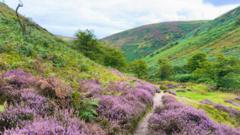
England is a manicured park masquerading as a wilderness. For centuries, the British countryside has been defined by the rigid geometry of hedgerows, the short-cropped grass of sheep-grazed fells, and the sterile monocultures of industrial timber. When the movement to restore these "wild spaces" gained momentum a decade ago, it arrived with a romantic vision of lynx prowling the shadows and ancient forests rising from the scrub. But the reality on the ground is far more chaotic, politically charged, and fraught with ecological uncertainty.
To restore a corner of England, you cannot simply step back and let nature take the wheel. The wheel has been missing for too long. Restoring ecological health requires more than just planting trees; it demands a violent break from the aesthetic traditions that have governed the English soul since the Enclosure Acts. It involves a messy struggle between landowners, embittered farmers, and a government that seems to change its environmental subsidies as often as the seasons.
The Myth of the Pristine Past
Most people look at the rolling hills of the Lake District or the moors of Yorkshire and see "nature." They are wrong. These are industrial sites, shaped by the extraction of wool and meat. The bare, treeless peaks that many hikers cherish are actually ecological deserts, kept in a state of arrested development by overgrazing.
To bring back the wild, we must first accept that there is no "original" state to return to. The climate has changed, species are extinct, and the soil is depleted. True restoration is not a rewind button. It is a forward-looking attempt to build a functioning ecosystem that can withstand a warming world. This means moving away from the "chocolate box" version of England and embracing the scrubby, messy, and unpredictable growth that occurs when humans stop tidying up.
The Trophic Cascade Problem
The core mechanism of a healthy wild space is the trophic cascade. This is the biological chain reaction triggered by the presence or absence of top predators. In England, the lack of large carnivores means that deer populations have exploded. These deer act as a biological vacuum, eating every sapling that dares to break the surface.
Without wolves or lynx to move these herbivores around, the forest cannot regenerate. This is why many "restoration" projects look like nurseries, with thousands of plastic-guarded trees standing in straight lines. It is an artificial solution to a biological vacancy. Until we address the missing predators—or commit to massive, permanent culling programs—the English woods will remain on life support.
Money and the New Landed Gentry
The economics of the English countryside are shifting. For decades, the Common Agricultural Policy (CAP) paid farmers based on how much land they farmed, incentivizing the removal of every "unproductive" bush or pond. Post-Brexit, the new Environmental Land Management schemes (ELMs) were supposed to pay for "public goods" like carbon sequestration and biodiversity.
However, the transition has been a disaster of bureaucracy. Smaller farmers are being squeezed out, while wealthy investors buy up large estates to use as carbon offsets. This has created a "Green Grab," where local communities feel their heritage is being erased to satisfy the ESG requirements of corporations in London.
The Problem with Carbon Credits
When a multi-national corporation buys a thousand acres of Cumbrian hillside to plant spruce trees, they aren't restoring nature. They are creating a carbon plantation. These monocultures are often biologically dead, providing little habitat for native insects or birds.
True restoration requires a diversity of species and ages. It requires "ghost ponds" to be excavated and rivers to be allowed to meander again. These actions don't always fit neatly into a corporate spreadsheet. The financialization of the wild is perhaps the greatest threat to genuine ecological recovery, as it prioritizes measurable carbon over the unquantifiable complexity of a living system.
The Human Element and the Rural Divide
The most significant barrier to restoring wild spaces isn't biological; it’s social. There is a deep-seated resentment in rural England toward what is perceived as "urban interference." To a farmer whose family has worked the same land for five generations, the word "rewilding" can sound like an insult. It implies that their labor was a mistake.
For a restoration project to succeed, it must move beyond the "fortress conservation" model. You cannot fence off the locals. In places like the Knepp Estate in Sussex, the transition from intensive farming to a "wilded" system succeeded because it eventually created new economic opportunities through eco-tourism and high-quality, pasture-fed meat.
Breaking the Aesthetic Obsession
England has a pathological obsession with "neatness." A fallen tree is seen as a mess to be cleared rather than a vital habitat for beetles and fungi. A field of brambles is seen as "waste ground" rather than a nursery for the next generation of oaks.
To restore the wild, we have to learn to love the rot. Deadwood is the heartbeat of a forest. Scrub is the frontline of biodiversity. Until the British public can look at a tangled thicket and see beauty instead of neglect, the political will to allow nature to truly expand will remain fragile.
The Beaver as a Master Engineer
If there is one glimmer of hope in the struggle to revive the English landscape, it is the return of the European beaver. After being hunted to extinction 400 years ago, beavers are being reintroduced in enclosed and wild trials across the country.
They are far more efficient—and cheaper—than any human engineer. Their dams slow the flow of water, reducing downstream flooding. They create complex wetlands that filter pollutants and provide homes for amphibians, dragonflies, and birds.
The presence of beavers transforms a dry, straightened stream into a pulsing, multi-layered ecosystem. They demonstrate that the best way to restore a corner of England is often to step aside and let a non-human specialist take over the heavy lifting. But even here, the conflict remains. Farmers worry about flooded fields and blocked culverts. The government dickers over legal statuses. The beaver is ready to work; the humans are the ones holding up the permit.
Soil The Forgotten Foundation
We talk about trees and birds, but the real battle for the English wild is fought underground. Decades of intensive tillage and chemical fertilizers have turned much of the soil into little more than a dead substrate. It has lost its structure, its mycorrhizal networks, and its ability to hold water.
Restoring the soil is a slow, invisible process. It involves letting organic matter accumulate and allowing the fungal networks to reform. Without healthy soil, any forest planted on top is fragile. We see this in the high failure rates of saplings during recent summer droughts. A wild space is only as resilient as its roots.
The Role of Rare Breeds
In the absence of extinct megafauna like the aurochs or wild boar, restoration projects often use "proxies." Tamworth pigs, Exmoor ponies, and Highland cattle are used to mimic the disturbance patterns of ancient herbivores.
Their hooves break up the soil, creating seedbeds. Their dung provides a feast for insects. Their browsing prevents any one species of plant from dominating. This is "management through messiness." It is a calculated use of domestic animals to trigger wild processes. It’s not a perfect substitute for the wild beasts of the Pleistocene, but it’s the best tool we have in a fragmented landscape.
The Scalability Trap
Small-scale projects are heartening, but they are often "islands of green" in a sea of gray. For a wild space to be truly functional, it needs connectivity. A single ten-acre wood is a tragedy of isolation. Birds and insects need corridors to migrate, find mates, and adapt to shifting temperatures.
The challenge is to scale these efforts across property lines. This requires a level of cooperation that is historically rare in the English countryside. It involves "Nature Recovery Networks" that link national parks with private estates and even suburban gardens.
England's wild spaces will never be the vast, unpeopled wilderness of the Yukon or the Serengeti. They will always be a patchwork, a mosaic of human activity and natural resurgence. The goal isn't to remove people from the land, but to change how people exist within it.
Restoration is not about creating a museum piece. It is about building a system that can breathe again. It is about the return of the nightjar’s call and the sight of a river bursting its banks into a newly born marsh. This isn't a luxury; it is a fundamental necessity for a country that has become one of the most nature-depleted places on earth. The time for polite conservation is over. We need to let the weeds in.