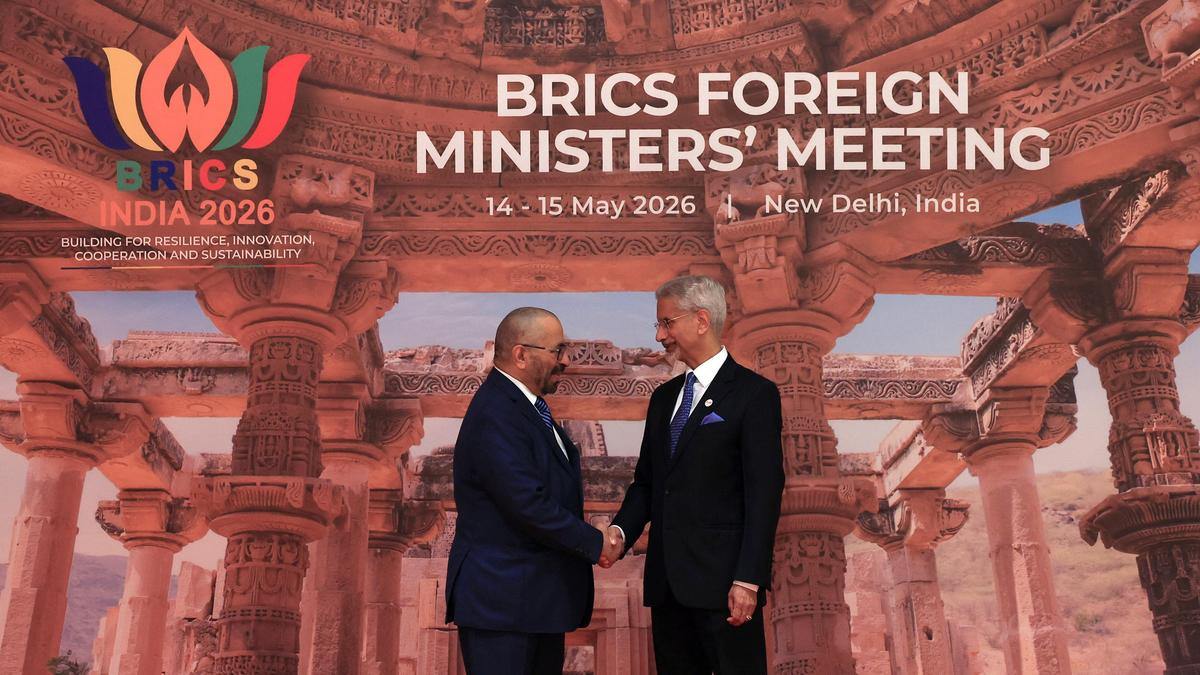
The gathering of BRICS foreign ministers in India arrives at a moment where the bloc’s lofty rhetoric about a "multipolar world" is meeting the jagged reality of a Middle East on fire. While the group has long positioned itself as a counterweight to Western hegemony, it now faces an internal stress test that no amount of diplomatic signaling can hide. With a potential full-scale war involving Iran—a newly minted member—and global oil prices teetering on a knife-edge, the alliance is no longer just debating trade routes. It is trying to prevent its own members from dragging the collective into a geopolitical abyss.
India finds itself in the uncomfortable seat of the host, balancing its strategic partnership with the United States against its historical commitment to non-alignment and its growing role within BRICS. The stakes are concrete. If the conflict between Iran and its regional rivals escalates, the resulting spike in crude prices won't just be a line graph on a Bloomberg terminal. It will be an inflationary gut-punch to the developing economies that BRICS claims to represent.
The Iran Complication
The admission of Iran into BRICS was intended to signal the bloc's expansion into a formidable energy powerhouse. Instead, it has imported a massive security liability. Tehran’s involvement in a widening regional conflict forces other members like Brazil and South Africa to choose between their anti-colonial ideology and the practical need to avoid being associated with a state at war.
Russia, already bogged down in its own protracted conflict, views the Middle Eastern instability as a useful distraction for the West. However, for China and India, the calculus is different. China relies on stable maritime routes for its massive export machine. India needs cheap energy to sustain its manufacturing ambitions. Neither country benefits from a closed Strait of Hormuz or a 40% jump in the cost of a barrel of oil.
The internal tension is palpable. While the ministers will likely release a communique calling for de-escalation and a "balanced approach," the private meetings tell a story of deep anxiety. There is no unified BRICS military command, no shared defense treaty, and certainly no consensus on how to handle an aggressive Iran that is now officially "one of them."
The Oil Price Trap
Economics has always been the primary glue for this group, but that glue is thinning. We are seeing a divergence between the energy producers and the energy consumers within the bloc. Saudi Arabia (whose status remains a point of intense focus) and Russia want higher prices to fund their domestic agendas and war chests. Conversely, India and Egypt are desperate for price stability to prevent domestic unrest fueled by rising food and transport costs.
This isn't just a market fluctuation. It is a fundamental disagreement on the direction of the global economy. If BRICS cannot coordinate a coherent energy policy among its own members, its talk of a "BRICS currency" or an alternative to the petrodollar remains a fantasy. You cannot build a new financial architecture on a foundation of volatile energy prices and conflicting national interests.
Logistics of a Crisis
The Red Sea corridor has already shown how fragile the alternative trade routes are. While Russia promotes the Northern Sea Route and China pushes its Belt and Road Initiative, the current reality is that BRICS trade still depends heavily on the very checkpoints that are currently under threat.
- Shipping Costs: Insurance premiums for tankers in the Gulf have skyrocketed, adding a "war tax" to every shipment.
- Refining Margins: Indian refineries, which have profited from processing discounted Russian crude, face a squeeze if global benchmarks move too high, too fast.
- Supply Chain Resilience: The much-touted "de-risking" from the West is proving difficult when the alternatives are located in active combat zones.
India’s Tightrope Act
New Delhi is not just hosting a meeting; it is performing a high-wire act. Prime Minister Modi’s government has spent years cultivating a "Vishwa Mitra" (friend to the world) image. That image is difficult to maintain when sitting at a table with nations that are increasingly viewed as an "axis of resistance" by the G7.
India’s interest in BRICS is primarily about reform of the United Nations and the IMF. It wants a seat at the top table. However, it does not want BRICS to become a pro-China, anti-West club. This creates a friction point with Beijing. China sees BRICS as a vehicle for its own global leadership. India sees it as a platform for the Global South. These are two very different visions.
The border disputes between India and China in the Himalayas continue to cast a long shadow over every session. It is hard to project a unified front to the world when two of your most powerful members have tens of thousands of troops staring each other down across a disputed frontier. The "unity" of BRICS is often a performance for the cameras, masking a series of bilateral grievances that remain unresolved.
The Expansion Hangover
The recent move to double the size of the bloc was a bold political statement, but it has made the group even harder to manage. Adding countries with wildly different economic structures and political systems—ranging from theocratic monarchies to secular democracies—has diluted the core mission.
Instead of a streamlined economic engine, BRICS is starting to look like a mini-United Nations, complete with the same gridlock and empty rhetoric. The foreign ministers in India are tasked with creating a "partner country" model for future applicants, a move that signals even they realize the current pace of expansion is unsustainable. They are trying to build the plane while it is already in the air, and the engines are starting to smoke.
The Dollar Stays Under the Bed
Talk of "de-dollarization" will dominate the headlines coming out of this summit, but the data tells a different story. While the share of the US dollar in global reserves has dipped slightly, it remains the undisputed king of trade. Most BRICS members still hold the vast majority of their foreign exchange reserves in dollars and euros.
Switching to local currency settlements sounds good in a press release, but it is a nightmare for a merchant in Brazil trying to buy machine parts from China. Until there is a liquid, stable, and transparent alternative, the dollar remains the only game in town. The ministers know this. The central bankers know this. The rhetoric is a political tool, not a financial reality.
The Shadow of the G7
Every move made in the Indian summit is a reaction to the perceived exclusion of these nations from the halls of power in Washington and Brussels. But resentment is not a strategy. The BRICS bloc has successfully identified the flaws in the current global order—the weaponization of finance, the uneven distribution of vaccines, the slow response to climate change in poor nations—but it has yet to provide a functional alternative.
If the group spends this meeting merely complaining about Western double standards while ignoring the chaos within its own ranks, it will miss a critical window. The world is watching to see if BRICS can actually govern, or if it is just a collection of grievances.
The Price of Failure
If this meeting ends with nothing more than a generic statement on "peace and security," it will be a victory for the status quo. The real work is in the technical details: creating a shared insurance pool for shipping, establishing a clear mechanism for oil price stabilization within the bloc, and finding a way to keep Iran from lighting a match in the world’s gas station.
The ministers are running out of time. The wars in the Middle East and Ukraine are not waiting for a consensus to emerge in a conference room in India. The "unity" being tested today isn't about whether these countries like each other. It is about whether they can survive the fallout of each other's actions.
The true measure of this summit will not be the group photo of smiling ministers in traditional Indian vests. It will be the price of oil next Tuesday and the volume of trade that actually manages to bypass the traditional financial system without collapsing. If they can’t solve the bread-and-butter issues of energy and security, BRICS will remain a debating society rather than a world power. The era of easy growth and loud speeches is over. Now comes the hard part of actually managing a world in crisis.
Stop looking at the handshakes. Watch the tankers.
:max_bytes(150000):strip_icc():focal(819x186:821x188)/Murdaugh-Family-e90854a716884d608fb6fd925e18d840.jpg)
