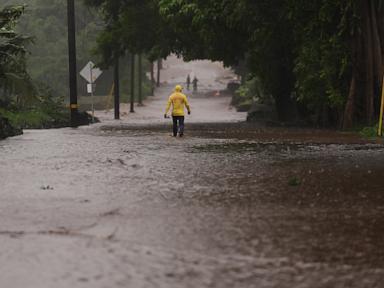
Salt stings the back of your throat before you even step outside. It carries on a heavy, metallic wind that smells of bruised water and old engine grease. Down at the harbor, lines groan against the iron cleats as the swell begins to shoulder past the breakwater. Fishermen do not look at each other. They look at the barometric pressure gauges on the bulkheads, watching the needle drop with a quiet, sickening acceleration.
The air feels thick enough to chew.
Thousands of miles out over the open basin, far beyond the shipping lanes where the albatrosses ride the thermals, something massive has just remembered its own strength. Hurricane Nolo has reformed.
In the dry language of weather advisories, meteorologists speak of sustained winds, millibars, and vector coordinates. They talk about sea surface temperatures climbing above twenty-eight degrees Celsius like it is a math problem on a chalkboard. But numbers do not capture the sound of a roof shingle lifting off its nails in the dark. Numbers do not measure the hollow dread in a mother's chest as she tapes masking tape across a picture window to keep the glass from turning into shrapnel.
Consider what happens next: the warm breath of the tropics feeds an engine that has no business spinning this late in the season.
Water is memory. Every drop of moisture suspended in those towering cumulonimbus clouds holds the solar heat absorbed over months of baking open ocean. When the vortex tightens, that heat transforms into kinetic violence. The storm does not care about coordinates. It cares about fuel. And right now, the upper atmosphere is feeding it a banquet.
For the people living in the low-slung coastal towns where the mangrove swamps bleed into salt marshes, this routine is an exhausting inheritance. You learn to read the sky the way other people read morning newspapers. A pale halo around the moon means moisture is moving high up. A sudden, dead silence—when the gulls simply vanish from the pilings—means the real trouble is locking its jaw.
Take Elena, who runs a cooperative boat repair yard just fifty yards from the high-tide mark. She has lived through four major landfalls in her lifetime. Her knees ache forty-eight hours before a depression turns into a named storm.
"People think you board up your windows and wait it out," she says, wiping grease from her knuckles with a rag that has seen better decades. "They think it is like a heavy thunderstorm with a bit of shouting outside. It isn't. A hurricane has weight. It sits on your chest. The air pressure drops so fast your ears pop, over and over, like you are in a descending elevator that never hits the lobby."
When Nolo strengthens back into a hurricane after a brief, deceptive weakening, it shatters the collective sigh of relief that had just settled over the coast. Evacuation orders get rewritten. Gas stations see sudden, jagged lines of sedans and pickup trucks with trailers hitched to their bumpers. The psychology of the storm is entirely built on anticipation. The waiting is where the frayed nerves live.
Meteorologically speaking, Nolo’s resurgence is driven by an upper-level trough shifting eastward, clearing the outflow channels aloft. That is the scientific anatomy of the beast. The upper winds stop shearing the top off the storm tower, allowing the chimney of warm, moist air to vent freely into the stratosphere. Once that happens, the pressure at the center plummets. The surrounding air rushes in to fill the void, spinning faster and faster, caught in the invisible gears of the Coriolis effect.
It is physics operating on a terrifying scale.
Yet, down on the docks, physics looks personal.
A commercial trawler named the Pacific Star checks its moorings twice. The skipper, a weathered man whose face looks like salted leather, knows that riding out a category-two or category-three blow at the dock is a fool's gamble if the storm surge coincides with astronomical high tide. The math is simple: add four feet of wind-driven water to a normal six-foot tide, and suddenly the concrete pier is simply an underwater obstacle course.
The ocean reclaims what we build upon its edges with casual indifference.
We forget this because most of the year, the sea is a postcard. It is blue. It is dotted with sails and dotted with vacationers eating ice cream along the boardwalk. We build million-dollar condominiums on barrier islands made of shifting sand and crushed seashells, treating nature like a permanent landlord who never raises the rent or loses his temper.
Then Nolo spins up.
Then the satellite loops on the evening news show a swirling, white-eyed monster shaped like a Catherine wheel, creeping across the blue expanse at twelve miles per hour. Twelve miles per hour does not sound fast. A bicycle goes faster. But a twelve-mile-per-hour wall of water and wind does not stop when you tell it to.
The human element in all of this is not just survival; it is adaptation. Every time a storm like Nolo rewrites the coastal geography, building codes change. Architects learn to design garages with breakaway lower walls so the storm surge can flow right through the ground floor without tearing the foundation from the earth. City planners look at mangrove restoration not as an environmental hobby, but as a critical line of defense—natural shock absorbers that blunt the teeth of the incoming surge before it reaches the asphalt.
We are constantly negotiating with a power we cannot tame. We build higher walls, smarter warning systems, and better evacuation routes, but the ocean always gets the last word.
Night falls early when the outer rainbands arrive. The sky turns a bruised, unnatural shade of violet-green—the color of a fresh bruise on bone. Streetlights flicker on hours before dusk because the cloud ceiling is practically resting on the chimney tops.
Out over the water, Nolo is breathing. You can hear the low, sub-audible thrum in the ground, a seismic vibration born of millions of tons of churning surf slamming against the continental shelf.
The wind takes a sudden, sharp turn from the northeast.
The first heavy drops of rain hit the tin roof like handfuls of gravel. In houses up and down the coast, television screens glow with the amber crawl of emergency alerts. People are checking batteries, filling bathtubs with fresh water, and securing patio chairs that could become airborne missiles.
There is an ancient, primal clarity to moments like this. The clutter of modern life—the emails, the schedules, the endless background noise—strips away instantly. You are left with very few things that actually matter: the people under your roof, the shelter over your head, and the unyielding rhythm of the elements outside.
The barometer keeps dropping. The wind is finding its voice now, rising from a low moan to a sharp, screaming whistle as it hits the corners of the eaves.
Nolo is back. And the coast is holding its breath, waiting for the wind to turn.