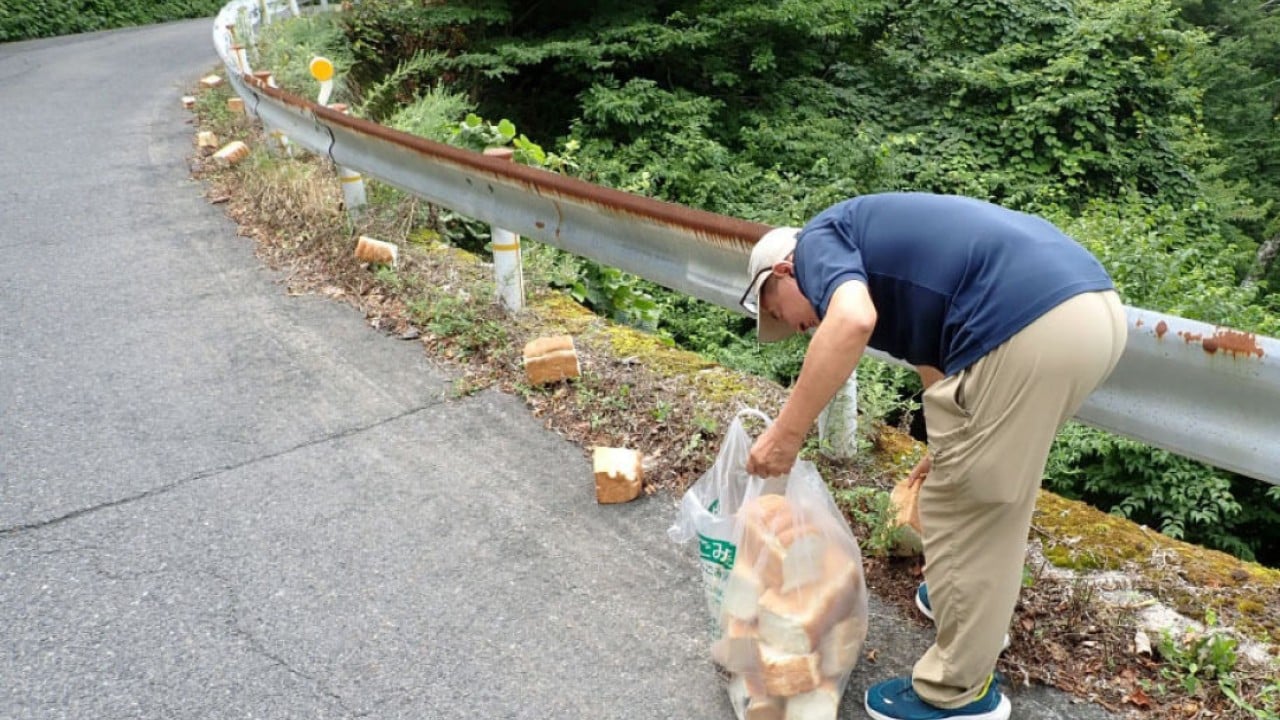
Seventy-six loaves of white bread, lined up with mathematical precision along a hundred-and-fifty-meter stretch of guardrail in Daisen-Oki National Park, present an immediate administrative puzzle. Local authorities in Tottori Prefecture are not merely tracking a standard littering infraction; they are hunting an unknown actor who systematically deposited thirty-nine kilograms of carbohydrates alongside raw poultry organs in a known bear habitat.
The initial discovery on August 14 sparked quiet bewilderment among the staff of the Natural Parks Foundation. Workers initially cleared the roadside, collecting over sixteen kilograms of baked goods. Then the bread came back. It returned on consecutive days, joined eventually by one point three kilograms of fresh chicken offal.
This is not the accidental spillage of a poorly secured commercial delivery truck. The loaves were unwrapped, upright, and placed at conspicuous intervals. Someone took considerable time out of their morning or night to curate a buffet for the forest.
The Anatomy of an Ecological Trap
Why would anyone haul dozens of kilograms of groceries into the mountain passes of western Japan only to arrange them like parking markers?
To understand the gravity of the investigation, one must understand the current ecological tipping point across rural Japan. Bear encounters have spiked dramatically over recent seasons, pushing regional governments into states of high alert. Predators and wild boars are increasingly foraging near human settlements, drawn by urban sprawl, depopulated mountain villages, and unfortunately, accessible food sources left by humans.
Dropping rich caloric fuel directly onto a mountain roadway acts as an explicit invitation. Environment Minister Hirotaka Ishihara addressed the public following the incidents, categorizing the action not as a quirky prank, but as a direct threat to public safety.
Wild animals conditioned to associate roadways with high-value carbohydrates quickly lose their natural wariness. They cross asphalt to feed. Traffic accidents multiply. Encounters with hikers turn fatal. The person placing the bread is short-circuiting the survival instincts of local fauna, replacing fear of humans with a dangerous, learned dependence.
Unraveling the Motive Matrix
Investigators are currently examining multiple theories, each darker or stranger than the last.
One initial hypothesis pointed toward commercial waste evasion. Bakeries generate surplus stock, and paying municipal fees to dispose of spoiled or un-sellable product eats into operational margins. Yet, this theory collapses under basic scrutiny. The bread recovered from Daisen was unblemished, structurally sound, and free of the standard deformation marks found in production batch failures. More crucially, commercial dumpers seek concealment. They drop waste in ravines, hidden culverts, or deep forest ditches—not conspicuously on top of guardrails beside heavily traveled scenic routes.
Another theory suggests an eccentric act of wildlife feeding by a misguided local resident. Japan occasionally grapples with well-meaning citizens who believe they are assisting starving creatures. However, the introduction of raw chicken livers and gizzards introduces a different operational signature. Offal spoils quickly, attracts scavengers instantly, and requires refrigeration prior to placement. This points to deliberate planning rather than a casual pantry cleanout.
A third, more unsettling possibility involves intentional disruption. By baiting apex predators directly onto roadways, an individual could be attempting to manufacture wildlife conflicts, test emergency response times, or create local panic. While police have stopped short of labeling the act malicious sabotage, the methodical nature of the drops keeps every option open on the charging sheet.
The Broader Coastal Pattern
The mystery refuses to stay confined to the mountains of Daisen. Investigators have flagged contemporaneous reports from the Hakuto Coastline, situated roughly fifty kilometers away in Tottori City. There, matching loaves of bread appeared scattered across public parking lots and beachfronts.
The geographic separation suggests either a coordinated multi-site effort or a transient individual moving through the prefecture leaving a trail of bizarre, carb-heavy breadcrumbs. Prefectural police have expanded patrols, reviewing traffic cameras and questioning local merchants about bulk purchases of white bread and poultry parts. Under Japan's Waste Management and Public Cleansing Act, the perpetrator faces severe legal penalties if caught.
The investigation grinds forward against a backdrop of public amusement and underlying anxiety. Internet forums debate whether the culprit is a modern-day folk eccentric, a prankster, or something far more calculated. Meanwhile, park rangers continue their early morning sweeps, scanning the guardrails for the next installment of an inexplicable mountain menu.
The authorities wait for the security cameras to catch the hands that line the loaves along the asphalt, ending a quiet game of ecological roulette before a predator steps out of the tree line and onto the road.