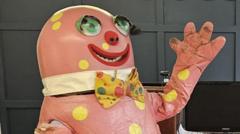
A frayed, foam-filled pink monstrosity covered in yellow spots has just commanded a staggering sum at a British auction house. The item, an original stunt costume of the chaotic 1990s television icon Mr Blobby, sold under the hammer for £8,500 at Bristol-based Auctioneum. Driven by a wave of intense bidding that extended across the Atlantic, the sale far exceeded initial expectations, while an accompanying Baby Blobby prop fetched an additional £2,100. This is not merely a story about television memorabilia. It is a striking indicator of how Gen X and millennial buyers are shifting the financial baseline of pop culture collecting.
The market for modern artifacts is changing rapidly. For decades, traditional auction houses focused on fine art, antique furniture, and centuries-old historical relics. Today, a generation with growing disposable income is bypassing mahogany sideboards in favor of the bizarre cultural touchstones of their childhood.
The Anatomy of a Nineties Phenomenon
Mr Blobby was never meant to be a beloved hero. Created by Noel Edmonds and writer Charlie Adams for the BBC variety show Noel’s House Party in 1992, the character was originally conceived as a sophisticated prank. The goal was to lampoon the overly earnest nature of children's television by presenting a hyperactive, destructive creature who could only scream his own name.
The joke backfired in the most lucrative way possible. Instead of alienating the public, Mr Blobby captured the national psyche. He achieved a Christmas number one single, spawned extensive merchandise lines, and became the centerpiece of multiple short-lived theme parks known as Crinkley Bottom.
This specific costume carries an unusual amount of cultural weight. While the first two suits built by the BBC were tightly guarded for indoor studio recordings, this third unit was the workhorse. It was sent into the field for dangerous outside broadcasts, physical stunts, and heavy promotion. It is the exact suit that dangled from helicopters, sprinted along Charmouth beach, and suffered the physical toll of 1990s physical comedy.
After its television tenure, the suit moved to the Cricket St Thomas theme park in Somerset. There, the late Mickey Wills, who served as the park’s head of entertainment, wore the heavy foam assembly for up to seven high-energy performances a day. The wear and tear is visible, yet that exact degradation is what authenticated its historical footprint for serious collectors.
Inside the Real Auction Versus the Internet Myth
The £8,500 hammer price might seem modest compared to headlines from a few years ago. In early 2023, a different, heavily damaged Mr Blobby costume was listed on eBay by a former production member. The internet erupted. Bidding rapidly spiraled out of control, eventually peaking at a ridiculous £62,000.
The transaction collapsed within an hour. The winning bidder simply walked away, highlighting the structural flaws of unregulated online marketplaces. eBay bids carry no legal enforcement mechanisms, meaning that viral social media campaigns often generate phantom valuations that vanish when payment is due.
Traditional auction houses operate under a completely different framework. The sale at Auctioneum required pre-registration, verified bidding credentials, and legally binding contracts. The £8,500 figure represents actual, liquidated capital moving from a collector's bank account to an auction house. It is a genuine baseline valuation, free from the artificial inflation of internet trolls.
This reality check exposes the divide between internet hype and institutional collecting. Serious investors look for chain of custody and provenance. The Cricket St Thomas connection provided that verified lineage, proving that the suit was a genuine relic of British comedy history rather than a clever reproduction or an unvetted production backup.
Why Defective Material Holds Appreciating Value
There is an inherent irony in archiving items made of cheap materials. The Mr Blobby costume was constructed using unstable foam, industrial latex, and basic textiles. These materials were never engineered to survive for three decades. They degrade, crumble, and lose their structural integrity if left in standard storage conditions.
Museums face immense challenges preserving modern rubber and plastics. The fact that this costume survived in a recognizable form is an anomaly. Collectors are beginning to realize that twentieth-century pop culture artifacts are far scarcer than eighteenth-century porcelain because the manufacturing components of modern toys and props are inherently self-destructive.
The scarcity drives the premium. When an object is built to be disposable, the surviving examples become extraordinarily rare. This scarcity is compounded by the emotional connection of the buyers.
The people who grew up watching Saturday night television in the UK are now in their late late thirties, forties, and early fifties. They are entering their peak earning years. They are looking to reclaim fragments of a media ecosystem that existed before the fragmentation of the internet.
The Fragmented Future of Entertainment Memorabilia
Monolithic cultural moments are dying out. In the 1990s, a huge portion of the British population watched the same television channel at the exact same hour on a Saturday night. This collective experience created a massive, unified consumer base that shared the exact same cultural references.
Modern media does not work this way. Algorithmic feeds, niche streaming platforms, and fragmented audiences mean that very few contemporary television properties will ever achieve the universal name recognition required to fuel a multi-thousand-pound auction battle thirty years from now.
An item from a modern streaming series might have passionate fans, but it rarely commands the cross-generational awareness of a character that was broadcast directly into millions of living rooms simultaneously. The high prices paid for nineties relics reflect the final era of truly monocultural entertainment.
Investors who flip these items are banking on the continued relevance of nostalgia. It is a volatile strategy. As generations age, the market for their childhood artifacts inevitably shifts. The market for pre-war toys has softened significantly because the generation that cherished them has largely passed away. A similar destiny eventually awaits the relics of the nineties.
For now, the appetite for the strange and the nostalgic remains robust enough to turn old television props into genuine financial assets. The successful sale in Bristol demonstrates that even the most chaotic, divisive characters of the television age can transition from a producer's joke into a lasting piece of financial history.
The new owner of the costume now faces the immediate, costly challenge of environmental preservation. They must prevent the historic foam from disintegrating into yellow dust, ensuring that this bizarre monument to British television history survives to shock future generations.