The United Nations Educational, Scientific and Cultural Organization (UNESCO) draft decision to omit the Great Barrier Reef from its World Heritage List in Danger represents an institutional compromise between macroeconomic stability and accelerating ecological degradation. While the decision provides short-term protection for Australia’s regional economy, it masks a compounding ecological deficit. The tension between institutional diplomacy and biophysical reality can be decoded by separating the political mechanics from the physical feedback loops governing the reef ecosystem.
The core tension rests on a divergence of timelines. Institutional diplomacy operates on a multi-year reporting cadence, while the marine ecosystem responds to acute thermal anomalies that occur over weeks. The decision to defer an "in danger" classification until at least 2028 provides a structural buffer for capital allocation, but it does not alter the thermodynamic trajectory of the Coral Sea.
The Macroeconomic Liquidity Cushion
The preservation of the reef’s status acts as a direct stabilization mechanism for Queensland's regional economy. The financial exposure avoided by this diplomatic deferral is quantified by two structural economic dependencies.
- The Direct Employment Multiplier: The reef ecosystem supports approximately 77,000 jobs across regional Queensland. These positions are primarily concentrated in the hospitality, marine transport, and conservation sectors. An "in danger" designation introduces systemic risk to this workforce by signaling structural decline to global travel markets, potentially suppressing international visitor numbers.
- The Aggregate Economic Yield: The Great Barrier Reef generates an estimated $9 billion AUD annually in national economic value. This capital injection operates via a high-velocity multiplier effect in regional coastal communities. Maintaining the current status protects the asset value of tourism infrastructure and ensures the continuity of international credit and insurance lines for marine operators.
The federal and state governments have deployed an aggressive capital expenditure strategy to secure this economic baseline. Total committed state and federal funding for reef conservation and catchment management since 2014 has surpassed $5 billion AUD, including a $330.5 million AUD allocation in the 2026–2027 Queensland budget and a $91.8 million AUD federal allocation earmarked for catchment remediation and experimental coral spawning pilots. This deployment of capital acts as a fiscal shield designed to demonstrate compliance with UNESCO mandates while stabilizing domestic political risk.
The Tri-Component Stress Model
The diplomatic reprieve contrasts with the underlying physical variables. The long-term equilibrium of the Great Barrier Reef is governed by a tri-component stress function where local anthropogenic inputs amplify global thermal stressors.
Total Ecosystem Stress = f(Thermal Dissipation, Catchment Runoff Yield, Ecological Extraction)
1. Thermal Dissipation and Calcification Deficits
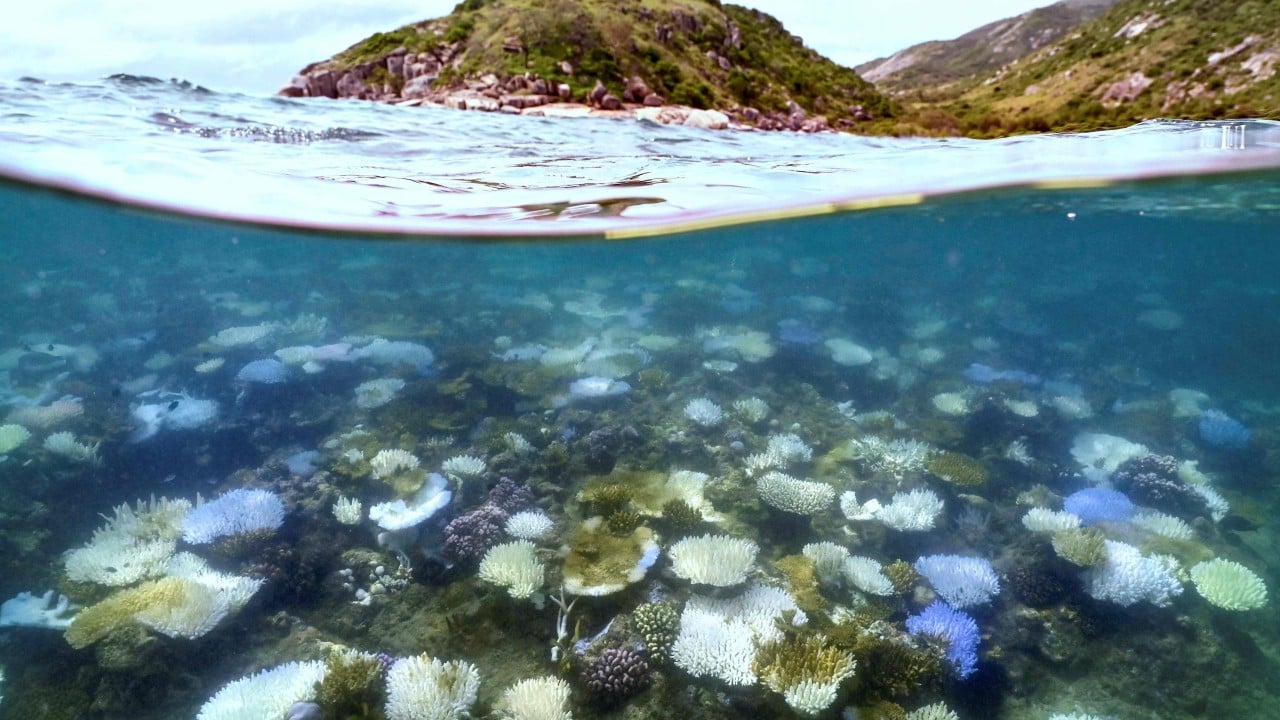
The primary driver of structural collapse is the frequency and intensity of marine heatwaves. Marine organisms rely on a narrow thermal envelope; when ambient sea surface temperatures exceed local summer maxima by as little as 1°C for consecutive weeks, the symbiotic relationship between the coral host and photosynthetic zooxanthellae ruptures.
The reef experienced successive mass bleaching events in 2016, 2017, 2020, 2022, and 2024, followed by structural declines in hard coral cover across the 2024–2025 seasonal cycle. The structural consequence is a critical reduction in the calcification rate of scleractinian corals. When calcification rates drop below the ambient rate of bioerosion, the physical matrix of the reef framework degrades, leading to a collapse in structural complexity.
2. Catchment Runoff Yield and Solar Attenuation
The secondary stressor is land-based agricultural runoff from the adjacent Queensland catchments. This input introduces two distinct destructive mechanisms:
- Particulate Sedimentation: Fine sediments suspended in agricultural runoff increase water turbidity, creating a solar attenuation effect. Reduced photosynthetically active radiation limits the metabolic capacity of deeper coral communities.
- Nutrient Enrichment: Excess nitrogen and phosphorus compounds alter the biochemical balance of the inshore lagoon. This nutrient subsidy triggers macroalgal blooms that outcompete coral recruits for substrate space. Concurrently, elevated nutrient concentrations are strongly correlated with population spikes of the predatory Crown-of-Thorns starfish (Acanthaster planci), which systematically consume live coral tissue.
3. Ecological Extraction and Trophic Cascades
Commercial and recreational fisheries pressures introduce top-down ecological stress. The extraction of biomass from specific trophic levels—particularly apex predators and large herbivorous fishes—weakens the ecosystem's internal control mechanisms. Without robust herbivore populations to graze down macroalgae following a coral mortality event, the system undergoes a phase shift from coral-dominated to algal-dominated states, locking the reef into a low-resilience equilibrium.
The 2028 Deferral and Institutional Governance
UNESCO’s decision to request an updated progress report by 2028 creates a four-year operational window. Critics from the environmental science sector characterize this deferral as an institutional failure to act on clear empirical indicators—essentially issuing a "fifth yellow card" without enforcement teeth. However, from a governance perspective, the timeline creates a structured policy experiment.
The primary policy mechanism relies on the Reef 2050 Catchment Water Quality Strategy. This framework attempts to decouple agricultural productivity from nutrient output along the Queensland coast. The targeted metrics include a reduction in dissolved inorganic nitrogen and anthropogenic fine sediment loads.
The operational limitation of this strategy lies in its voluntary and incentive-based structure for landholders. While legislative restrictions on clearing native vegetation within reef catchments have been tightened to address runoff at the source, loopholes regarding agricultural clearing along specific waterways persist. The lack of a direct binding mechanism to enforce industrial and agricultural compliance creates a fundamental mismatch between policy goals and ecological timelines.
Furthermore, domestic energy policy directly conflicts with marine preservation efforts. While environmental agencies execute localized conservation measures, macro-level state infrastructure decisions continue to support legacy fossil-fuel generation assets and approve coal-extraction permissions. This policy divergence demonstrates that localized conservation investments operate as a mitigation strategy for the symptoms of climate stress rather than a structural intervention against its root causes.
The structural trajectory of the Great Barrier Reef will be decided by the interaction between global thermal anomalies and the localized resilience buffers generated by catchment management. The 2028 UNESCO reporting requirement functions as a hard boundary for the current policy framework. If the combined investments of over $5 billion AUD fail to demonstrably reverse nutrient and sediment loads within this window, the current institutional buffer will dissolve. Asset managers, tourism operators, and state planners must utilize this four-year window to transition from short-term conservation logic to structural adaptation models, anticipating that international institutional protections will inevitably recede as biophysical thresholds are breached.