Berlin prides itself on being an open sanctuary. Millions flock to the German capital because it offers a rare kind of freedom. You can walk down the streets without hiding who you are. Then reality crashes through the barricades.
On a warm July evening in 2026, the annual Christopher Street Day celebration turned into a war zone. A white van plowed into the crowds near the Tiergarten park. One woman lost her life, and twenty-nine others sustained injuries. For a city that views its queer-friendly culture as an unbreakable shield, the blow cut deep.
The Anatomy of a Tragedy at the Tiergarten
The festival had been drawing to a close. Hundreds of thousands had spent the day celebrating diversity under the summer sun. Right around ten o'clock at night, the atmosphere shifted instantly. A Citroën SpaceTourer driven by 21-year-old Abdul Ballout breached pedestrian zones on a path not normally open to traffic.
The vehicle smashed into a tree after mowing down festival-goers. Witnesses reported that the driver abandoned the van immediately and continued the assault on foot with a bladed weapon, leaving a trail of panic and severe injuries.
Organizers halted stage performances within minutes. Emergency responders set up landing zones near the Reichstag to airlift the critical casualties. What was supposed to be the crown jewel of European LGBTQ+ celebration became the latest site of mass violence on German soil.
Who Was the Perpetrator?
The manhunt ended violently the next day in the Spandau district of Berlin. Police located Ballout, a German citizen of Lebanese descent, in an allotment garden complex. According to law enforcement statements, he rushed officers with a knife, forcing special forces to open fire. He died at the scene from his injuries.
Federal prosecutors quickly mapped out his radicalization path. Ballout had traveled to the Middle East in 2025 trying to join the Islamic State. He was caught, sent back, and convicted in May of preparing a serious state-endangering act of violence.
Yet, he walked free on a suspended sentence because time served in pre-trial detention absorbed his punishment. That detail sparked immediate public fury.
The Political Fallout and Security Failures
Interior Minister Alexander Dobrindt categorized the incident as an Islamist terrorist attack. Chancellor Friedrich Merz called the ramming an assault on the entire fabric of German society.
Questions are swirling about how a known extremist with ties to terrorist networks remained on the streets. Police had searched his apartment just weeks prior regarding weapons laws violations, only to leave after finding a toy gun. The gap between judicial sentencing and actual public protection is widening.
Germany has seen this script before. The 2016 Christmas market attack at Breitscheidplatz and the 2024 Magdeburg vehicle ramming haunt the national consciousness. Each event brings fresh promises from politicians to tighten borders, monitor extremists, and harden public spaces. Each event repeats itself with agonizing familiarity.
What This Means for Public Gatherings Going Forward
Open-air festivals face a grim operational reality. Cities cannot wrap every park and boulevard in concrete blocks without destroying the very openness that makes them vibrant. Yet, relying on trust alone is no longer an option.
Community leaders and security agencies are scrambling to adapt. Security architecture for large-scale events like Christopher Street Day will look entirely different next year. Expect stricter perimeter controls, advanced vehicle-blocking infrastructure, and sharper intelligence monitoring.
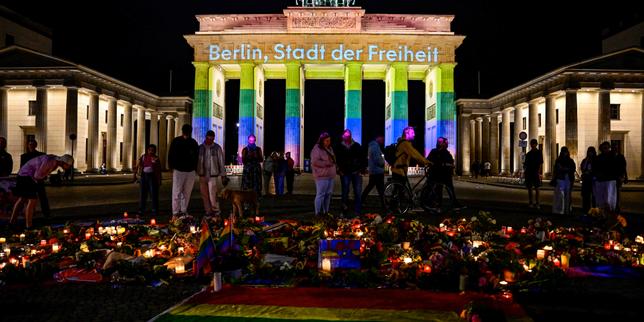
The queer community in Berlin refuses to let fear win. Makeshift memorials of candles, rainbow flags, and handwritten notes quickly emerged near the Brandenburg Gate. People gathered to state clearly that visibility will persist.
The illusion of total safety in a progressive bubble has vanished. Berlin remains resilient, but the cost of that resilience has proven devastatingly high.