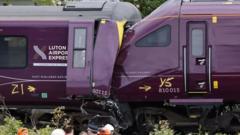
A catastrophic derailment near Bedford has left one person dead, nine in critical condition, and more than 100 injured, exposing severe vulnerabilities in regional rail infrastructure. The commuter train, carrying hundreds of morning passengers, jumped the tracks at a critical switching junction outside the station. Emergency crews flooded the scene to extricate victims from crumpled passenger cars. While official federal investigators are just beginning their field analysis, preliminary indications from local rail workers and track inspection logs point toward a mechanical failure at a legacy switching point—a component that records show was flagged for structural wear months ago.
This tragedy is not an isolated stroke of bad luck. It is the predictable consequence of a system pushed past its design limits.
The Mechanical Mechanics of Failure
To understand what went wrong at Bedford, you have to look at the physical geometry of a rail switch. When a multi-ton train approaches a junction, its direction is dictated by a set of tapered steel rails known as switch points. These points must align flush against the stock rails with microscopic precision. A gap of even a fraction of an inch can allow the wheel flange—the inside lip of the train wheel—to split the switch.
When a train splits a switch at high speed, the front bogies travel down one track while the rear axles are forced down another. The physics are unforgiving. The middle coaches are subjected to immense, conflicting lateral forces. They twist. They lift. Finally, they tear away from the couplers and slide down the embankment.
According to internal maintenance logs leaked by union representatives shortly after the crash, the specific assembly at the Bedford junction had been cited for "metal fatigue and lateral movement" during a routine inspection late last year. The repair was classified as deferred. In the rail industry, "deferred" is often a polite euphemism for gambling with safety margins to preserve daily scheduling windows.
The Cost of the Two Minute Delay
Rail operators live and die by performance metrics. Network managers face heavy financial penalties if trains run even three minutes behind schedule. This structural incentive system creates an intense, unyielding pressure on maintenance crews to perform quick fixes rather than comprehensive overhauls.
Replacing a compromised switching frog or a worn set of points requires taking a line completely dark for twelve to twenty-four hours. On a high-traffic commuter corridor, a twenty-four-hour shutdown triggers political outrage, lost revenue, and gridlock on regional highways. Therefore, the default operational posture often becomes one of temporary mitigation. Crews apply heavy grease, tighten bolt assemblies, and clear the track before the morning rush.
This patch-and-pray approach works for a week, perhaps a month. But steel has a memory. Every heavily loaded transit car that thunders over a weakened rail inflicts micro-fractures deep within the metal matrix.
The Myth of the Automated Safety Net
In the wake of recent high-profile accidents, industry executives have frequently pointed to automated signaling systems as the ultimate guarantee of passenger safety. These electronic systems are designed to monitor track integrity and train spacing via computerized transponders. If a rail breaks completely, the electrical circuit is interrupted, throwing a red signal to stop approaching traffic.
But software cannot fix a mechanical deformation.
If a switch assembly is mechanically loose but still structurally whole enough to maintain electrical contact, the automated system sees a green light. The computer believes the track is safe because the copper wires and fiber-optic cables are intact. It cannot detect the fact that the underlying steel ties have rotted out or that the ballast beneath the track has turned to mud due to poor drainage.
We have built a sophisticated digital wrapper around an aging, analog chassis. The Bedford derailment proves that when the physical foundation fails, all the digital warnings in the world amount to nothing more than a post-accident data log.
Funding Realities and the Accountability Vacuum
Whenever a fatal derailment occurs, a familiar script unfolds. Politicians offer public condolences. Corporate spokespersons promise a transparent investigation. Regulators issue emergency directives demanding immediate inspections across the entire network.
Then, the financial reality sets in.
A comprehensive modernization of regional rail infrastructure requires capital expenditure that public transit budgets simply cannot sustain under current tax models. Privatized lines prioritize shareholder returns and short-term liquidity over thirty-year infrastructure investments. Public systems depend on unpredictable government grants that are frequently slashed during economic downturns.
The result is a fragmented network where the newest trains run on tracks laid down during the mid-twentieth century.
True systemic resilience cannot be achieved through reactive inspections carried out in the shadow of a body count. It requires an immediate, legally binding shift in how track maintenance is prioritized. Regulatory agencies must have the power to shut down compromised lines immediately, without facing corporate litigation or political retaliation over resulting commuter delays. Until the cost of deferring critical track maintenance exceeds the cost of halting service to fix a known hazard, the steel will continue to break, and passenger coaches will continue to leave the rails.