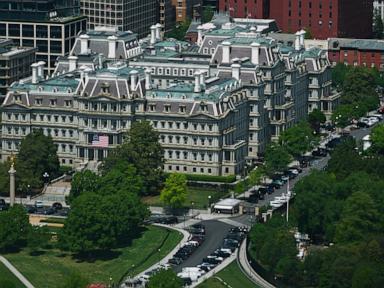
The Eisenhower Executive Office Building does not ask for your affection. It demands your attention. Sitting just steps from the West Wing, it is a massive, unruly pile of French Second Empire architecture, a gray mountain of granite and zinc that seems to vibrate with the sheer weight of American history. It is a building of shadows, steep mansard roofs, and over 1,500 windows that have looked out onto the unfolding of the modern world.
For over a century, its color has been a point of stability. It is the color of a thunderstorm over the Potomac. It is the color of serious men in woolen coats making decisions that shift the tectonic plates of global power. But now, a proposal has emerged from the former president’s camp that would change the very face of the White House complex: Donald Trump wants to paint the Eisenhower building white.
To the casual observer, it sounds like a simple home renovation project. To the historians, architects, and the federal agencies tasked with guarding the nation's aesthetic soul, it is a quiet war over the meaning of heritage.
The Weight of the Stone
To understand why a coat of paint matters, you have to feel the texture of the building itself. If you walk past it on a humid D.C. afternoon, the granite feels cool, almost damp. It has a gravity that the gleaming white stucco of the White House lacks. The White House is a symbol of the Presidency—shining, aspirational, and constantly refreshed. The Eisenhower building, originally the State, War, and Navy Building, is a symbol of the State—permanent, heavy, and unyielding.
When it was completed in 1888, it was the largest office building in the world. Mark Twain famously called it the "ugliest building in America," but he said it with the kind of backhanded respect one gives to a formidable opponent. It wasn't meant to be pretty. It was meant to be a fortress of bureaucracy.
Imagine a preservationist named Sarah. She has spent twenty years studying the way light hits the porticos of Washington’s federal triangle. To Sarah, the idea of painting this granite is not just a change in palette; it is a mask. In this hypothetical but very real struggle, she represents the voice of the stone. She knows that once you paint granite, you lose the breath of the building. The stone can no longer "weep" or release moisture. It becomes a sealed monument, a ghost of its former self.
The Vision of a Uniform Empire
The push to turn the gray mountain white stems from a specific aesthetic philosophy. Donald Trump has long expressed a preference for the "classical" look—the Neoclassical and Federalist styles that define the National Mall. To his eyes, and the eyes of his supporters in this endeavor, the Eisenhower building is a dark, Victorian anomaly that clashes with the pristine, ivory-colored neighbors.
The goal is visual harmony. Proponents argue that the White House complex should look like a unified campus. They see the gray granite as "gloomy" or "dated," a relic of a Gilded Age excess that doesn't fit the crisp, clean image of American leadership in the 21st century. By painting it white, they believe they are finally "finishing" the look of the executive grounds, bringing the rebellious French architecture into the fold of the American Neoclassical family.
The Commission of Fine Arts and the General Services Administration now find themselves in the middle of this aesthetic crossfire. These agencies are the gatekeepers. They are the ones who must decide if the visual whim of a leader outweighs the material integrity of a National Historic Landmark.
The Invisible Stakes of a Brushstroke
There is a cost to uniformity that goes beyond the price of the primer. When we talk about "whiting out" history, we are talking about the erasure of layers. The Eisenhower building represents a specific moment in the American story—a time when we were looking to Europe for grandeur, trying to prove that our young Republic could build with the same complexity and ambition as the Old World.
Consider the physical reality of the task. We are talking about millions of square feet of ornate, carved stone. To paint it is a commitment to a cycle of maintenance that never ends. While granite ages gracefully, gathering a patina that tells the story of the decades, paint chips. It peels. It stains.
In a metaphorical sense, the debate mirrors our current political climate. On one side, there is the desire for a bold, singular vision—a "brand" that is instantly recognizable and perfectly polished. On the other, there is a messy, complicated respect for the original material, flaws and all.
The "gray" of the building is where the nuance lives. It is where the shadows of the 19th century meet the light of the present. To turn it white is to simplify the narrative. It is to say that everything in the seat of power must be uniform, bright, and scrubbed of its idiosyncratic past.
The Ghost in the Hallway
Inside the building, the hallways are nearly two miles long. They are lined with black and white marble floors that have felt the footsteps of Theodore Roosevelt, Douglas MacArthur, and Winston Churchill. In those halls, the color of the exterior doesn't matter as much as the atmosphere of the interior. But the atmosphere is a product of the whole.
If you stand in the center of the Indian Treaty Room, surrounded by gold leaf and dark wood, you feel the weight of the building's original intent. It was designed to be an experience of density and detail. If the outside becomes a flat, white surface, the transition into that dense interior becomes jarring. It breaks the spell.
The federal agencies considering this move are not just looking at paint chips. They are looking at the National Historic Preservation Act. They are looking at the 1901 McMillan Plan, which sought to beautify Washington but also respected the monumental nature of its core. They are wrestling with a fundamental question: Does the current tenant of history have the right to permanently alter the inheritance of those who come after?
The Texture of Truth
Critics of the plan often point to the "White City" of the 1893 World's Columbian Exposition in Chicago. It was a temporary dream of white plaster and lath, designed to look like marble but destined to crumble. It was an illusion of permanence.
The Eisenhower Executive Office Building is the opposite of an illusion. It is 100% real. It is stubborn. It is difficult to clean, hard to heat, and impossible to ignore. Its grayness is its truth.
When the sun sets over the Ellipse, the building undergoes a transformation. The granite catches the orange and purple hues of the sky, turning a deep, bruised violet. It glows with a subterranean light. If it were painted white, it would simply reflect the sun, blindingly bright at noon and flatly gray at dusk. It would lose its ability to change with the day.
The decision rests in the hands of committees and boards, men and women in quiet rooms reviewing architectural impact statements. But the conversation belongs to everyone who walks past those iron fences. It is a reminder that our public spaces are not just backdrops for the evening news. They are the physical manifestations of our values.
The battle for the Eisenhower building is a battle between the shine of the new and the depth of the old. It asks us if we can handle the complexity of a gray stone mountain, or if we need everything to be painted in the simplest, brightest color we can find.
As the agencies deliberate, the building stands silent. It has survived fires, threats of demolition in the 1950s, and the shifting tastes of twenty-four presidents. It waits, as it always has, indifferent to the fashions of the men who occupy the offices within its thick, granite walls. The stone does not need the paint. The question is whether we think we need the stone to look like something else.
The scaffolding may go up. The brushes may be dipped. But beneath any layer of white, the granite remains—heavy, cold, and waiting for the next century to uncover it again.