Silence.
Not the peaceful quiet of a Sunday morning in Tbilisi, when the mist still clings to the Mtkvari River and the smell of freshly baked shoti bread drifts out from basement bakeries, but the heavy, suffocating hush of a room where someone has just turned off the microphone mid-sentence.
If you want to understand what is happening in Georgia right now, forget the dry constitutional briefings for a second and picture a kitchen table in Rustaveli Avenue—let us call its owner Nino, a hypothetical composite of thousands of young Georgians who spent the last two years waving European Union flags against water cannons and tear gas. Nino is twenty-six. She works in a small logistics firm, speaks three languages, and keeps a folded EU flag next to her winter coat by the front door. For years, she believed that democracy was a noisy, exhausting, sometimes infuriating argument between people who disagreed about how to build a country. She thought that when 2028 arrived—the year scheduled for Georgia’s next parliamentary elections—she would walk into a school gymnasium, step behind a cardboard curtain, and choose between competing visions of her future.
Now, she is staring at a ballot paper where every serious alternative has been erased before the ink even dries.
That is the reality staring down the South Caucasus nation as the ruling Georgian Dream party moves toward banning the country’s main opposition parties ahead of the 2028 legislative elections. On paper, it reads like a bureaucratic maneuver, a legalistic clean-up operation wrapped in the language of accountability and constitutional order. On the ground, in the cobblestone alleys of Old Tbilisi and the apartment blocks of Batumi, it feels like watching someone lock every exit door in a crowded theater and then calmly announce that the show will go on as scheduled.
The Architecture of an Empty Choice
To grasp how a country arrives at the brink of single-party rule without firing a shot on election day, you have to trace the slow, deliberate tightening of the screws.
Following the disputed parliamentary elections of October 2024—a vote marred by widespread allegations of intimidation, ballot stuffing, and deep polarization that prompted tens of thousands of citizens to flood the streets night after night—the political crisis in Georgia stopped being a temporary storm and became the climate itself. The ruling party, founded by billionaire Bidzina Ivanishvili, had campaigned on an explicit, chilling promise. They told voters that if they secured a constitutional majority, they would initiate legal proceedings to ban the United National Movement (UNM) and its affiliated political forces—effectively outlawing the primary opposition bloc that has anchored Georgian politics for two decades.
Think of a healthy democracy like a bridge suspended by opposing tension cables. One side pulls left, the other pulls right, and the tension between them holds the roadbed suspended over the gorge. Remove the cables on one side because you dislike the strain they create, and you do not make the bridge more stable. You send the whole structure plunging into the river.
Yet that is precisely the logic driving the campaign to dissolve Georgia’s main opposition movements. The ruling authorities accuse the UNM and its allies—coalitions like Unity – National Movement, Coalition for Change, and Strong Georgia—of acting against state interests, dragging the country toward conflict, and undermining national sovereignty. By framing political rivals not as opponents with different policies, but as existential enemies of the state, the government has shifted the debate from who governs better to who is allowed to exist.
I have watched similar patterns unfold across post-Soviet spaces over the last fifteen years, and the choreography is always eerily familiar. First comes the rhetoric of existential threat. Then come the laws targeting civil society and independent media—like Georgia’s controversial "foreign agents" legislation, modeled closely on Russian statutes, which branded Western-funded NGOs and watchdogs as organizations pursuing foreign interests. Next, parliamentary boycott disputes strip opposition lawmakers of their mandates. Finally, the Constitutional Court becomes the surgical instrument used to amputate political pluralism altogether.
What Happens When You Outlaw Half the Country
Let us pause and ask the question that rarely makes it into diplomatic communiqués. What does banning a political party actually do to real human beings?
A political party is not merely a logo on a campaign poster or a line item in a registry at the Ministry of Justice. It is a vessel for millions of individual grievances, hopes, and identities. In the October 2024 elections, hundreds of thousands of Georgians cast their ballots for opposition coalitions, despite intense pressure, economic anxiety, and a media environment heavily tilted toward the state. When a government declares those parties illegal, it does not magically convert those voters into supporters of the ruling establishment. It tells them that their citizenship is conditional—valid only so long as they cheer for the people already in power.
Consider what happens next in a town like Kutaisi or Zugdidi.
Imagine a local schoolteacher—again, a hypothetical figure drawn from countless real testimonies of public-sector workers in the region—who quietly supports an opposition platform because she wants stronger European integration and judicial reform. Under a multi-party system, she has a legal avenue to express that dissent. She can donate a few lari, attend a rally, or simply cast a secret ballot. Once those parties are outlawed, every association with them becomes a potential liability. Yesterday’s campaign volunteer becomes today’s suspect. Yesterday’s local councilor becomes an outcast stripped of representation.
Fear does not need a policeman on every corner to do its work. It just needs ambiguity. When nobody knows where the new red lines are drawn, people begin drawing them inside their own heads, censoring their conversations over dinner, deleting messages from their phones, and withdrawing from public life altogether.
The European Dream on Ice
For nearly thirty years since regaining independence from the Soviet Union, Georgia’s compass pointed relentlessly westward. Joining the European Union and NATO was not a niche project championed by urban elites; it was written directly into Article 78 of the Georgian Constitution, backed by overwhelming majorities—consistently hovering around eighty percent in public opinion polls—across generations and social classes.
In December 2023, that dream touched solid ground when the EU granted Georgia candidate status. I remember the footage from Freedom Square that night: strangers hugging in the freezing December air, fireworks exploding over the St. George monument, grandmothers weeping beside university students. It felt irreversible.
How quickly irreversible things can unravel.
By mid-2024, Brussels had effectively frozen Georgia’s accession process in response to democratic backsliding, the passage of the foreign-influence law, and escalating rhetoric against Western partners. European officials warned repeatedly that dismantling the political opposition is incompatible with European Union membership. You cannot join a club built on pluralistic democracy while systematically outlawing your own parliament's minority benches.
Here is the paradox that leaves many outside observers baffled: why would a leadership push policies that alienate its closest Western allies while claiming it still supports European integration?
The answer lies in the brutal arithmetic of survival. For an entrenched political elite, true European integration brings poison pills: an independent judiciary that cannot be called on the phone to deliver a verdict, anti-corruption bodies with real teeth, transparent procurement rules that dismantle patronage networks, and genuinely competitive elections where power can actually change hands. From the perspective of those holding the reins, losing power is no longer just an electoral defeat; it is an existential risk. Keeping the European flag on the flagpole while hollowing out the democratic substance beneath it allows the authorities to tell domestic voters they have not abandoned Europe, even as the door to Brussels slams shut.
The Mechanics of Legal Erasure
To understand how the ban is being constructed, look closely at the legal mechanism at play. Under Georgian constitutional law, the Constitutional Court holds the authority to ban a political party if its aim is to overthrow or forcibly change the constitutional order, infringe upon the independence and territorial integrity of the country, or propagate war and violence.
Historically, that clause exists in many European constitutions—including Germany’s—as a defensive shield against violent extremism or totalitarian movements seeking to destroy democracy from within. It was never designed as a broom for a ruling party to sweep away its mainstream electoral rivals.
Yet by establishing parliamentary investigative commissions focused on the period when the United National Movement governed—between 2003 and 2012, including the tragic August 2008 war with Russia—the ruling majority has worked to build an official record portraying the opposition not merely as flawed former administrators, but as a criminal syndicate treasonous to the nation.
And notice the sweep of the net. The ambition has not stopped at the UNM alone. By categorizing newer coalitions—formed by younger politicians, former bankers, and ex-allies who broke away from Georgian Dream itself—as "satellites" or "branches" of the same collective entity, the legal dragnet widens enough to catch virtually any viable challenger capable of clearing the five-percent electoral threshold in 2028.
It is an ingenious trap. If you ban only one party, voters simply migrate to another. If you define every effective opposition force as an ideological offshoot of the banned party, you ensure that no matter how many new parties spring up before 2028, they can be invalidated before a single ballot is printed.
Doubt, Nuance, and the Weight of History
It would be dishonest—and a disservice to anyone trying to truly understand Georgia—to pretend that the country’s opposition is without flaws or historical baggage.
When Mikheil Saakashvili’s United National Movement swept to power in the 2003 Rose Revolution, it transformed a failing state crippled by petty corruption and blackouts into a modernized, functioning bureaucracy at breakneck speed. Yet that modernization came with heavy authoritarian excesses: zero-tolerance policing that swelled prison populations, allegations of abuse in detention facilities, pressure on independent television stations, and an executive branch that brooked little dissent. By 2012, when Georgian Dream peacefully defeated the UNM at the ballot box, millions of Georgians genuinely celebrated the end of an overbearing era.
Those memories are real. They are not inventions of state propaganda; they live in the scars of families who suffered injustices during those years.
Understanding that history explains why the ruling party’s narrative resonates with a segment of the population, particularly older voters and residents in rural regions who remember the turbulence of the 2000s and fear instability above all else. When government officials warn that returning the opposition to power would mean chaos or renewed conflict with Moscow—a terrifying prospect in a country where Russian troops already occupy twenty percent of the territory, in Abkhazia and South Ossetia—that fear lands on fertile ground.
I confess that watching this unfold fills me with a deep, unsettling uncertainty. When a society’s legitimate historical traumas are weaponized to justify dismantling democracy today, how do you untangle genuine grief from political manipulation? You cannot tell a family that suffered in 2009 that their pain does not matter, yet you cannot allow that pain to become the pretext for locking an entire generation out of their own future in 2028.
Two truths can stand side by side: a former government can have committed grave mistakes, and banning its successors—along with every independent rival—can still be a fatal blow to freedom.
A Democracy Measured in Footsteps
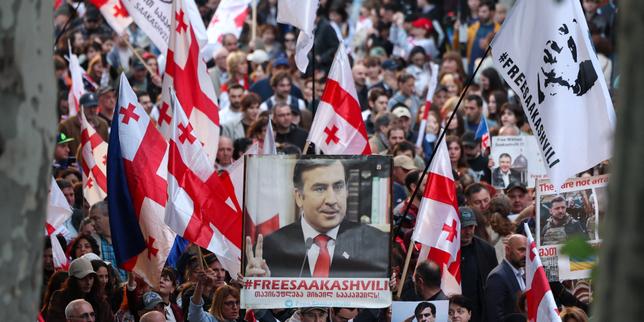
If you walk down Rustaveli Avenue on a cold evening, past the neoclassical columns of the Parliament building, you see the counter-weight to all these legal maneuvers. You see students wrapping themselves in Georgian and European flags, artists projecting messages onto stone facades, grandfathers standing beside teenagers who were not even born during the Rose Revolution.
They are not marching because they are in love with every opposition politician. In fact, if you talk to young protesters in Tbilisi over coffee, many of them will tell you bluntly that they are frustrated with the opposition’s internal squabbles, lack of unified strategy, and old faces. They are not fighting for a specific party leader. They are fighting for the right to choose—and, just as importantly, the right to throw out whoever they choose four years later if they fail.
That is the heartbeat of any real republic. Democracy is not the guarantee that good people will always win. It is the guarantee that bad policies can be reversed without bloodshed, and that no leader owns the state as personal property.
If Georgia arrives at the 2028 legislative elections with its principal opposition parties banned, its independent watchdogs crippled, and its media landscape hollowed out, the vote will still take place. Cameras will still record officials dropping envelopes into transparent ballot boxes. Observers from friendly capitals will still issue statements praising the technical organization of the polls.
But everyone inside the country will know the truth.
Back in that small apartment near Rustaveli Avenue, Nino keeps her folded blue flag on the shelf by the door, right next to her keys. Every morning before she leaves for work, her hand brushes past the fabric—a quiet, stubborn reminder that a country is not defined by the decrees signed in its parliament, but by the people who refuse to pretend that an empty ballot is a choice.



