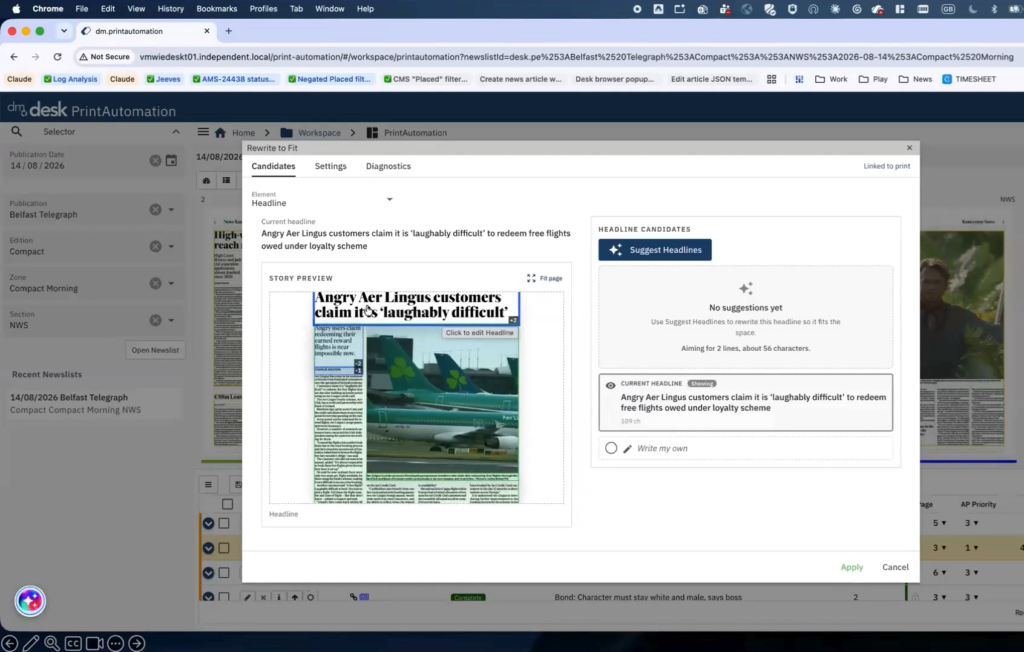
The convergence of algorithmic generation and legacy publication structures introduces a distinct operational friction point: the physical or digital manifestation of the newspaper page. When computational workflows attempt to automate editorial layout, the primary failure mode is not a lack of aesthetic variation, but a fundamental misunderstanding of the economic and cognitive constraints governing information hierarchy. News curation is an allocation problem operating under extreme time compression and spatial scarcity.
Treating page composition as a visual styling exercise misses the core mechanic. A newspaper page functions as a cognitive dashboard where spatial distribution communicates priority, urgency, and relational context. Replacing human layout desks with autonomous routines requires mapping editorial judgment into quantifiable variables, a process that exposes the limits of current programmatic design paradigms.
The Structural Mechanics of Editorial Layout
Editorial layout operates as a constrained optimization problem. The physical broadsheet or digital viewport provides a fixed canvas, while incoming reporting supplies a variable set of text blocks, imagery, infographics, and advertisements.
The human production editor solves this multivariate equation through continuous triage, balancing multiple competing vectors:
- Information Density: Maximizing the volume of high-value signal transmitted per square centimeter without triggering cognitive overload for the reader.
- Hierarchical Signaling: Using typographic scale, whitespace, and optical weight to establish an immediate, intuitive reading order that aligns with newsroom priorities.
- Temporal Decay: Accounting for the shelf-life of a story, ensuring breaking developments command visual dominance while evergreen analysis occupies secondary zones.
- Commercial Obligations: Preserving strict spatial boundaries and adjacency rules for paid inserts, maintaining regulatory and contractual separation between editorial and advertising assets.
When programmatic systems ingest these variables, they frequently reduce layout to a grid-fitting exercise. By prioritizing algorithmic whitespace minimization or aesthetic uniformity, automated tools often flatten the intentional friction that human editors introduce to signal investigative weight or narrative gravity.
The Cost Function of Algorithmic Composition
To evaluate the viability of automated page building, one must examine the underlying cost function. Traditional layout workflows incur high labor costs, significant coordination friction, and strict temporal bottlenecks. The editorial production cycle requires night-side copy desks, art directors, and production editors to negotiate placement under hard press deadlines.
Autonomous layout promises to invert this cost structure by driving marginal labor expenses toward zero and compressing production latency from hours to milliseconds. However, this substitution introduces hidden operational penalties that offset immediate payroll reductions.
Traditional Workflow:
Reporting -> Editing -> Manual Layout Negotiation -> Quality Control -> Press

Automated Workflow:
Reporting -> Parsing Engine -> Constraint Solver -> Programmatic Rendering -> Error Correction
The error correction phase represents the hidden tax of algorithmic composition. When a constraint solver misreads the semantic weight of an investigative piece and juxtaposes it with a trivial lifestyle brief, the semantic collision degrades brand equity.
Human editors maintain quality through intuitive anomaly detection—recognizing instantly when a juxtaposition is inappropriate, offensive, or confusing. Programmatic models lack this semantic grounding, requiring extensive heuristic rulebooks that grow increasingly brittle as newsroom formats evolve.
Typographic Hierarchy and Cognitive Ergonomics
The core artifact of newspaper design is the front page, an intentional arrangement designed to capture attention in high-noise retail environments. The visual hierarchy relies on proportional scaling and contrast.
Automated layout engines frequently default to rigid scale ratios derived from digital web design templates. These ratios often fail when translated to dense multi-column print environments or complex multi-story digital fronts.
Typography in journalism is not merely decorative; it is a semiotic system. A headline set at 72 points in a condensed bold face carries a different rhetorical weight than the same text set at 48 points in an open serif face.
Programmatic composition tools struggle with semantic sentiment analysis. If an automated system assigns a massive display font to an incorrectly categorized or sarcastic headline, the visual emphasis actively subverts the reporting.
The cognitive ergonomics of reading require predictable scanning paths. Human designers exploit peripheral vision and Gestalt principles of proximity and similarity to guide the eye through complex layouts.
When code attempts to mimic these principles via automated bounding-box calculations, it frequently produces layouts that are mathematically balanced yet functionally sterile. The reader loses the intuitive cues that separate a hard-hitting accountability investigation from a soft-focus human interest piece.
The Adjacency Problem and Revenue Integrity
Beyond editorial coherence, page architecture directly impacts commercial viability through advertising adjacency. In print operations, spatial placement determines inventory pricing. In automated digital or hybrid workflows, programmatic layout engines must dynamically allocate space for sponsored content without violating editorial integrity firewalls.
Human layout teams maintain these boundaries through institutional memory and explicit ethical guidelines. An editor knows implicitly that an investigative report on municipal corruption cannot sit adjacent to an advertisement for a real estate developer implicated in the probe.
Algorithmic layout systems evaluate inventory strictly on spatial dimensions and keyword matching. This narrow optimization creates severe brand safety vulnerabilities.
Without deep contextual reasoning engines, automated page builders risk pairing high-tragedy news events with incongruous commercial messaging. The financial downside of a single catastrophic algorithmic placement can outweigh weeks of operational labor savings, introducing systemic risk into the publication's revenue stream.
Operationalizing Hybrid Workflows
Given the limits of unconstrained programmatic layout, sustainable adoption requires a shift from complete automation to targeted human-in-the-loop augmentation. The goal is not to replace the layout desk, but to offload low-level spatial computation while preserving human authority over semantic weighting.
Successful implementation relies on modular design systems where articles are pre-packaged with precise metadata tags defining their narrative weight, visual assets, and priority tier. The layout engine acts as a constraint satisfaction tool, generating candidate arrangements that comply with grid parameters and commercial requirements.
The human editor functions as an editorial gatekeeper, selecting, tweaking, or overriding the programmatic output based on qualitative judgments that resist quantification.
This division of labor exploits the comparative advantages of both systems. Algorithms excel at rapid permutation testing, calculating thousands of potential grid configurations in milliseconds. Human editors excel at contextual nuance, emotional resonance, and ethical oversight.
Treating page building as an end-to-end black-box automation challenge invites failure. Treating it as a collaborative computation problem allows newsrooms to scale production capacity without sacrificing the editorial discernment that defines high-trust journalism.
Deploy the automated layout engine strictly as a constraint solver for repetitive modular sections, retaining human editorial control over front-page architecture and high-stakes investigations to protect both semantic integrity and brand equity.