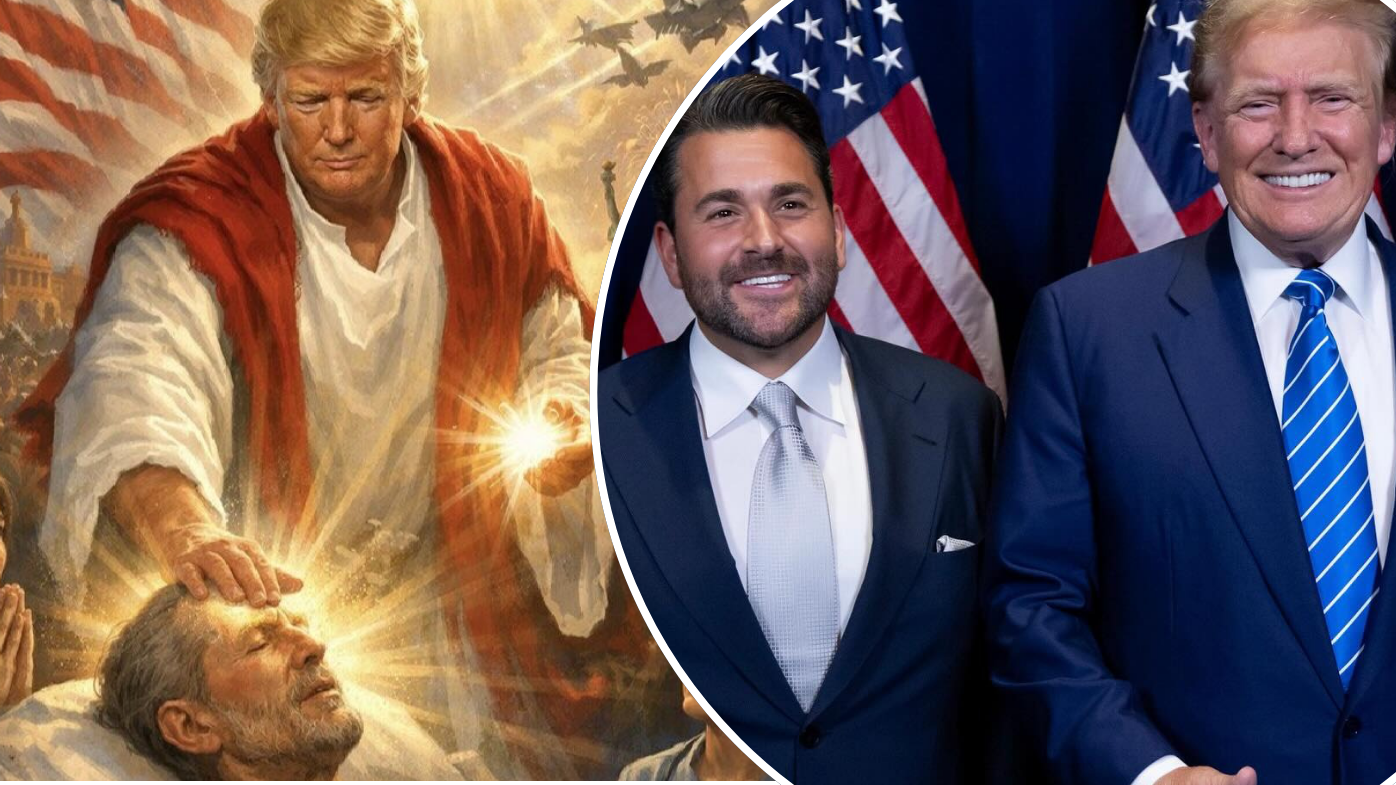
George Christensen did not just share a picture. When the former Member of the Australian Parliament posted a generative AI image of Jesus Christ walking alongside Donald Trump to his Facebook page, he wasn't acting as a casual observer of American politics. He was functioning as a crucial node in a global, decentralized machinery that converts religious sentiment into digital political capital. This specific image—a surreal, high-definition depiction of a golden-robed savior flanking a suit-clad politician—went viral not because of its artistic merit, but because it satisfied a specific craving in the algorithmic ecosystem. It signaled the arrival of a new era where political myth-making is no longer the sole province of expensive ad agencies, but a crowdsourced effort managed by international actors with nothing to lose and everything to gain from domestic American chaos.
The Resurrection of the Fringe via Silicon
For years, Christensen was a loud, often controversial figure in the National Party of Australia, representing the tropical electorate of Dawson. Since leaving office, he hasn't faded into the quiet retirement typical of former backbenchers. Instead, he has pivoted into the "alternative" media space, leveraging platforms like Substack and Facebook to maintain a base of several hundred thousand followers. His role in the Trump-Jesus AI phenomenon is a case study in how international figures use American cultural flashpoints to drive their own engagement metrics.
The image in question didn't appear by accident. It was the product of a specific prompt, likely fed into a tool like Midjourney or DALL-E, designed to evoke the "Aesthetic of the Devout." These AI models are trained on billions of images, including centuries of religious iconography. When a user asks for "Jesus with Trump," the AI doesn't understand theology or policy. It understands patterns. It pulls the soft lighting of 19th-century Sunday school lithographs and merges them with the sharp, saturated colors of modern political photography.
The result is a visual artifact that feels familiar yet entirely new. It bypasses the logical centers of the brain and targets the emotional core of the viewer. For a certain demographic, seeing their political hero literally blessed by a divine figure isn't "fake news"—it’s a visual representation of a spiritual truth they already hold.
The Mechanics of the Viral Feedback Loop
Why does an Australian ex-politician care about US election imagery? The answer is found in the economics of the attention economy. Christensen’s digital presence thrives on conflict and tribalism. By posting content that resonates with the American MAGA movement, he taps into a massive, highly active audience that far exceeds the population of his former electorate in Queensland.
The process works in a three-stage cycle that most traditional newsrooms are still struggling to map. First, a piece of content is generated—often by an anonymous "creator" in a Discord server or a private Facebook group. Second, an established "amplifier" like Christensen picks it up. His status as a former government official lends a veneer of legitimacy to the post, even if the content is patently absurd. Third, the platform’s algorithm sees the initial surge of likes, shares, and angry comments (outrage is just as valuable as praise) and pushes the post to millions of others who have never heard of George Christensen.
This is the Algorithmic Laundering of political propaganda. By the time the image reached the average American voter's feed, its origin in an Australian suburban office was irrelevant. It had become a grassroots "meme," a piece of digital folk art that felt like it belonged to the community.
The Death of the Gatekeeper
In the previous century, a political image of this nature would have required a printer, a distribution network, and a legal team to vet for libel or blasphemy. Today, those barriers are non-existent. Christensen’s post cost him zero dollars to distribute. The AI tool likely cost a $20 monthly subscription.
The danger isn't just that the image is "fake." Everyone with a functioning retina knows Jesus didn't actually walk through a campaign rally in 2024. The danger is the erosion of shared reality. When religious symbols are hijacked by AI to serve partisan ends, the symbols themselves lose their objective meaning. They become mere skins or textures used to wrap a political message.
The Religious Right and the Prompt Engineering Frontier
There is a profound irony in the adoption of AI by the religious right. AI is the ultimate product of secular, materialist science—a "black box" of linear algebra and probability. Yet, it is being used to create the most "spiritual" imagery the internet has seen in decades.
We are seeing the birth of Prompt-Based Theology. In this space, the "truth" of an image is measured by its "vibe" rather than its accuracy. Christensen understood this instinctively. He wasn't trying to trick people into thinking the photo was a real historical record. He was providing a tool for worship. In the modern political landscape, support for a candidate has taken on the characteristics of a religious conversion. The AI image serves as the contemporary equivalent of a stained-glass window for an illiterate congregation; it tells a story that words cannot adequately convey to a distracted public.
The Australian Connection
Australia has long been a testing ground for global media trends, largely due to the influence of the Murdoch empire. Christensen grew up in that environment, understanding that the most effective way to stay relevant is to be the loudest voice in the room. By positioning himself as a bridge between Australian "freedom" movements and the American "America First" movement, he creates a globalized brand of grievance.
The "Trump-Jesus" image is just one weapon in a much larger arsenal. These influencers are currently experimenting with AI-generated audio and video to see what sticks. They are looking for the "sweet spot" of cognitive dissonance—content that is just believable enough to be shared, but controversial enough to spark a fight in the comments section.
The Technical Vulnerability of the Electorate
The average social media user is not equipped for this. Most digital literacy programs focus on identifying "fake news" articles or checking sources. They do not prepare people for the visceral impact of high-fidelity AI imagery.
When an AI generates an image, it navigates what researchers call the Latent Space. This is a mathematical map of all possible images the model can create. By entering specific keywords, the user "navigates" to a coordinate where "Trump" and "Jesus" overlap. The machine doesn't have a bias; it simply follows the path of least resistance based on its training data. Because the internet is flooded with pictures of Trump and classical paintings of Jesus, the path between them is short and well-paved.
Christensen and his ilk are essentially miners in this latent space. They dig for the most evocative combinations and bring them to the surface. The platforms—Facebook, X (formerly Twitter), and Instagram—provide the infrastructure to transport these minerals to the masses.
Why Fact-Checking is Failing
Traditional journalism responds to these images with fact-checks. They point out that Jesus’s hands have six fingers (a common AI glitch) or that the lighting is inconsistent with a real-world environment. This is like bringing a ruler to a dream.
The people sharing Christensen’s post don't care about the number of fingers. They are participating in a Performance of Belonging. Sharing the image is a way of saying, "I am on this side." Every time a fact-checker debunks the image, it only reinforces the belief that the "establishment" is out to suppress the "truth."
The industry needs to stop treating these as isolated incidents of misinformation. They are tactical strikes in a war of perception. George Christensen is a pioneer in a new kind of borderless politics where an Australian politician can influence an American election by simply clicking "generate" and "post."
The Financial Incentive of the Fringe
Follow the money, and the picture becomes even clearer. Christensen’s digital ecosystem—his newsletters, his social media presence, his appearances on fringe broadcasts—all rely on a steady stream of high-engagement content. AI is the ultimate labor-saving device for the independent agitator.
Before AI, creating a high-quality propaganda poster required a graphic designer. Now, it requires ten seconds of typing. This democratization of high-fidelity content means that the volume of "mythological" political content will only increase. We are entering a period of Infinite Content, where every niche grievance can have its own customized, high-definition visual library.
Christensen’s move was a calculated play for relevance in a world where attention is the only currency that matters. He didn't need to win an election in Dawson to have power; he just needed to be the guy who posted the image that five million people saw.
The Structural Threat to Discourse
The real danger here isn't the specific image of Jesus and Trump. It’s the normalization of the Synthetic Narrative. When a significant portion of the population begins to prefer synthetic images over real ones because the synthetic ones better reflect their internal biases, the concept of an objective public square dies.
We are watching the "Great Decoupling" of imagery from reality. In the past, a photograph was a "trace" of a real event. Light hit a sensor or a piece of film. Today, an image is a "calculation." It is a statistical prediction of what an image should look like based on a prompt.
George Christensen didn't just share a meme. He helped usher in the era of Calculated Reality, where the most powerful images are those that never happened at all.
Identify the AI glitches in every political image you see. Look for the melting backgrounds, the fused limbs, and the impossible shadows. But more importantly, look for the person who posted it and ask what they stand to gain from your emotional reaction. The "why" is always more dangerous than the "how."
Stop reacting. Start analyzing the source. If the person posting an American religious icon is a former politician from the other side of the planet, you aren't looking at a message of faith; you are looking at a product of the global outrage industry.