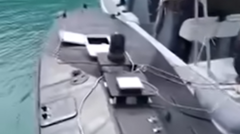
The discovery of a sophisticated, unidentified naval drone in the Ionian Sea represents more than a localized security anomaly; it is a physical manifestation of the declining cost of maritime denial. While initial reports focus on the "mystery" of the craft’s origin, the real value lies in the platform’s architecture, which signals a shift toward disposable, high-endurance surveillance. The object—a sleek, metallic vessel resembling a miniature torpedo or a high-speed submersible—indicates a design priority for low observability and long-range persistence over raw kinetic power. Analyzing this asset requires a departure from traditional naval "presence" metrics, shifting instead toward an assessment of autonomous endurance and the geometric expansion of surveillance blankets in contested waters.
The Architecture of Low-Signature Autonomy
To understand the tactical utility of the Ionian asset, one must decompose its physical form into three functional subsystems: the hull geometry, the energy density of the propulsion system, and the sensor aperture.
Hydrodynamic Efficiency vs. Internal Volume
The craft’s tapered, cylindrical profile suggests a design optimized for laminar flow. In underwater vehicles, drag is the primary constraint on operational range. By minimizing the frontal cross-section, the manufacturers have maximized the distance the unit can travel per kilowatt-hour of battery capacity. This specific geometry suggests the drone was not designed for short-range harbor defense but for "blue water" transit or prolonged loitering.The Acoustic Profile
The absence of visible external propellers points to the use of a pump-jet or a high-efficiency electric thruster. This reduces the cavitation signature—the primary method by which sonar arrays detect submerged objects. For a state or non-state actor, the goal is not just to collect data, but to do so without triggering the "cost of discovery," which would result in the loss of the asset or the compromise of the intelligence mission.Sensor Integration
The recovered unit features specialized apertures likely housing electro-optical (EO) sensors or side-scan sonar. Unlike traditional manned vessels, these autonomous units operate as "edge nodes" in a wider network. They do not require high-bandwidth real-time transmission, which would reveal their location via radio frequency (RF) emissions. Instead, they likely utilize burst-transmission protocols or physical recovery of data logs, making them nearly invisible to standard electronic warfare (EW) sweeps.
The Economics of Maritime Denial
The presence of this drone underscores a fundamental shift in the cost-exchange ratio of naval warfare. Traditionally, controlling a sea lane required an expensive destroyer or frigate. The Ionian discovery proves that "sea denial"—the ability to prevent an opponent from using a space safely—is becoming commoditized.
The Attrition Variable
Maintaining a surface fleet involves massive capital expenditure ($CAPEX$) and operational expenditure ($OPEX$). In contrast, a fleet of low-cost autonomous underwater vehicles (AUVs) operates on a logic of attrition. If a $50,000 drone forces an opponent to deploy a $1 billion frigate for three weeks of search-and-rescue or patrol operations, the drone has already achieved a strategic victory through "economic exhaustion."
The Intelligence Horizon
The Ionian Sea is a critical corridor for NATO movements and undersea infrastructure, including fiber-optic cables and energy pipelines. The utility function of a lost drone is calculated by:
$$U = (P_{success} \times V_{data}) - (P_{capture} \times C_{exposure})$$
Where:
- $P_{success}$ is the probability of a successful mission.
- $V_{data}$ is the strategic value of the gathered intelligence.
- $P_{capture}$ is the probability of the unit being found (as happened here).
- $C_{exposure}$ is the political or technical cost of the asset being analyzed by an adversary.
For the operator of the Ionian drone, $C_{exposure}$ was likely deemed low because the components are likely "off-the-shelf" (COTS), making attribution difficult. This "plausible deniability" is a core feature of modern grey-zone maritime operations.
Probabilistic Origin and Mission Profile
Without state markings, determining the origin requires a forensic audit of the internal components—specifically the inertial navigation systems (INS) and the pressure-hull welding techniques. However, we can categorize the likely mission profiles based on the location of the find.
Sub-Surface Mapping and Infrastructure Vulnerability
The Mediterranean floor is a dense grid of communication cables. A drone of this size is perfectly suited for "bathymetric mapping," which is the precursor to sabotage. By identifying the exact burial depth and tension points of undersea cables, an actor gains the ability to decapitate regional communications during a flashpoint conflict.
Acoustic Signature Harvesting
The Ionian Sea serves as a transit point for various naval powers. A loitering drone acts as a passive listener, recording the unique acoustic signatures of passing submarines and surface ships. This data is fed into machine-learning algorithms to improve the target-recognition capabilities of torpedoes and anti-ship missiles in the future.
Test-Bed Prototyping
The possibility remains that the unit is a prototype from a regional defense contractor or a NATO-aligned research facility that suffered a mechanical failure. The "mystery" element often stems from bureaucratic silos where a recovery team (the Hellenic Navy) is not immediately informed of a localized research project. However, the lack of recovery transponders—standard on most research AUVs—suggests a more clandestine intent.
Technical Limitations and Failure Modes
The fact that the drone was "found" rather than "intercepted" indicates a terminal failure in its recovery cycle or power management.
- Energy Depletion: Most small-scale AUVs rely on lithium-ion or silver-zinc batteries. If the propulsion system encounters stronger-than-expected currents (common in the Ionian), the drain on the battery exceeds the programmed safety margin, leading to a "dead" asset that drifts with the surface current.
- Navigational Drift: In the absence of GPS (which does not penetrate water), AUVs use dead reckoning. Errors in the internal gyroscopes accumulate over time, leading to the vehicle surfacing in the wrong coordinates, where it becomes a hazard to navigation and a target for discovery.
- Communication Blackout: If the unit was designed to surface and "phone home" via satellite link, a failure in the antenna housing would leave it stranded.
Strategic Implications for Mediterranean Security
The recovery of this asset serves as a warning that the "undersea shield" of NATO’s southern flank is no longer a vacuum. The proliferation of these systems creates a "cluttered" environment where distinguishing between a commercial research tool, a fishing buoy, and a hostile surveillance node becomes an impossible task for traditional radar.
The Hellenic Navy’s examination of the hull will focus on the "provenance of parts." If the microchips and sensors are sourced from a specific geopolitical bloc, the mystery evaporates. Until then, the presence of the drone confirms that the Ionian Sea has become a laboratory for asymmetric maritime competition.
Security forces must now transition from "gatekeeping" (protecting specific ports) to "wide-area persistence." This involves deploying their own networks of "picket" drones to detect and neutralize intruding assets before they reach sensitive infrastructure. The era of the "empty" ocean is over; the future is a crowded, autonomous, and increasingly silent competition for the seabed.
The immediate tactical requirement for regional actors is the establishment of an "Undersea Domain Awareness" (UDA) registry. This would mandate acoustic "license plates" for legitimate research drones, allowing defense forces to use "identify-by-exception" logic. Any asset not broadcasting a verified acoustic or RF handshake is automatically classified as hostile. This move shifts the burden of proof onto the operator and increases the $C_{exposure}$ for clandestine missions, effectively re-establishing a degree of deterrence in the Ionian and beyond.