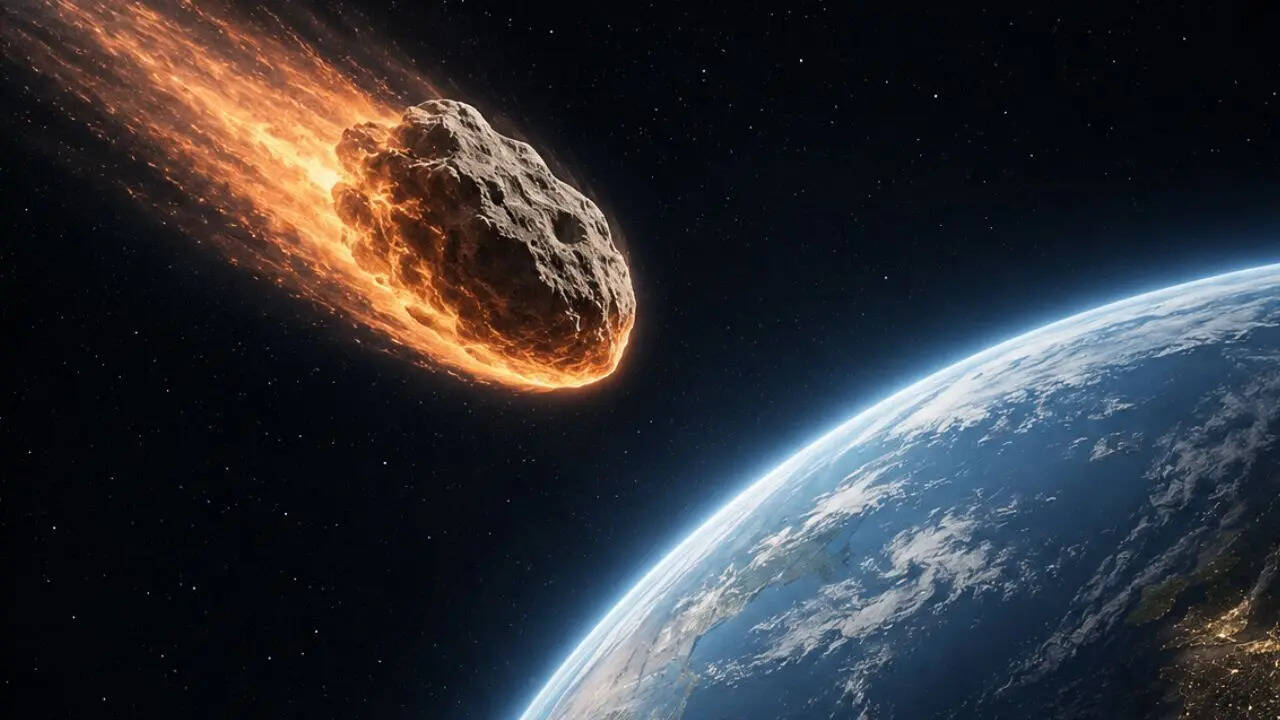
NASA just flagged a school bus-sized rock named 2026 JH2 that's barreling toward our neighborhood. You don't need to panic or start building a bunker in the backyard. It's not going to end civilization. But ignoring it would be a mistake because these close shaves are the only real practice we get for the big one. Space is crowded. Most people think it's a vast, empty vacuum, but it's actually crawling with "near-Earth objects" or NEOs that keep astronomers up at night.
NASA's Center for Near-Earth Object Studies (CNEOS) keeps a constant watch on these things. When they say an asteroid is "close," they're talking about astronomical scales. This specific rock, roughly 10 to 12 meters in diameter, is passing within a distance that makes scientists lean in closer to their monitors. It’s moving fast. It’s small enough to burn up if it hit the atmosphere, yet large enough to cause a massive mid-air explosion like the one we saw over Russia years ago. For a more detailed analysis into similar topics, we recommend: this related article.
The Reality of 2026 JH2 and Its Path
Calculations show 2026 JH2 will clear us safely. However, the trajectory of a rock this size is influenced by more than just gravity. There's something called the Yarkovsky effect. Essentially, as an asteroid absorbs sunlight and radiates it back out as heat, it acts like a tiny thruster. This can nudge an asteroid off its predicted path over time. For a bus-sized object, that nudge doesn't change much for this pass, but it matters for the next one.
NASA uses the Goldstone Solar System Radar and the Pan-STARRS survey to track these movements with incredible precision. They aren't just looking for a "yes" or "no" on impact. They're looking at rotation, composition, and whether the rock is a solid chunk of iron or just a loose pile of space gravel. 2026 JH2 belongs to the Apollo group of asteroids. These are the ones that cross Earth's orbit, making them the most frequent visitors to our immediate vicinity. For broader background on this development, detailed reporting can be read on BBC News.
Why Small Asteroids Are Often More Dangerous Than Big Ones
We're actually pretty good at finding the "planet killers." We’ve mapped out almost all the asteroids larger than a kilometer. We know where they are. We know they aren't hitting us anytime soon. The real headache comes from the 10-meter to 140-meter range. These are much harder to spot because they're dim. Often, we don't see them until they’ve already zoomed past us or, in some cases, until they hit the atmosphere.
Think back to the Chelyabinsk event in 2013. That rock was about 20 meters wide. Nobody saw it coming because it arrived from the direction of the sun, blinding our telescopes. It exploded with the force of about 30 Hiroshima bombs. It shattered windows for miles and injured over a thousand people. 2026 JH2 is slightly smaller than that, but it’s in the same weight class. It’s a reminder that space doesn’t need to send a mountain to ruin your Tuesday.
How NASA Actually Tracks These Targets
The process isn't just pointing a telescope and clicking a photo. It’s about data points over time. When a new object like 2026 JH2 is spotted, the Minor Planet Center in Cambridge, Massachusetts, becomes the central hub. They take observations from hobbyists and professional observatories alike to build a "risk corridor."
I've talked to folks who follow this stuff daily. They'll tell you the math is solid, but the "uncertainty" grows the further out you look. For this 2026 pass, the window is tight. We know exactly where it will be. But every time a rock passes close to a planet, the planet's gravity bends its orbit. Earth is literally changing the future path of 2026 JH2 as it swings by. This "gravitational slingshot" means we have to re-calculate its entire future every single time it visits.
What Happens If We Actually Find One On A Collision Course
If 2026 JH2 were actually going to hit, we wouldn't just sit there. The DART mission proved we can change an asteroid’s mind. By slamming a spacecraft into a rock, NASA showed we can nudge these things. For a school bus-sized object, we wouldn't even need a massive impactor. A relatively small kinetic hit years in advance would be enough to make it miss Earth entirely.
The problem is lead time. We need years, not weeks. That's why missions like the NEO Surveyor are so vital. We're trying to move from a "reactive" stance to a "proactive" one. We want to find these things decades before they become a headline. Right now, we’re mostly playing dodgeball in the dark.
What You Should Do Instead Of Worrying
Stop looking for "doomsday" dates on TikTok. Most of those "NASA confirms" headlines are clickbait designed to scare you. The real data is public. You can check the CNEOS Sentry table yourself. It lists every known object with even a microscopic chance of hitting us.
If you're interested in the science, get a decent pair of binoculars or a beginner telescope. While 2026 JH2 is too small and fast for most backyard setups to track easily, its passing is a great excuse to learn the night sky. Most people don't realize how much stuff is actually moving up there.
Keep an eye on the official NASA Asteroid Watch Twitter (or X) feed. They're direct. They don't hype things up. If there’s a real threat, that’s where the verified info will live. Don't rely on secondary news sites that prioritize ad revenue over orbital mechanics.
The pass of 2026 JH2 is a win for science. Every time a rock comes this close, we get better data. We refine our tracking algorithms. We learn more about the debris left over from the birth of our solar system. It’s a flyby, not a funeral.
Check the NASA Small-Body Database for the latest flyby schedules if you want to stay ahead of the news cycle. There are dozens of these close approaches every month that never make the news because they aren't "bus-sized" enough for a catchy headline. Awareness is better than anxiety. Stick to the hard numbers and let the astronomers do the sweating.