The Institutional Friction of Post-Conflict Transitions
The transition of the Bangsamoro Autonomous Region in Muslim Mindanao (BARMM) toward its inaugural parliamentary elections represents a fundamental stress test for institutional design in post-conflict zones. When a governance framework shifts from provisional administration to elected parliamentary representation, the mechanism of power allocation undergoes a violent compression. Decades of un-channeled political ambitions, localized clan rivalries, and armed factionalism converge on a single institutional bottleneck.
In established democracies, elections serve as a periodic referendum on administrative competence governed by deep-rooted norms and reliable third-party enforcement. In post-conflict autonomous territories, however, elections function as high-stakes zero-sum redistribution events. The stakes extend far beyond legislative seats; they determine resource allocation, security control, administrative appointments, and patronage distribution for years. When the prize of electoral victory dictates economic survival and territorial security, the incentives for compliance with procedural rules degrade rapidly.
The structural vulnerability of this transition lies in the mismatch between administrative ambition and local security capacity. The central government and regional authorities deployed substantial security forces to safeguard the electoral process, yet the fundamental architecture of local dispute resolution remained fragile. Understanding why violence erupts during these milestones requires examining the precise mechanical chain linking institutional deficits to physical conflict on the ground.
The Micro-Mechanics of Polling Center Escalation
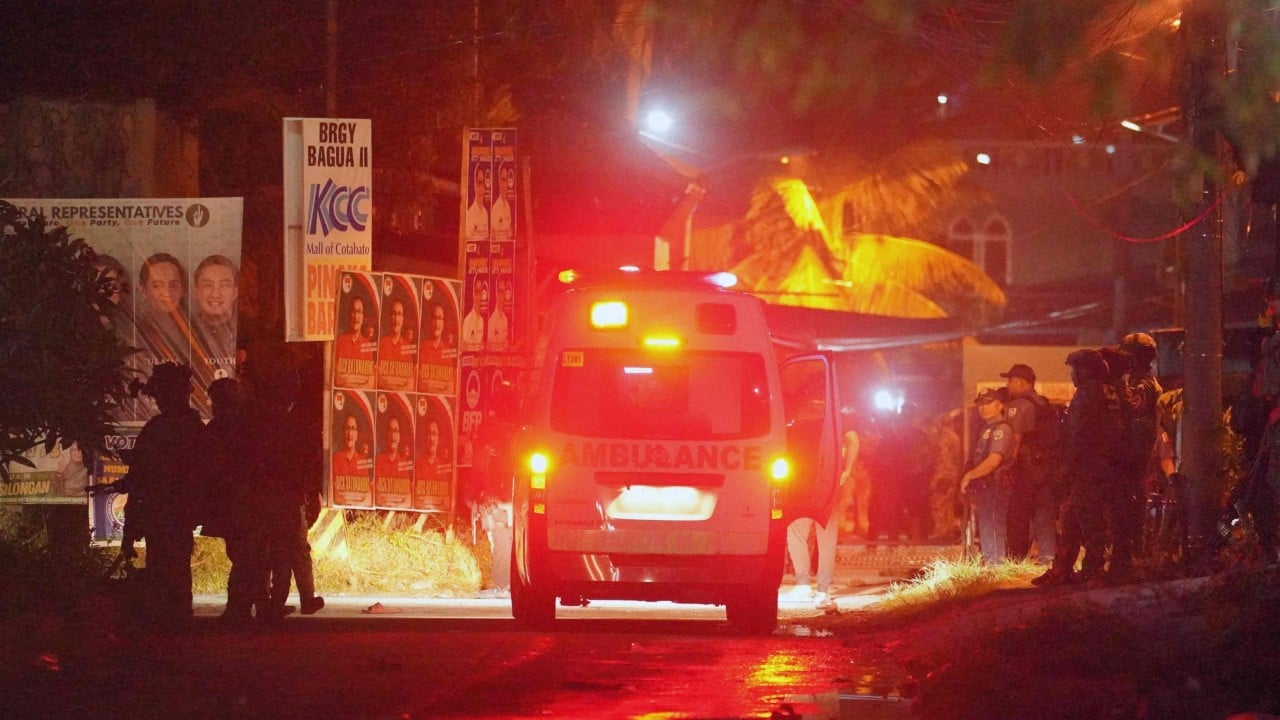
The kinetic outbreak outside the Datu Usman Mampen Elementary School in Cotabato City, which left three dead and fifteen wounded, illustrates the operational dynamics of polling center friction. The incident did not emerge from a sophisticated, pre-planned tactical assault by insurgent organizations. Instead, it followed a predictable escalatory curve born of spatial congestion and symbolic competition.
The sequence began with a structural bottleneck: crowding at the perimeter of a high-density polling center hours before balloting commenced. In environments marked by intense polarization, the act of voting carries profound symbolic weight. Rival political factions vie not only for legislative outcomes but for immediate psychological dominance at the voting station. The desire of competing groups to establish presence, control access points, and signal dominance creates an immediate physical proximity between hostile actors.
This physical friction manifested as a struggle for position in the queue. In the absence of rigorous, neutral queue management by security personnel, minor shoving matches escalated into physical altercations. Once a fistfight broke out in a crowded, high-tension area where firearms were readily accessible, the threshold for lethal escalation collapsed. The presence of armed individuals within factional entourages transformed a localized dispute into a deadly firefight.
This micro-level failure demonstrates that election security cannot focus solely on perimeter defense against organized insurgencies. It must account for crowd dynamics, queue management, and the immediate disarmament of all political entourages entering voting perimeters. When spatial control breaks down, the physical design of the polling center itself becomes a catalyst for violence.
State Intervention Limits and Electoral Control Mechanisms
Faced with localized security breakdowns, state authorities deployed administrative and coercive countermeasures, most notably placing volatile areas such as Cotabato City and Maluso in Basilan under the direct control of the Commission on Elections (COMELEC). While such measures signal state resolve and authorize emergency interventions, their operational efficacy reveals distinct limitations.
Placing a jurisdiction under COMELEC control alters the chain of command, subordinating local police forces to national election authorities and authorizing heightened military deployment. This intervention is effective at suppressing large-scale armed movements and deterring overt intimidation by formal militia units. However, it exhibits structural blind spots when confronting decentralized, opportunistic violence and administrative subversion.
For instance, while security forces contained the immediate aftermath of the Cotabato City shootings and intercepted improvised explosive devices, they struggled to prevent pre-election logistical corruption in other sectors. In Basilan, the discovery of pre-shaded ballots across multiple precincts exposed a parallel vector of electoral distortion. When kinetic suppression succeeds, bad actors frequently migrate from open violence to administrative fraud, exploiting gaps in chain-of-custody protocols for election materials.
The fundamental limitation of state intervention in these settings is its reactive posture. Security architectures are calibrated to respond to outbreaks of violence or fraud after detection, rather than neutralizing the structural incentives that drive actors to subvert the process in the first place. Consequently, state control functions as a stabilizing thumb on the scale rather than a permanent resolution of underlying political rivalries.
The Cost Function of Factional Competition in Weak Institutional Settings
To understand why local political actors resort to violence despite the presence of state security forces, one must examine the cost function governing factional behavior. In an institutional setting where judicial recourse is weak, corruption is difficult to prosecute, and the rule of law is inconsistently applied, formal legal mechanisms fail to guarantee the security or economic viability of political factions.
When a political faction evaluates whether to respect electoral rules or employ intimidation, it weighs several variables:
- The probability of state detection and prosecution for electoral offenses.
- The economic and security losses associated with losing political office.
- The perceived bias or capture of local administrative and law enforcement bodies.
- The retaliatory capacity of rival factions if concessions are made.
In regions with a history of armed conflict, the perceived cost of losing political control is existential. Local power holders often rely on control over local government units to finance security operations, protect economic ventures, and shield kin groups from legal or extrajudicial retaliation. Therefore, the expected utility of disrupting an election or seizing an unfair advantage through force frequently outweighs the deterrent value of state penalties, which are heavily discounted by actors who believe enforcement is selective or corruptible.
This dynamic explains why appeals for peace by regional leaders, while morally necessary, often fail to alter the calculus of low-level operatives and rival clans. Without credible, immediate, and impartial enforcement of the law, rational actors default to self-preservation and aggressive posturing.
Strategic Calibrations for Institutional Enforcement
Addressing the root causes of electoral violence in autonomous regions requires moving beyond temporary security surges toward structural institutional engineering. The recurrence of violence during foundational democratic exercises points to specific vulnerabilities that must be systematically dismantled before future electoral cycles.
First, the physical architecture of voting must be re-engineered to eliminate points of friction. Polling centers must be decentralized, and queue management must be insulated from political actors through neutral, professionalized administrative staff supported by impartial security cordons that enforce strict disarmament zones well beyond the immediate school perimeter.
Second, the administrative oversight of electoral materials requires end-to-end cryptographic and physical tracking to neutralize administrative fraud, such as pre-shading. When physical ballot security is absolute, the incentive for factions to seize control of specific polling stations diminishes, as tampering becomes logistically impossible.
Third, the state must dismantle the private armed groups and informal security apparatuses that sustain local political dynasties. As long as politicians maintain private enforcers, the transition from violent competition to peaceful civic participation remains incomplete. Disarmament initiatives must be decoupled from election schedules and pursued as a continuous, permanent mandate of national security policy.
Finally, the accountability mechanism for electoral crimes must be radically accelerated. When investigations into shootings, intimidation, and ballot tampering drag on for years without prosecution, the deterrent effect vanishes. Establishing specialized, fast-track electoral tribunals with dedicated investigative units can alter the risk calculation for bad actors, ensuring that the cost of violence exceeds any possible political gain.
Philippines Vote Turns Deadly! 3 Killed, 15 Wounded In ...
This video documentation provides direct visual and contextual evidence regarding the immediate aftermath and security conditions surrounding the outbreak of violence at the polling center in Cotabato City.


