Fifty years of low-Earth orbit complacency are about to collide with the cold reality of deep space. When the four astronauts of the Artemis II mission climb into the Orion capsule, they aren’t just taking a victory lap around the Moon. They are serving as the ultimate stress-test for a spacecraft architecture that has never carried a human heart past the Van Allen belts. While public relations broadcasts focus on the inspiration of the crew, the engineering reality is a high-stakes calculation of heat shields, radiation shielding, and the brutal physics of a high-velocity splashdown.
The mission represents the first time humans will leave the protective magnetic cradle of Earth since 1972. It is a ten-day sprint that pushes the Orion Multi-Purpose Crew Vehicle (MPCV) to its absolute limits. This is not a repeat of Apollo. The technology is newer, the systems are more integrated, and the margin for error has shrunk as the complexity of the life-support systems has scaled. To understand the gravity of Artemis II, one must look past the press releases and into the telemetry of what happens when a machine built on Earth meets the vacuum of the lunar far side.
The Heat Shield Problem
The most critical moment of Artemis II doesn't happen at the Moon. It happens at 25,000 miles per hour in the upper atmosphere of Earth. When Orion returns from its lunar trajectory, it hits the air with such force that it creates a plasma field around the craft. This isn't the standard re-entry experienced by the International Space Station crews. A return from the Moon involves significantly more kinetic energy, which translates into thermal loads that would vaporize a standard spacecraft.
During the Artemis I uncrewed test, engineers observed unexpected charred material loss from the Avcoat heat shield. Instead of wearing away evenly—a process called ablation—the material chipped off in small pieces. This "skipping" effect has been the subject of intense scrutiny for months. NASA’s decision to proceed with a crewed mission hinges on the belief that this phenomenon, while surprising, does not compromise the structural integrity of the capsule. It is a calculated risk. If the shield fails to shed heat uniformly, "hot spots" can develop, potentially threatening the pressure vessel where the four astronauts sit.
Living in a Telephone Booth
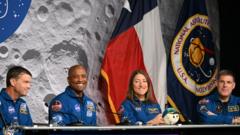
For ten days, Reid Wiseman, Victor Glover, Christina Koch, and Jeremy Hansen will occupy a pressurized volume roughly the size of a large SUV. This is a radical departure from the spacious confines of the ISS. Every breath they take and every drop of sweat they produce must be scrubbed, recycled, and managed by a Life Support System (LSS) that has never functioned with four metabolic loads in deep space.
The LSS on Orion is a marvel of miniaturization, but it is also a single point of failure. Unlike the station, which can be resupplied or evacuated in hours, a malfunction halfway to the Moon is a death sentence if the redundant systems don't kick in instantly. The crew has spent thousands of hours training for "manual override" scenarios where they must take control of the carbon dioxide scrubbing or the pressure regulation. They aren't just pilots; they are high-stakes plumbers and electricians in a vacuum.
The Radiation Ghost
Beyond the protection of Earth’s magnetosphere, space is a shooting gallery of high-energy particles. Solar Particle Events (SPEs) and Galactic Cosmic Rays (GCRs) pose a constant threat to human DNA. While the Apollo missions were short enough that the crews largely avoided major solar storms by luck, Artemis II is launching during a period of increasing solar activity.
Orion features a "shelter" concept where the crew can huddle in the center of the capsule, surrounded by water tanks and equipment to create a thicker barrier against radiation. It’s a primitive but effective solution. However, the long-term effects of this exposure remain the great unknown of the program. Every hour spent outside the magnetosphere adds to a cumulative dose that NASA's medical teams will be tracking for the rest of the astronauts' lives. They are the guinea pigs for the Mars generation.
Communication Blackouts and Autonomous Fear
When Orion passes behind the Moon, the crew will experience a total silence from Earth. For those minutes, they are more isolated than any human being in existence. This period of "Loss of Signal" (LOS) forces the onboard computers to handle navigation and life support without the safety net of Mission Control in Houston.
Modern avionics are exponentially more powerful than the Apollo Guidance Computer, but they are also more susceptible to "bit flips" caused by cosmic radiation. A single stray particle hitting a memory chip can cause a system crash. NASA uses "voting" computers—multiple systems running the same calculations to ensure a majority rules—but the software complexity of Artemis is a double-edged sword. More code means more potential for unforeseen bugs to emerge in the harshest possible environment.
The Violence of the Pacific
The mission ends in the Pacific Ocean, but the splashdown is far from a gentle dip. Orion utilizes a "skip re-entry" maneuver, essentially bouncing off the atmosphere like a stone on water to bleed off speed and target a specific landing zone. This reduces the G-loads on the crew but increases the precision required for the navigation systems.
Once the parachutes deploy and the capsule hits the water, the crew faces a new danger: the "stable two" position. If the capsule flips upside down in the waves, a series of balloons must inflate to right the craft. If those balloons fail, the crew is suspended upside down in their seats, potentially nauseous from the transition back to gravity, waiting for recovery teams in a tossing sea. It is a brutal end to an exhausting journey.
The Logistics of the Moon
We often talk about Artemis as a singular event, but it is actually a sprawling logistical nightmare involving hundreds of contractors and thousands of miles of supply chain. The Space Launch System (SLS) rocket is a massive, expensive beast that can only be produced at a rate of roughly one per year. This "single-shot" nature of the hardware means there is no "backup" rocket waiting in the wings if Artemis II has a pad abort or a mid-flight failure.
This scarcity creates an immense psychological pressure on the flight controllers. Every decision is weighed against the fact that a failure doesn't just mean a lost mission; it could mean the end of the entire lunar program for a generation. The political appetite for space exploration is notoriously fickle, and the Artemis program is built on a foundation of international agreements and taxpayer funding that demands near-perfection.
Why This Mission Matters More Than Apollo
Apollo was a sprint driven by Cold War optics. Artemis is an attempt to build a permanent presence. Artemis II is the gatekeeper. If the crew successfully navigates the lunar flyby and proves that the Orion life support can handle a full human complement, the path to the Gateway station and the lunar surface becomes clear.
If they struggle, or if a major system fails, the timeline for human lunar landings will slip into the 2030s. This isn't just about flags and footprints. It’s about proving that we can reliably operate a crewed vehicle in the deep-space environment for extended periods. The data gathered from the crew’s physiological responses and the ship’s structural performance will dictate the design of every Mars-bound craft for the next fifty years.
The Unseen Variables
There is a tendency to view these missions as scripted events. They are anything but. Spaceflight is a series of controlled explosions and high-speed impacts. The crew of Artemis II knows that they are riding on a vehicle that is essentially a prototype. Every valve, every circuit, and every seal is a hypothesis that only the mission itself can prove.
The astronauts aren't just following a flight plan; they are the final layer of redundancy in a system that is pushing the boundaries of what is physically possible. They are the human element in a machine designed to survive the most hostile environment known to man. When they splash down in the Pacific, the success won't be measured by the photos they took of the lunar surface, but by the integrity of the data recovered from the ship's systems.
The Real Cost of Progress
The Artemis program is frequently criticized for its cost and its reliance on "legacy" technology like the RS-25 engines from the Space Shuttle. However, this reliance is a strategic choice. By using flight-proven engine designs, NASA hoped to reduce the variables in an already complex mission. Artemis II is the moment where that strategy is tested. Can refurbished 20th-century propulsion technology reliably carry 21st-century avionics and life support to the Moon?
The answer determines the future of NASA as a deep-space agency. If Artemis II succeeds, it validates the "incremental" approach to space exploration. If it falters, it will likely be the last time the United States builds a heavy-lift rocket using this traditional procurement model. The stakes extend far beyond the four seats inside the capsule.
The Mission Is the Message
When the crew looks out the window at the receding Earth, they will be seeing a sight that only 24 people have ever seen before. But they won't have time for poetry. Their schedule is packed with tests: manual proximity operations, checking the performance of the optical navigation system, and monitoring their own biological markers.
They are technicians in a high-speed laboratory. The "splashdown moment" is the final exam. It is the point where the kinetic energy of the mission is finally extinguished and the crew can breathe air that wasn't recycled by a machine. Until that moment, they are in a constant state of managed crisis, operating a vehicle that is at the very edge of its design envelope.
The success of Artemis II isn't found in the headlines; it’s found in the heat shield’s char layer, the oxygen scrubber’s efficiency, and the crew’s ability to stay alive in a place where nothing else can. Stop looking at the Moon and start looking at the machine. It is the only thing standing between four humans and the absolute zero of the void.