The coffee in the paper cup had gone cold hours ago. Marcus did not drink it. He simply held the damp cardboard against his palms while the monitor cast a faint, ghostly blue glow across the quiet room. Outside, Washington was asleep, wrapped in the heavy, humid stillness of a late-night autumn. Inside, the servers hummed—a steady, dry respiration of cooling fans that sounded less like machinery and more like the breathing of a caged animal kept just out of sight.
On the screen, a line of code scrolled past. It was synthetic prose, generated in milliseconds by an architecture that did not know it existed.
Across the Pacific, in rooms just as quiet and far more opulent, other men were looking at similar screens. They were looking at models that could predict economic shifts, map biological proteins, and synthesize human speech with an inflection so subtle it could fool a grieving mother. And now, the men who commanded the world's two largest economies were preparing to sit across a table and talk about pressing the pause button.
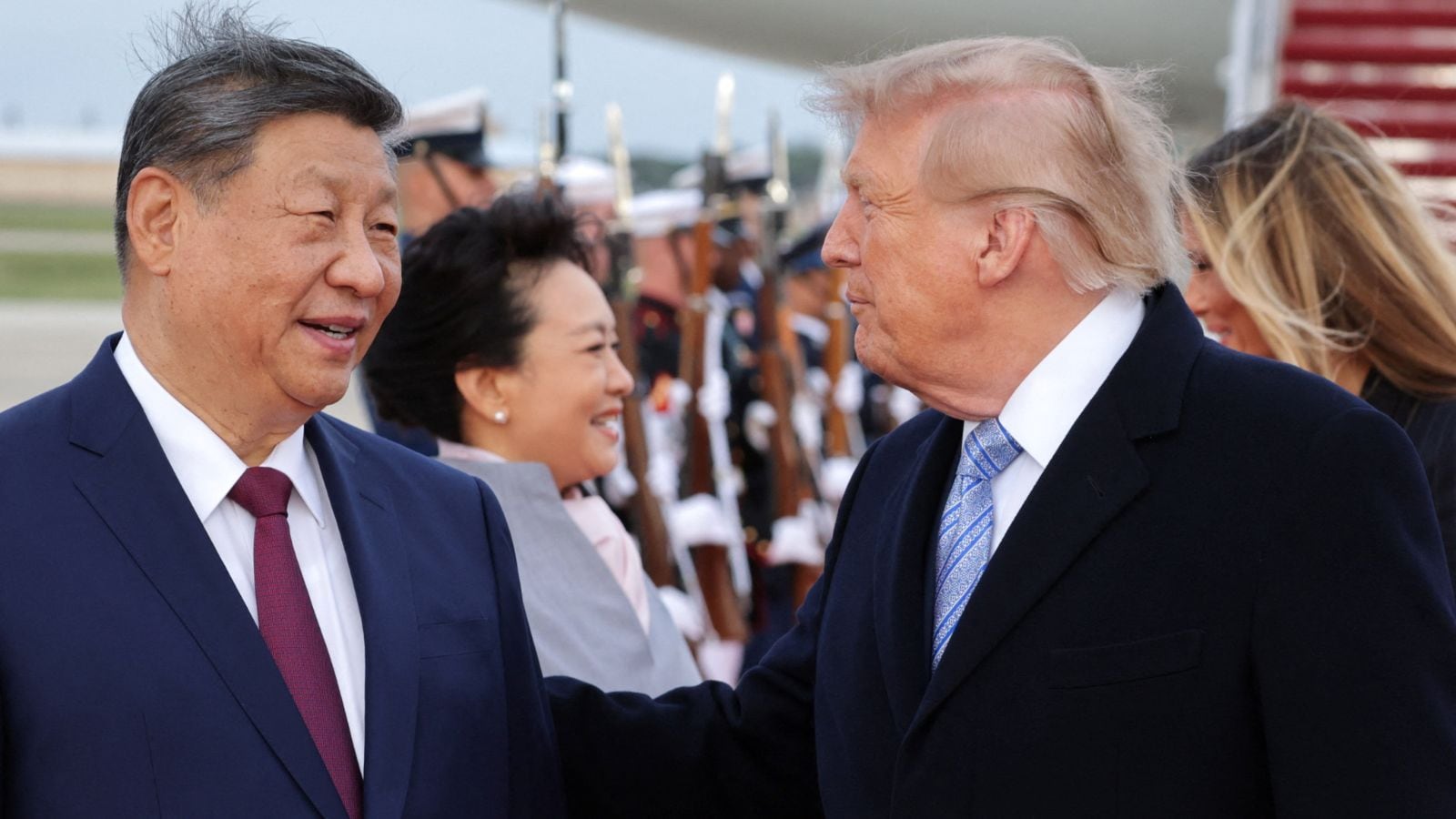
President Trump’s recent declaration carried a characteristic bluntness. He wanted to discuss artificial intelligence with President Xi Jinping, but his stated ambition was deceptively simple, almost quaint in its defiance of momentum: he wanted to leave it exactly where it is.
A freeze. A ceasefire in silicon.
To the casual observer, the idea sounds comforting. It evokes the image of two exhausted runners lowering their hands to their knees, calling a truce before the finish line turns into a precipice. But history is littered with the bones of treaties designed to stop rivers with toothpicks. Technology does not recognize a ceasefire. Code does not sleep while diplomats sleep.
Consider what actually happens when you tell a river to stop flowing.
The Physics of an Invisible Race
To understand why a standstill between Washington and Beijing sounds easier than drawing breath, one must look at the nature of the material itself.
Decades ago, nuclear arms control treaties worked because the fuel of atomic destruction was heavy, scarce, and radioactive. You could count centrifuges. You could weigh enriched uranium. You could look at grainy satellite photographs of concrete bunkers in the desert and know with a reasonable degree of certainty whether a nation was building a bomb. The containment vessel had mass. The weapon had a footprint.
Artificial intelligence possesses none of these physical constraints.
It is made of logic and electricity. It lives on thousands of off-the-shelf graphics cards humming quietly in basement apartments, in university computer science labs, in corporate server farms tucked behind unremarkable industrial parks in Ohio and Guangdong. A breakthrough in neural network architecture does not require a shipping container or a secure rail line. It requires a GitHub repository, an internet connection, and a mind willing to type.
When Donald Trump suggests leaving artificial intelligence "right where it is," he is proposing a moment of absolute stillness in a system designed exclusively for acceleration. He is looking at a boulder rolling down a steep shale mountain and asking it to hover mid-air, purely by mutual agreement.
The political impulse is understandable. Fear is a rational response to the unknown. When politicians look at autonomous systems, they do not see algorithms; they see the unraveling of human authority. They see automated stock market crashes triggered in microseconds by digital entities executing logic no human programmer can trace. They see disinformation campaigns so sophisticated they dissolve the shared bedrock of objective reality. They see weapons systems selecting targets faster than an officer can blink.
So the instinct arises: stop it. Freeze the capability. Draw a line in the digital sand and declare that the clock stops here.
Yet, power abhors a vacuum. And in the shadowy calculus of global hegemony, a voluntary freeze by two superpowers is not an end to the race; it is an invitation for everyone else to sprint.
The Shadow Market
If the United States and China were to genuinely lock their respective vaults—if OpenAI, Google, Baidu, and the sprawling research labs of both governments were ordered to halt training runs, freeze parameter counts, and cap compute clusters at current thresholds—what happens the next morning?
Does innovation grind to a halt? No. It scatters.
Intelligence is liquid. It flows toward the lowest point of resistance. If the primary actors step back from the frontier, the frontier does not vanish; it simply becomes decentralized. Smaller nations with technical talent and fewer diplomatic obligations will step into the void. Open-source models, already proliferating across the globe with terrifying velocity, will be downloaded, modified, and fine-tuned on decentralized networks that no executive order can touch.
Marcus knew this better than most. He had spent his career watching the walls between academic research and commercial application dissolve into nothingness. The core recipes for advanced neural networks are published openly in peer-reviewed journals. You cannot unring a bell that has already echoed across every continent on Earth.
To freeze artificial intelligence at its current stage is like trying to freeze the English language after the invention of the printing press. You can ban the publication of new books, but you cannot stop people from talking.
And yet, the meeting between Trump and Xi matters. Not because it will achieve its stated goal of absolute stasis, but because the mere fact of the conversation acknowledges a shared terror. For the first time, the two titans of the modern world are looking at a creation they no longer fully control, and they are blinking.
The Weight of a Meeting Room
Imagine the room where this conversation will happen.
Polished mahogany. Heavy drapes shutting out the glare of noon. Translators whispering softly into small microphones. On one side, a leader who views international relations through the transactional lens of a real estate deal, where leverage is everything and a good headline is worth a dozen policy papers. On the other side, a leader who views history in centuries, framing statecraft as an inevitable, patient restoration of civilizational primacy.
They do not speak the same conceptual language.
When Trump talks about leaving AI "where it is," he is thinking in terms of a temporary truce, a deal struck to stabilize markets or manage domestic anxieties. When Xi listens, he is calculating the second- and third-order effects on military modernization, industrial capacity, and party hegemony. For Beijing, technological dominance is not a commercial vertical; it is the absolute prerequisite for national survival in the twenty-first century. To cede the high ground, even temporarily, is to invite historical humiliation.
So what does "leaving it where it is" actually mean in practice?
It means guardrails. It means clumsy, imperfect protocols designed to prevent catastrophic misunderstandings. It looks like a red telephone for neural nets—a secure line used not to negotiate peace treaties, but to ensure that an autonomous drone swarm or a high-frequency trading algorithm does not accidentally trigger a kinetic war because a model hallucinated an anomaly in a radar feed.
It is an admission of weakness disguised as strength. Both men know they cannot stop the wave. But they can try to build a seawall out of rhetoric, hoping it buys them time before the water crests the top.
The Human Cost of the Pause
Behind the geopolitical posturing and the endless trade rhetoric lies the quiet, ordinary anxiety of people like Marcus.
They are the ones who have to live inside the machine. They are the software engineers, the ethicists, the data annotators working in windowless rooms for pennies an hour, and the citizens watching their professions transform into historical curiosities overnight.
When politicians talk about freezing technology, they treat human ingenuity as a switch that can be flipped on and off at will. They do not see the millions of hours of labor, the sleepless nights, the quiet breakthroughs made by twenty-something researchers working on cheap laptops in cramped apartments from Mumbai to Montreal.
Progress is not a monolith. It is a billion tiny, uncoordinated human decisions made every single day.
To tell that vast, sprawling ecosystem to stop is to misunderstand the very nature of human desire. We build tools because we are afraid of our own limitations. We want medicine that cures diseases before they manifest. We want energy systems that do not choke the atmosphere. We want answers to questions we do not yet know how to articulate. Every line of code written is an attempt to push back the dark a little bit further.
To freeze that process because the political machinery of two aging superpowers cannot keep up is to ask humanity to unlearn its defining trait.
The Last Horizon
The summit will happen. Cameras will flash. Statements will be issued in the neutral, bloodless prose of diplomatic communiqués. Words like "cooperation," "stability," and "responsible development" will be polished until they are entirely smooth, reflecting whatever the listener wants to see in them.
Then the leaders will walk out of the room. The doors will close.
In Virginia, the cooling fans will keep humming. In Shenzhen, the server clusters will keep drawing massive currents of electricity from the grid, their billions of mathematical parameters adjusting, shifting, learning, and growing denser by the second.
Marcus closed his laptop. The screen flickered black, reflecting his own tired face in the glass. He stood up, walked to the window, and looked out at the empty street below. The streetlights buzzed with a faint, steady yellow warmth. The world outside looked solid, permanent, and reassuringly slow.
But down in the dark, beneath the pavement and inside the silicon core of the modern world, the river was still running. It was cutting deeper into the stone, carving out a future that neither presidents nor policies could command. And the only certainty left was that there was no way back to the shore.