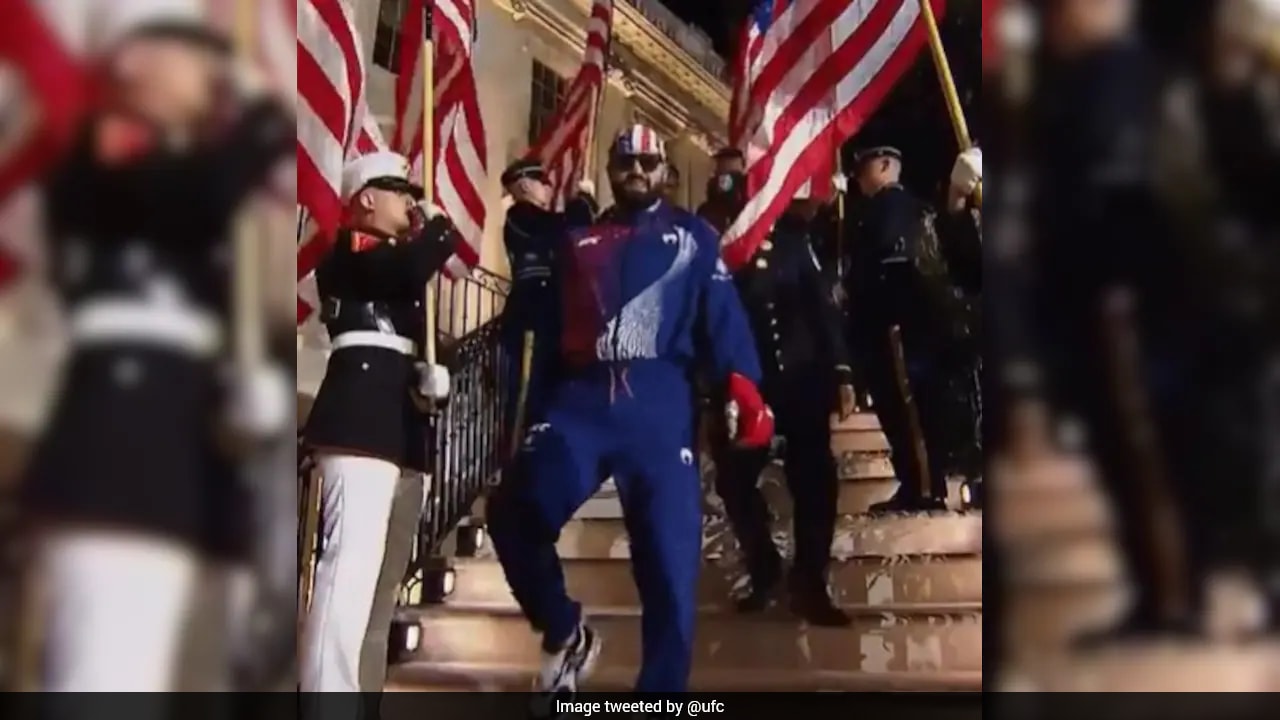
The air inside the convention center tasted of stale beer, expensive cologne, and the distinct, electric ozone of a crowd waiting for a spark. Thousands of faces blurred into a sea of red hats, their eyes fixed on the velvet-roped VIP section where the birthday boy sat. It was a celebration of political power wrapped in the raucous skin of a cage-fighting rally.
Then, the microphone screeched.
Colby Covington stepped up. He is a man who bleeds for a living, a mixed martial artist known as much for his calculated, villainous persona outside the Octagon as his wrestling pedigree within it. He looked out at the sea of supporters gathered to celebrate Donald Trump’s 78th birthday at a Turning Point Action convention in Las Vegas. Covington didn't talk about takedown defense. He didn't talk about training camps. Instead, he took aim at a woman who wasn't in the room, who hasn't been in public office for nearly a decade, and who has never stepped foot inside a cage.
He attacked Michelle Obama.
The comment itself was crude, a retread of a tired, conspiratorial internet trope meant to dehumanize and mock the former First Lady’s appearance and gender. It was delivered with a smirk, designed to elicit the maximum amount of cheap applause from a partisan crowd.
The room erupted. People cheered. Men in tailored suits laughed alongside teenagers in graphic tees.
But if you watched closely, if you looked past the immediate roar of the stadium, you could see the invisible threads of a much larger, much darker shift in how we talk to—and about—each other. This wasn't just a athlete making a bad joke at a political rally. This was a case study in the total collapse of the boundary between entertainment, bloodsport, and human dignity.
The Gladiator’s New Script
To understand why a professional fighter feels compelled to insult a former First Lady at a birthday party, you have to understand the modern economy of attention.
Imagine a young athlete starting out in the local circuits. Let’s call him Marcus. Marcus trains until his knuckles split. He runs until his lungs burn. He wins his fights cleanly, shakes his opponent's hand, and goes home. But Marcus notices something frustrating: the quiet, respectful fighters are fighting for pennies on the preliminary cards. The fighters who scream insults at press conferences, who insult their opponent's families, who construct elaborate, cartoonish personas—they are the ones headlining pay-per-views. They are the ones driving sports cars.
The sporting world has learned a dangerous lesson from the entertainment industry: outrage is a commodity.
Covington is a master of this market. Years ago, facing the threat of being cut from his promotion despite winning his fights because his style was deemed "boring," he made a conscious choice to become the villain. He adopted a hyper-patriotic, deeply divisive persona. He realized that it didn't matter if the crowd loved him or hated him, as long as they paid to see him.
But the boundary of what is acceptable in the name of "hype" keeps moving outward.
When sports marketing bleeds into political theater, the rules of engagement change entirely. In a traditional athletic rivalry, the trash talk is contained. It is a contract between two competitors who have agreed to step into a ring and settle their differences with their fists. When Covington reached outside the sporting world to target Michelle Obama, he broke that contract. He used the armor of his athletic celebrity to launch a one-way assault on a civilian target.
The Chemistry of the Crowd
There is a terrifying intoxication in a crowd that has found a common target.
Psychologists have studied this phenomenon for centuries. When we gather in large, homogeneous groups, our individual sense of responsibility melts away. We become part of a larger organism. If that organism decides that cruelty is the price of admission, otherwise decent people will find themselves laughing at things that would make them flinch if they heard them whispered in a quiet room.
Consider what happens next: the moment the video clips hit the internet.
The algorithm does not have a moral compass. It does not look at a clip of an athlete insulting a woman and think, this is harmful. It looks at the metrics. It sees millions of views, hundreds of thousands of angry comments, and an equal number of celebratory shares. The system rewards the behavior by pushing it into the feeds of millions more.
By the time the sun came up the next morning, the comment was no longer just a moment in a Las Vegas convention center. It was a digital firestorm. On one side, people expressed profound disgust at the casual misogyny and racism embedded in the remark. On the other, supporters defended it as "just a joke" or a blow against political correctness.
Lost in the noise was the actual human being at the center of the target.
Michelle Obama has spent her life under a microscope that most of us cannot fathom. She has spoken openly about the unique weight of being the first Black First Lady of the United States, about the constant, exhausting necessity of having to be "twice as good" just to be considered equal. The insults leveled at her over the years have rarely been about her policy initiatives or her speeches. They have almost always been aimed directly at her personhood, her femininity, and her humanity.
When an elite athlete reinforces those specific, cruel tropes, it isn't an act of political defiance. It is a public bullying tactic masquerading as bravery.
The Mirror of the Cage
We like to think of sports as a sanctuary, a place where the messy, tribal warfare of politics cannot reach. We want the field, the court, and the cage to be pure meritocracies where the only things that matter are skill, heart, and discipline.
That sanctuary is gone.
The modern political landscape has discovered that sports fans are the ultimate prize. They are loyal, passionate, and already accustomed to viewing the world in terms of "us versus them." By embedding political rhetoric into the fabric of sporting events, politicians and athletes create an environment where loyalty to a team and loyalty to a political ideology become indistinguishable.
But there is a steep price to pay for this fusion.
When we normalize the use of vicious, personal degradation as a tool for political entertainment, we degrade the culture itself. We teach the teenagers watching the broadcast that the way to win an argument is not to build a better case, but to humiliate the other side completely. We replace debate with a spectacle of cruelty.
The real problem lies elsewhere, far away from the bright lights of the Vegas strip or the VIP sections of political galas. It rests in the quiet spaces where ordinary people have to live together. It is in the high school hallways where kids copy the language of their favorite fighters. It is in the workplaces where professional boundaries are eroded by the casual disrespect modeled by public figures.
The crowd eventually went home that night. The birthday cake was eaten, the banners were packed away, and the arena emptied out into the desert air. Colby Covington will step back into the Octagon, risking his body for fame and fortune. The political machines will continue to spin, searching for the next piece of content to feed the insatiable hunger of the internet.
But the words remain, hanging in the digital ether, a quiet testament to a culture that has forgotten how to fight clean.