When an American president publicly confuses an island of four hundred thousand people with a sprawling autonomous Arctic territory he claims to desire, small nations stop laughing and start checking their locks.
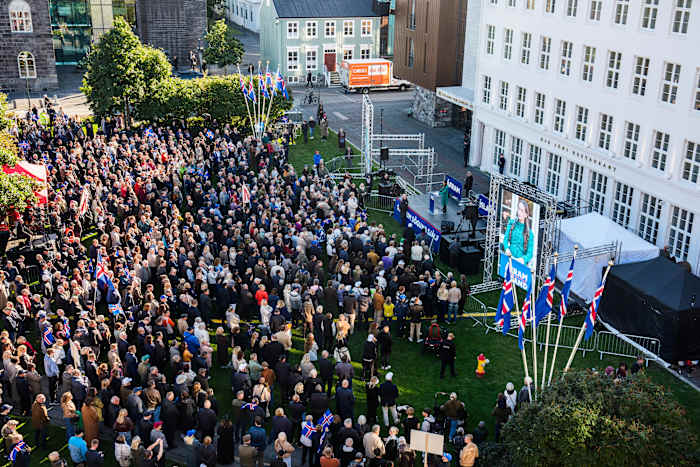
Icelandic voters head to the polls to answer a stark binary question: should the North Atlantic island nation resume long-dormant accession negotiations with the European Union? This referendum is not a binding decree to adopt the euro or hand over control of local waters tomorrow. It is an anxious security measure. Spurred by Washington’s shifting posture in the Arctic and repeated rhetoric regarding the acquisition of neighboring Greenland, Iceland’s political establishment accelerated a vote that exposes deep historical anxieties about sovereignty, fish, and survival in a fracturing global order.
The catalyst for this sudden referendum lies two hundred and ninety kilometers to the west. When U.S. leadership trained its sights on Greenland, floating concepts of annexation and dismissing strategic geopolitical boundaries, the shockwaves hit Reykjavik immediately. Compounding the alarm were verbal gaffes from Washington where the names of the two territories were swapped interchangeably. For an isolated island nation that relies heavily on a defense agreement with the United States while fiercely guarding its absolute independence, the message was impossible to ignore. If a self-governing territory of a NATO ally can be targeted for acquisition, traditional security guarantees suddenly look remarkably fragile.
Decades of national identity in Iceland have been built upon standing apart. After severing ties with Denmark in 1944, the country famously stared down the British Royal Navy during the Cod Wars of the 1970s, successfully protecting its rich fishing grounds from foreign trawlers. That fiercely guarded independence led Reykjavik to formally scrap its previous EU membership bid in 2015, primarily because the bloc’s rigid common fisheries policy threatened to let continental competitors scoop up the cod and haddock that sustain the local economy.
Yet the calculus of risk has shifted. Proponents of reopening talks argue that economic isolation is a luxury an independent state can ill afford when great power competition returns to the Arctic circle. While Iceland already sits comfortably within the European single market and the Schengen free-travel zone, supporters of integration point out that modern security requires institutional anchors. Standing completely alone in the North Atlantic while major powers vie for shipping lanes and mineral rights is no longer viewed as a safe harbor.
Opponents remain deeply entrenched, warning that even opening negotiations invites undue interference from Brussels. Fishing executives and nationalist politicians argue that the nation's core asset—its meticulously managed marine resources—will inevitably become a bargaining chip in a protracted accession process. For these skeptics, the current arrangement offers the best of both worlds: frictionless trade with Europe paired with absolute legislative sovereignty at home. They caution that rushing into an institutional embrace out of temporary geopolitical panic could permanently dilute the very autonomy Iceland fought a century to secure.
Prime Minister Kristrún Frostadóttir’s government has attempted to thread this needle by emphasizing that Saturday's ballot is merely a procedural checkpoint. A affirmative vote does not mean immediate membership; it simply mandates the European Commission to open exploratory talks across thirty-five distinct policy chapters. Even if those negotiations succeed, any final treaty would require a second, definitive national referendum before ratification.
This institutional buffer has done little to calm a polarized electorate. Turnout metrics, including robust early voting figures reported by public broadcaster RÚV, signal a deeply engaged populace wrestling with a fundamental identity crisis. The debate forces citizens to weigh the tangible economic risks of the common fisheries policy against the intangible, mounting fear of geopolitical abandonment.
As the ballots are counted, the outcome will dictate whether a proud seafaring nation chooses to bind its future closer to the continental European fold or bank once more on its historic isolation. The shadow stretching across the North Atlantic is long, and the margin for error in Reykjavik has shrunk to the width of a cod's fin.
For more context on how the accession process functions, review the guidelines on the European Union Enlargement Framework.
This video provides additional context on the security dynamics shaping the vote: Why Icelanders are reconsidering EU membership