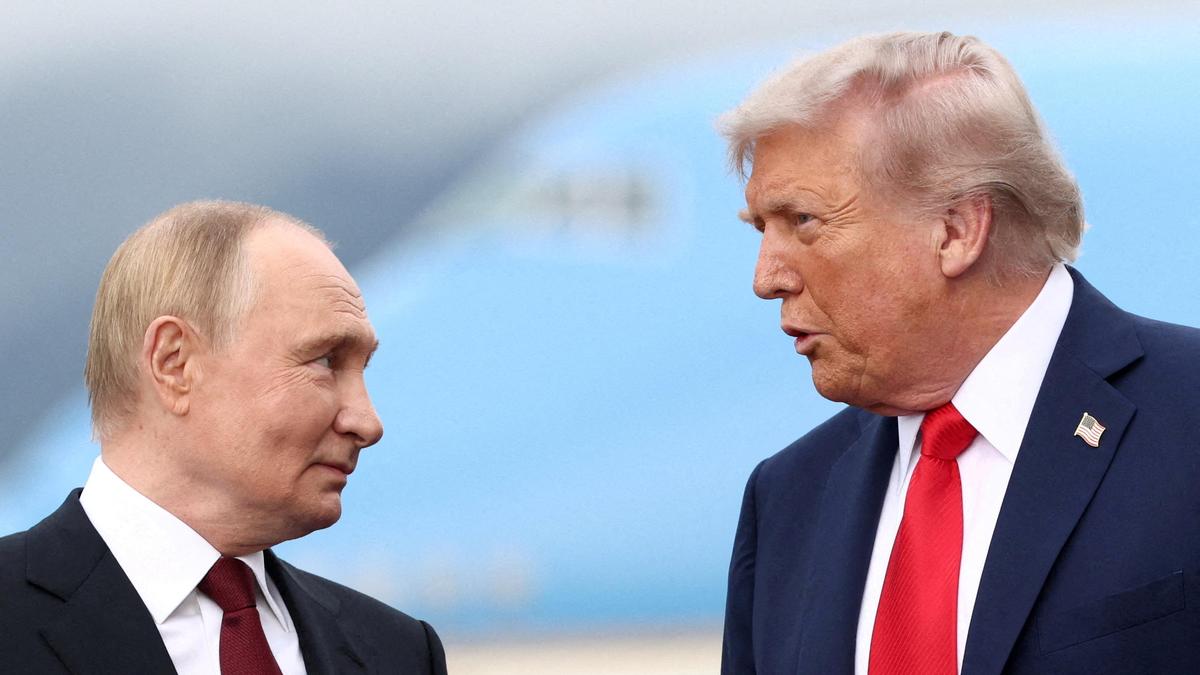
The current diplomatic engagement between the Trump administration, the Kremlin, and the Bankova is not a byproduct of rapport, but a calculated alignment of three distinct cost-benefit functions. While media narratives focus on the "good conversations" reported on April 26, 2026, a structural analysis reveals a high-stakes mechanical negotiation centered on the depreciation of military aid as a leverage tool and the strategic acquisition of time.
To understand the trajectory of these "constructive talks," one must deconstruct the three-pillar framework currently stabilizing this volatile trilateral relationship.
The Triad of Conflicting Utility Functions
The "good conversations" referenced by the President are the front-end interface for a complex negotiation engine. Each actor is operating within a specific utility function:
- The U.S. Utility Function (Cost Rationalization): The administration is optimizing for the reduction of foreign capital expenditures. By transitioning from open-ended military aid to "lease-lend" models or outright aid cessation, the U.S. creates a forced-choice environment for Kyiv. The primary goal is a settlement before the November 2026 midterm elections to validate a "peace through strength" campaign narrative.
- The Russian Utility Function (Strategic Reconstitution): For Putin, the utility lies in time acquisition. The current negotiation phase allows for the integration of seized territories and the replenishment of armored capabilities following the sharp escalation of missile strikes in early 2026. The Russian demand for Ukrainian elections is a targeted strike at the legitimacy of the current Ukrainian administration.
- The Ukrainian Utility Function (Existential Hedging): Zelenskyy’s utility function is driven by the preservation of statehood while managing a "capabilities-gap." The public insistence on 1991 borders serves as a high-anchor negotiating tactic, while the operational reality focuses on securing 15-to-20-year security guarantees—the central friction point in the recent Geneva and Abu Dhabi rounds.
The Geneva Mechanism: Technical Progress vs. Political Friction
The February 2026 Geneva meetings highlighted a widening divergence between military-technical mechanics and political feasibility. While both sides have engaged in "productive theatre" regarding prisoner exchanges and humanitarian corridors, the core structural bottleneck remains the Sovereignty-Security Trade-off.
The Buffer Zone Bottleneck
The U.S. has proposed a Free Economic Buffer Zone covering approximately 20% of the Donetsk province. The logic is grounded in traditional peacekeeping theory: create a demilitarized corridor where economic interdependence disincentivizes shelling.
- The Russian Rejection: Moscow views any internationalized zone as an infringement on its "new territorial realities."
- The Ukrainian Rejection: Kyiv views it as a "frozen conflict" mechanism that cedes de facto control without de jure recognition.
This creates a Logical Loop: A ceasefire requires security guarantees, but the U.S. refuses to provide "Article 5-style" guarantees until a ceasefire is permanent. This circular dependency is why the "good conversations" have yet to translate into a signed Memorandum of Understanding (MoU).
The Economics of Coercive Mediation
The administration’s strategy uses Negative Leverage—the threat of withdrawing existing support—rather than the Positive Leverage (increased aid) utilized by the previous executive.
The Aid Depreciation Curve
As of April 2026, the volume of U.S. military hardware arriving in Ukraine has seen a 65% reduction compared to the 2024 baseline. This creates an "aid depreciation curve" where the defensive capability of the Armed Forces of Ukraine (AFU) decreases at a predictable rate.
- Phase 1 (Stockpile Erosion): Ukraine utilizes existing reserves while domestic production scales.
- Phase 2 (The Negotiation Threshold): The point where defensive losses become unsustainable, forcing a "fast" return to the table.
- Phase 3 (The Settlement Window): The 60-day period where the U.S. offers a "bridge loan" of security assistance in exchange for immediate territorial concessions.
This mechanism explains the President's recent directive for Kyiv to "come to the table fast." It is a market-making move: lowering the "price" of peace by making the "cost" of war unaffordable.
The Board of Peace (BoP) and Global Capital Alignment
The formation of the Board of Peace (BoP) in early 2026 represents the institutionalization of this transactional approach. Unlike the United Nations, which operates on a consensus model, the BoP is structured as a Private-Public Partnership for Reconstruction.
- Financial Entry Barrier: Participating nations must contribute $1 billion to the fund for a three-year membership.
- Operational Mandate: The BoP is designed to oversee the "National Committee for the Administration of Gaza" and is being positioned as the template for a post-war Donbas reconstruction authority.
By involving countries like Azerbaijan, Turkey, and Argentina, the administration is building a "Coalition of the Transactional." These nations prioritize regional stability and trade over the ideological preservation of international borders. This shift de-centers the European Union, which remains locked in an "Empathy Recession," unable to match the U.S. in military output or the BoP in capital agility.
Strategic Forecast: The June 2026 Deadline
The "good conversations" are currently directed toward a June 2026 summit, likely to be held at the Mar-a-Lago or Doral facilities. The goal is to produce a "Dayton-2" agreement.
The probability of a breakthrough depends on the resolution of the Zelenskyy Legitimacy Variable. The U.S. has pressured Kyiv to hold presidential elections concurrently with a peace referendum. If Zelenskyy agrees, he risks internal political destabilization. If he refuses, he risks the final cessation of U.S. intelligence and satellite sharing—the "Zero-Aid Scenario."
The current trajectory suggests a Phased Ceasefire Model:
- Immediate Kinetic Freeze: All movement stops at current lines of contact.
- Referendum-Linked Recognition: De facto Russian control is acknowledged for 15 years, pending a UN-monitored (or BoP-monitored) referendum at the end of that term.
- The Security Bridge: A 15-to-20-year bilateral security pact with the U.S., excluding NATO membership.
Strategic recommendation: Analysts should monitor the Lease-Lend Debt Ratios of the Ukrainian Ministry of Finance. If these ratios spike in May, it indicates a final "push" of equipment is being traded for a June signature. If the ratios remain flat, the "good conversations" are merely a stall tactic while Russia prepares for a summer offensive.