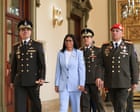
The recent displacement of the Venezuelan military’s top brass by Executive Vice President Delcy Rodríguez represents a calculated reconfiguration of the state’s internal security apparatus rather than a simple administrative reshuffle. By replacing long-standing commanders in the Strategic Operational Command of the National Bolivarian Armed Forces (CEOFANB) and key regional divisions, the Maduro administration is executing a "Coup-Proofing" optimization strategy. This maneuver prioritizes loyalty-based signaling and the fragmentation of internal power centers to mitigate the risk of a coordinated military pivot during periods of high political volatility.
The Triad of Institutional Control
The restructuring operates through three distinct mechanisms of control that ensure the military remains an extension of the executive branch rather than an independent arbiter of national stability.
1. The Loyalty-Competence Trade-off
In a standard professional military, promotion cycles are governed by meritocratic performance and years of service. In the current Venezuelan context, the administration utilizes a loyalty-centric selection filter. By elevating officers who lack independent political bases, the executive creates a debt of gratitude. These new appointees understand that their tenure is tied directly to the survival of the current political leadership, effectively synchronizing their personal incentives with the state’s preservation.
2. Fragmentation of Command Authority
Centralized command is efficient for external warfare but dangerous for an embattled executive. The recent shifts dilute the authority of any single general. By rotating personnel across the eight Strategic Regions of Integral Defense (REDI), the administration prevents commanders from building deep-rooted, horizontal alliances with local civilian leaders or rank-and-file units. This creates a vertical-only reporting structure that funnels all critical decision-making back to the Miraflores Palace.
3. Oversight by Civilian Proxies
The fact that Delcy Rodríguez—a civilian and a core member of the inner political circle—announced these changes emphasizes the subordination of the military to the United Socialist Party of Venezuela (PSUV). This serves as a psychological anchor for the armed forces: it signals that the military’s "top" is actually located within the civilian executive.
The Economic Integration of the High Command
The military in Venezuela does not function solely as a defense force; it is the primary manager of the nation's most lucrative industrial sectors. The reshuffle must be viewed through the lens of resource allocation.
- Extraction Rights: High-ranking officers often oversee mining operations in the Orinoco Mining Arc.
- Logistics and Distribution: Control over ports and food distribution (CLAP) provides commanders with unofficial "taxation" capabilities.
- Petroleum Oversight: The military’s presence within PDVSA ensures that the primary revenue stream of the country remains under the watchful eye of the security apparatus.
When Rodríguez replaces a commander, she is not just changing a name on an organizational chart; she is reassigning a portfolio of economic assets. This creates a competitive internal market for loyalty. Officers who perform their "political duties" are rewarded with lucrative "economic duties." If an officer shows signs of wavering, their removal constitutes an immediate financial decapitation.
Strategic Operational Command (CEOFANB) as a Bottleneck
The CEOFANB is the most critical node in the Venezuelan military hierarchy. It is the bridge between the political directives of the presidency and the tactical execution by the troops.
The replacement of the CEOFANB leadership suggests a shift in the perceived threat profile. While the previous leadership may have been focused on traditional border defense or counter-narcotics, the new cohort is likely optimized for Internal Order Maintenance. This involves a higher density of intelligence-sharing between the military (FANB), the intelligence services (SEBIN), and the military counter-intelligence (DGCIM).
The goal is to create a "Panopticon effect" where every officer believes they are being watched by another, preventing the formation of the "minimum winning coalition" necessary to execute a successful transition of power.
The Signal to the International Community
This restructuring is also a piece of external signaling. By showcasing a disciplined, reorganized military, the Venezuelan government communicates to international adversaries—specifically the United States and regional neighbors—that the security architecture is intact.
The "Stability Illusion" is maintained by showing that the executive has the power to fire and hire the most powerful men in uniform without facing a mutiny. This reduces the perceived effectiveness of external sanctions or diplomatic pressure aimed at "flipping" the military. If the military appears to be a monolithic block of loyalty, the cost-benefit analysis for foreign intervention shifts toward high-risk, low-reward.
Operational Limitations and Systemic Fragility
Despite the tactical brilliance of this reshuffle, the strategy contains inherent risks.
- Erosion of Professionalism: Continuous purges based on loyalty degrade the technical proficiency of the force. Over time, the military becomes an effective riot control agency but an incompetent national defense force.
- The Resentment Variable: Officers who are passed over for promotion or removed to make room for loyalists represent a growing "shadow class" of disgruntled veterans. If this group reaches a critical mass, they become a latent threat that can be activated by external actors.
- Dependency on Cash Flow: The entire loyalty model relies on the state’s ability to provide economic rents. If oil prices crash or production fails further, the executive loses the "currency" it uses to buy the military’s soul.
The Tactical recommendation for Observation
Analysts must stop looking at the names of the new commanders and start looking at their previous postings. If the new commanders come primarily from the National Guard (GNB) rather than the Army, it signals an anticipation of increased civil unrest. If they come from the DGCIM, it signals a crackdown on internal dissent within the military itself.
The current trajectory indicates that the Venezuelan executive is moving toward a "Praetorian Guard" model, where the military's primary, and perhaps only, function is the physical protection of the ruling elite. The strategic play for the administration is to continue the rapid rotation of commanders to ensure that no single individual becomes more powerful than the institution of the Presidency.
The strategic play for those monitoring from the outside is to identify the friction points created by these reassignments—specifically, which economic sectors are being handed to which factions. These shifts are the most reliable indicators of where the government feels most vulnerable.
Follow the movement of the REDI commanders in the border regions (Zulia and Táchira) over the next 90 days. If those commanders are replaced by individuals with direct ties to the Rodríguez-Maduro inner circle, it confirms a total withdrawal into a defensive, survivalist posture. The frequency of these changes is the pulse of the regime’s anxiety. Increased frequency equals increased perceived threat.
Would you like me to map the specific economic portfolios traditionally held by the previous commanders against the backgrounds of the new appointees to identify potential shifts in domestic resource control?