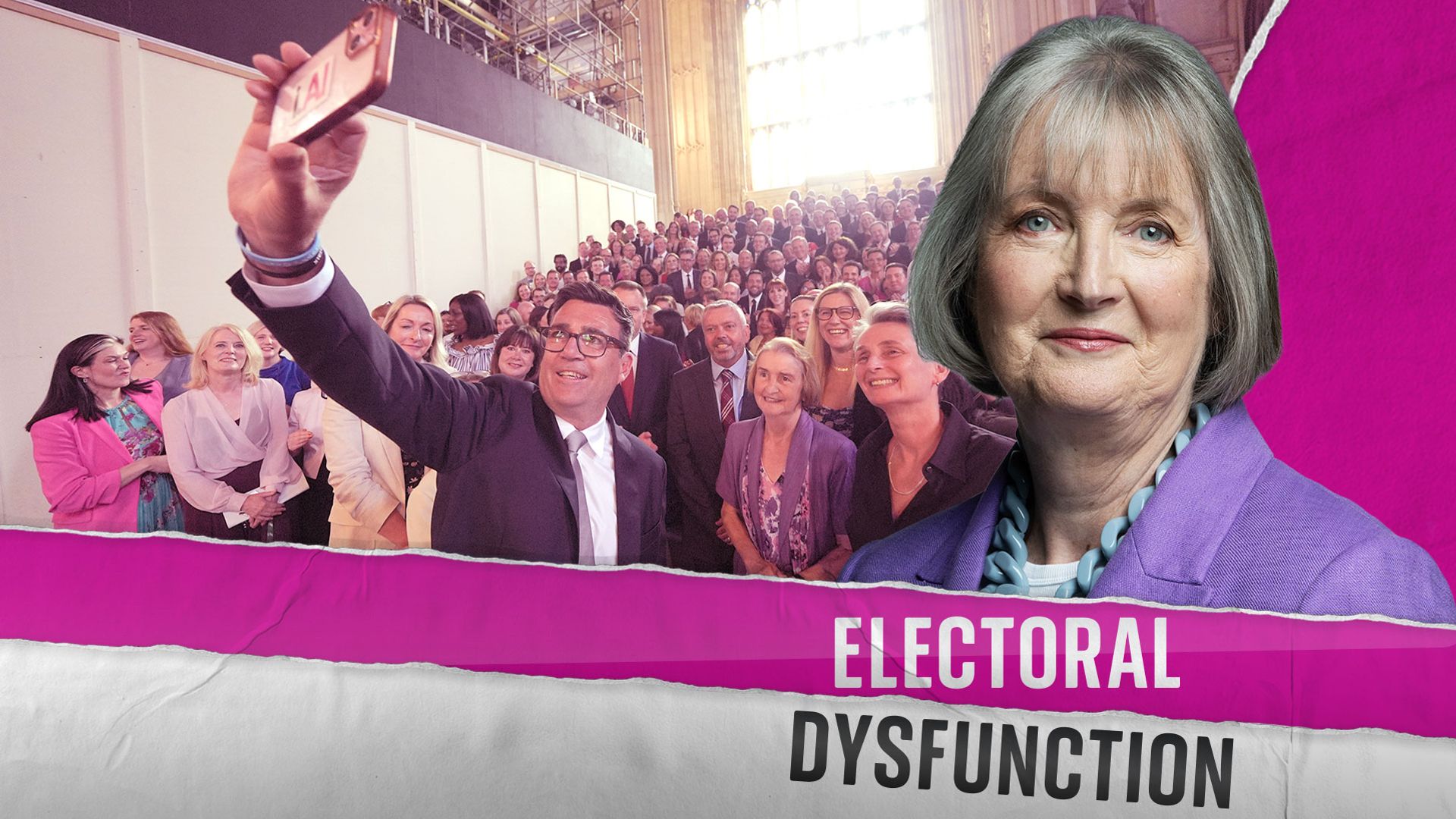
The transition of power in Westminster is rarely clean, but the impending arrival of Andy Burnham into Downing Street has triggered a profound internal revolt that threatens to break the Labour Party before his administration even begins. While public attention focuses on the economic black hole left behind by Keir Starmer, a far more volatile crisis is brewing behind closed doors. Female Labour MPs are actively organizing against what they perceive as the revival of an exclusive Westminster boys club. Led by veteran figures including Baroness Harriet Harman, this group has made it clear that their support for the incoming Prime Minister depends entirely on the composition of his inner circle. Trust is broken, the patience of backbenchers has expired, and the stage is set for an immediate confrontation over the gender balance of the next cabinet.
The core of the issue lies in the growing whisper network surrounding Burnham’s transition team. Rumors have intensified that the great offices of state are being carved up among a familiar cohort of male politicians from the New Labour era, including prominent roles for both Ed and David Miliband. For female parliamentarians who spent the last two years fighting a culture they described as hostile and exclusionary under Starmer, the prospect of a nostalgic restoration of late-2000s male dominance is completely unacceptable. Harman has stated plainly that the representation of women at the very top of the new government is now a central issue that will dictate the stability of Burnham's premiership. The days of playing nice are over.
The Ghost of the 2015 Playbook
To understand the intense skepticism greeting Burnham, one has to examine his historical record on gender representation, which is filled with grand declarations that failed to materialize. During his unsuccessful 2015 leadership campaign, Burnham explicitly promised an absolute fifty-fifty gender split in his shadow cabinet and pledged to appoint a woman as his first secretary of state to serve as a de facto parliamentary deputy. He argued back then that the top tier of the party had looked like a Westminster think tank for too long.
Yet, when given real executive power as the Mayor of Greater Manchester, the practical application of those ideals looked very different. Critics frequently pointed out that his closest advisory circles and the most powerful regional portfolios remained heavily dominated by men. The contrast between campaign poetry and executive prose has left a lasting impression on the Parliamentary Labour Party.
Female backbenchers are no longer willing to accept vague assurances or rhetorical commitments. They remember the promises of a decade ago, and they are matching that memory against the reality of the names currently being floated for Chancellor, Foreign Secretary, and Home Secretary. If the initial appointments feature an unbroken line of male faces, Burnham will face an immediate, organized backbench rebellion before he even stands at the dispatch box for his first Prime Minister’s Questions.
The Backbench Boiling Point
The current anger did not emerge in a vacuum. It is the direct result of years of compounding frustration with the culture of Downing Street. Earlier this year, a series of internal scandals prompted senior female MPs to demand that Starmer appoint a woman as a powerful deputy to force a complete cultural overhaul. When those demands were met with minor concessions and sideline advisory roles, the resentment merely shifted targets, waiting for the next leadership transition to reassert itself.
The entry of Andy Burnham into Parliament via the Makerfield by-election was meant to be a moment of absolute unity for a party desperate for a reset. Instead, it has weaponized the frustrations of women who feel they are consistently treated as campaign window dressing rather than governing partners. The anger is structural, deep, and highly strategic.
Female MPs are leveraging the fact that Burnham needs an orderly transition to establish his legitimacy without a protracted, divisive public vote. Because some figures within the party have questioned whether he can govern authoritatively without a fresh general election, he requires absolute discipline from his parliamentary colleagues. By signaling that this discipline is conditional on gender equity, Harman and her allies have effectively seized a veto over his prospective frontbench.
The Miliband Restoration and the Continuity Problem
The specific irritation among backbenchers is the sense that Burnham is looking backward rather than forward to fill his administration. The potential return of David Miliband alongside his brother Ed to the absolute peak of British political power is viewed by critics as a retrogressive step that ignores a generation of highly capable female talent.
The Stagnation of the Talent Pipeline
Forcing a restoration of older frontbenchers creates a bottleneck that stifles the promotion of women who have spent years defending the party on the backbenches and in junior shadow roles. The argument from the Burnham camp is often one of competence and experience. They suggest that an incoming government facing massive national challenges needs individuals who have already run large departments.
The counter-argument from the backbenches is devastatingly simple. If women are never given the chance to run those departments during a transition, they will never acquire the very experience used as a prerequisite for promotion. This circular logic has kept the Treasury, the Foreign Office, and the Home Office disproportionately under male control throughout the history of the party.
The Problem of the Treasury
The position of Chancellor of the Exchequer remains the ultimate battleground. Britain has rarely seen a woman hold the keys to No. 11 Downing Street with absolute autonomy, and the current transition is viewed as the definitive moment to shatter that specific ceiling permanently. If Burnham selects a male ally to manage the economy, it will be interpreted as an explicit statement that he does not view the party's female economic specialists as capable of handling the current financial crisis.
The Inheritance of a Broken Balance Sheet
Compounding the difficulty of Burnham’s transition is the catastrophic fiscal situation left behind by his predecessor. Starmer’s parting gift to the incoming leader is a massive budgetary shortfall, largely driven by the controversial funding mechanisms of the recent Defence Investment Plan. Burnham is arriving in Downing Street with an immediate multi-billion-pound bill that he must somehow resolve without triggering an immediate rebellion from the left of his party or panicking the financial markets.
This economic reality complicates the cabinet selection process immensely. A Prime Minister under severe financial pressure naturally retreats to his comfort zone, surrounding himself with trusted, long-term loyalists who will not leak details of painful spending cuts to the press. In Burnham’s case, that comfort zone is historically male and distinctly northern.
The danger for the incoming administration is that by prioritizing personal loyalty and familiarity to survive an economic crisis, Burnham will inadvertently spark a catastrophic political crisis with his own MPs. A cabinet that looks like an old boys club attempting to impose austerity-lite measures will find very few defenders on the government benches.
The Mechanics of a Modern Rebellion
The strategy being deployed by female MPs is far more sophisticated than simple public protest. They are utilizing parliamentary committees, regional caucuses, and coordinated media appearances to systematically dismantle the narrative that Burnham’s arrival is an uncontested coronation.
By framing the composition of the cabinet as a test of basic modernization and fairness, they have ensured that every single appointment will be viewed through the lens of gender equity. If the incoming Prime Minister attempts to bypass these concerns by offering minor, low-profile cabinet roles to women while retaining the core economic and security portfolios for his male inner circle, the strategy will backfire spectacularly.
The Parliamentary Labour Party is no longer the submissive entity it was during the height of previous administrations. The modern cohort of female MPs contains independent thinkers, former professionals, and seasoned campaigners who are entirely unafraid of party whips. They know that Burnham’s majority is fragile and that his moral authority as an unelected Prime Minister is open to challenge.
Every seat at the cabinet table must be earned, and the incoming leadership must realize that numerical representation is only the first step. True equity means the distribution of real domestic and international power, not just titles. If Andy Burnham fails to grasp this reality within his first forty-eight hours in Downing Street, his premiership will stall before he can even begin to address the economic ruin he has inherited.


